
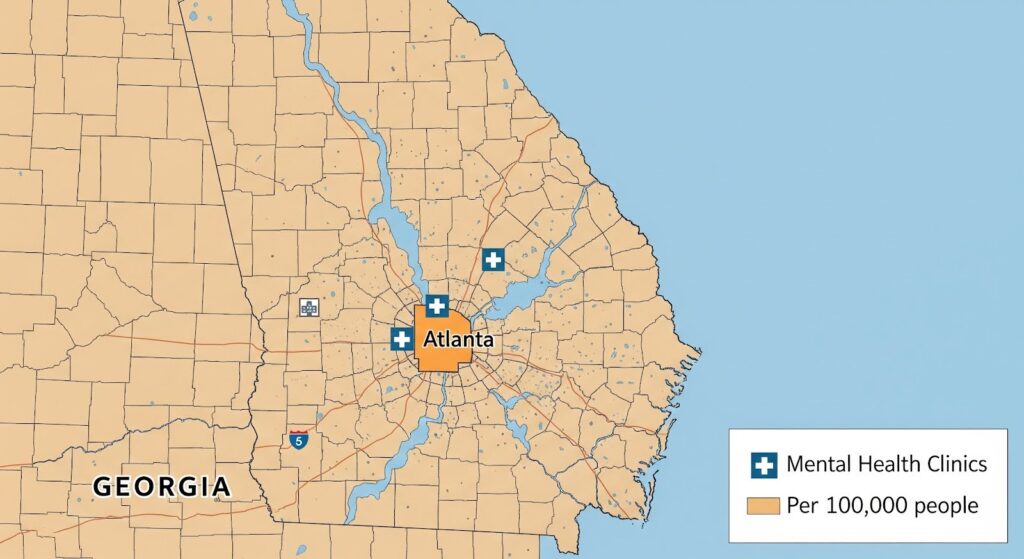
Georgia has only 1.52 mental health clinics per 100,000 residents, one of the lowest facility densities in the nation.
This shortage means emergency departments, crisis centers, and a handful of opioid treatment programs become the default “front door” for mental health and addiction care in metro Atlanta, often leaving people cycling through crises rather than receiving sustained treatment.
This article explains how the shortage arose, what it means for your access to care, and which practical strategies can help you or a loved one find treatment now.
Understanding Georgia’s Mental Health Clinic Shortage
The 1.52 clinics per 100,000 figure reflects how Georgia structures behavioral health services and how national surveys count facilities. The National Mental Health Services Survey (N-MHSS) excludes individual private practitioners, crisis-only programs, jails, and certain community support services from its facility tallies. In Georgia, the system relies heavily on large Community Service Boards (CSBs) that serve multiple counties under a single organizational umbrella. These CSBs often operate satellite locations but may register as one “facility” in federal data, artificially lowering the state’s clinic count.
Meanwhile, more than 96% of Georgia’s counties are designated Mental Health Professional Shortage Areas. In 2019, the state had one mental health provider for every 690 residents. The pandemic made workforce strains worse, and Georgia’s decision not to expand Medicaid limits coverage for low-income adults who need sustained care.
How the Shortage Developed?
Georgia’s low facility density stems from multiple factors working together. First, the state uses a public-safety-net model centered on CSBs, which consolidates services into fewer organizational entities. Second, Georgia is midway through rolling out state-certified Certified Community Behavioral Health Clinics (CCBHCs), with several providers targeted to begin billing Medicaid for CCBHC services in January 2026. Until cost-based prospective payment systems fully take effect, expansion lags behind need.
Third, crisis system investments through 988 implementation focus on stabilization and mobile crisis rather than proliferating traditional outpatient clinics. Fourth, the state’s CCBHC certification process functions as a quality gate, delaying participation until clinics meet comprehensive standards. And fifth, persistent workforce shortages constrain how many viable clinic sites can open and remain staffed, especially in rural and underserved urban areas.
What the Shortage Means for Mental Health Care in Atlanta?
A shortage of outpatient mental health clinics pushes people in crisis into emergency departments and short-stay crisis centers instead of sustained, community-based care. This shift strains hospitals, fragments follow-up, and leaves many residents cycling through high-intensity settings without stable, long-term treatment:
Emergency Departments Become the Front Door
When outpatient clinics are scarce or booked weeks out, hospital emergency departments turn into the default access point for behavioral health crises. In metro Atlanta, systems like Grady Health System, which recently opened a freestanding ED in Union City, see a growing volume of patients in mental health or addiction crisis. The CDC now specifically recommends that EDs screen, initiate medication for opioid use disorder, arrange warm handoffs to community care, provide naloxone, and involve peer recovery coaches to reduce loss to follow-up.
Without enough outpatient clinic slots, many patients stabilize in the ED but cannot secure timely follow-up appointments. Research in King County documented this pattern: scope-of-practice confusion, limited buprenorphine prescribing capacity, and referral incoordination lead to high rates of loss to follow-up after ED discharge. In Atlanta, Grady’s expansion and initiatives at Wellstar hospitals offer platforms to scale ED-initiated treatment, but success depends on having community providers ready to accept referrals within 24 to 72 hours.
Crisis Centers Fill Gaps but Cannot Replace Clinics
Fulton County operates a 24/7 Behavioral Health Crisis Center with peer “living room” space, observation chairs, and crisis beds. Across Georgia, the Department of Behavioral Health and Developmental Disabilities runs a network of Crisis Stabilization Units for short-term medically supervised care. These facilities reduce ED boarding and inpatient psychiatric admissions, helping people de-escalate safely.
However, crisis centers are not designed for long-term treatment. Their value for addiction and mental health care depends on strong connections to outpatient clinics, opioid treatment programs, and prescribers who can continue medications after stabilization. When those clinic slots are unavailable, crisis centers risk becoming holding patterns rather than true pathways to recovery.
Limited Opioid Treatment Program Capacity
Methadone remains essential for many people with opioid use disorder, especially those with high tolerance or prior unsuccessful trials of buprenorphine. Georgia licenses opioid treatment programs (OTPs) through the Department of Community Health’s Health Facility Regulation Division, which conducts compliance inspections. In metro Atlanta, providers like Alliance Recovery Center operate clinics in Decatur, Conyers, and Athens, offering methadone and buprenorphine with integrated counseling and peer support.
Still, OTP capacity does not match demand. Daily clinic visits for methadone create transportation and scheduling barriers, particularly for people in South Fulton or outer suburbs. Federal take-home dose flexibilities, allowing up to 28 days of take-home methadone for stable patients, can ease travel burdens, but not all patients qualify, and not all clinics have adopted maximum flexibility.
The Addiction Treatment Impact of Mental Health Clinic Shortage
When mental health clinics are in short supply, people with addiction often cannot access coordinated care for both substance use and co-occurring psychiatric conditions. This shortage fragments treatment, increases relapse and overdose risk, and pushes patients toward emergency departments instead of sustained, community-based recovery support:
Why Do Mental Health Clinics Matter for Addiction Care?
Over half of people with opioid use disorder also experience co-occurring mental health conditions like depression, anxiety, PTSD, or bipolar disorder. When mental health clinics are scarce, treating the “whole person” becomes nearly impossible. Patients may receive medication for opioid use disorder from an OTP or primary care provider but struggle to access psychiatric care for mood or trauma symptoms. This fragmentation raises the risk of relapse, overdose, and treatment dropout.
In Atlanta, the shortage forces many people into single-condition treatment silos. An individual might get buprenorphine from an ED discharge but wait six weeks for an initial psychiatric appointment, leaving untreated depression or anxiety to undermine recovery. Conversely, someone seeking outpatient mental health counseling may be told the clinic does not prescribe or coordinate addiction medications, requiring them to navigate multiple disconnected providers.
Treatment Deserts in Georgia Metro Areas
Even within metro Atlanta, access varies dramatically by zip code and transportation availability. Neighborhoods in South Fulton, parts of DeKalb County, and outer suburbs in Clayton and Henry counties function as treatment deserts, where the nearest mental health clinic or OTP requires long drives or multiple bus transfers. For people without reliable transportation or flexible work schedules, distance becomes a disqualifying barrier.
Data on accidental poisonings and overdoses as leading causes of death among adults aged 25 to 34 in the Cobb and Douglas Health District underscores the urgency of expanding access in these areas. Mobile service models, telehealth counseling, and extended medication pick-up hours can partially offset geography, but they cannot fully replace in-person clinic capacity when medical oversight and lab monitoring are required.
Policy and Payer Shifts in 2025
New enforcement of mental health parity laws and updates to Georgia’s coverage programs are reshaping how behavioral health and addiction services are paid for. These shifts aim to reduce denials, simplify authorizations, and expand access to treatments like buprenorphine for more consistent, affordable care:
Enforcement of Mental Health Parity
Georgia’s Mental Health Parity and Addiction Act (HB 1013) requires insurers to treat behavioral health benefits the same as medical and surgical benefits. In August 2025, the Georgia Office of the Commissioner of Insurance and Safety Fire announced it would fine insurers over $20 million for more than 6,000 parity violations uncovered through market conduct examinations. Violations included improper prior authorization requirements, unfair concurrent review practices, and retroactive medical necessity reprocessing.
This enforcement represents a major shift from reporting to action. For patients and providers, it means fewer inappropriate denials for mental health and addiction services, faster authorizations, and more predictable access to medications like buprenorphine. Over the next 12 to 24 months, sustained parity enforcement should reduce administrative friction and encourage more providers to accept insurance, gradually easing capacity constraints.
Georgia Pathways to Coverage Updates
Effective October 1, 2025, Georgia updated its Pathways program with expanded qualifying activities, reduced reporting frequency (application and annual renewal only), and retroactive coverage starting the first day of the application month. These changes lower administrative churn for low-income adults, improving the odds they can schedule and complete follow-up appointments for behavioral health care.
However, Georgia remains a Medicaid non-expansion state, leaving a substantial coverage gap for adults below the poverty line who do not meet Pathways criteria. Without broader Medicaid expansion, many Atlantans will continue to cycle between emergency care and self-pay options, unable to afford consistent clinic-based treatment.
Practical Strategies for Navigating the Shortage Now
If you or a loved one needs mental health or addiction care in Atlanta today, these steps increase your chances of timely access:
- Start in the emergency department when in crisis. Grady’s main campus and the new Union City location, along with Wellstar hospitals, offer 24/7 access. Ask about ED-initiated buprenorphine if opioid use disorder is a concern, and request a warm handoff to outpatient care before discharge.
- Use the 24/7 Behavioral Health Crisis Center in Fulton County for stabilization and same-day triage if you need immediate support but are not at imminent risk requiring hospitalization.
- Contact opioid treatment programs directly for methadone or buprenorphine. Programs like Alliance Recovery Center in Decatur offer comprehensive services. Ask about rapid-access induction slots reserved for urgent referrals.
- Leverage telehealth for initial psychiatric evaluations and follow-up counseling when in-person slots are unavailable. Many Georgia-licensed providers now offer video visits that meet parity requirements.
- Document insurance denials or delays. If your insurer imposes unfair prior authorization barriers or denies medically necessary behavioral health treatment, file a complaint with the Georgia OCI to support parity enforcement efforts.
- Connect with peer recovery coaches and community health workers who can navigate referrals, arrange transportation, and provide coaching between appointments, vital support when clinic appointments are weeks apart.

What Comes Next: Short-Term and Long-Term Outlook
Efforts to expand ED-initiated treatment, enforce parity laws, and modernize payment models will shape how quickly Georgia can close treatment gaps. Over time, workforce growth, new clinic sites, and community-based innovations will determine whether the system becomes more accessible, coordinated, and resilient for people with addiction and mental health needs:
Near-Term Gains (0 to 12 Months)
In the immediate term, scaling ED-initiated buprenorphine across Atlanta’s hospital systems offers the most actionable path to reducing overdose deaths and treatment gaps. The ED INNOVATION trial is testing whether extended-release injectable buprenorphine improves seven-day engagement compared to sublingual formulations. If successful, this approach stabilizes patients after discharge even when follow-up appointments are delayed, directly addressing the clinic shortage’s impact on retention.
Parity enforcement should begin reducing inappropriate insurance barriers within six to twelve months as insurers implement corrective actions. Pathways updates will modestly expand coverage stability, though the non-expansion status limits overall impact.
Mid-Term Trajectory (12 to 36 Months)
As Georgia’s CCBHC implementation advances, with multiple providers beginning Medicaid billing in early 2026, the state should see clinic capacity growth, especially within CSB networks. Cost-based prospective payment systems incentivize clinics to expand services and satellite locations. If these satellites are enumerated as distinct facilities in federal surveys, Georgia’s clinics-per-capita ratio will rise.
Mobile methadone pilots modeled on Philadelphia’s same-day induction programs could extend OTP access to underserved Atlanta neighborhoods, reducing travel barriers and reaching people where they are. Similarly, jail-based and court-linked medication starts for justice-involved individuals can capture a high-risk population often excluded from traditional clinic access.
Long-Term Structural Change
Ultimately, closing Georgia’s mental health clinic shortage requires workforce expansion, Medicaid expansion to cover more low-income adults, and deliberate investment in clinic infrastructure in treatment deserts. Wellstar’s Zero Suicide Initiative expansion and Grady’s ED footprint growth are positive signs of institutional commitment. But system-wide progress depends on state and federal policy decisions, sustained parity enforcement, and community willingness to support new clinic sites, especially in neighborhoods most affected by overdose mortality.
Atlanta’s mental health and addiction care system is strained, but it is not static. By understanding how the shortage shapes where and how people receive treatment, and by using the access points and policy levers available today, you can navigate the system more effectively and advocate for change that makes timely, compassionate care the norm rather than the exception.
If you or someone you care about is struggling with co-occurring mental health and substance use challenges, Summit Mental Health’s treatment programs offer comprehensive support that addresses both conditions together in an outpatient setting.

