
More than one in three adults who need mental health care in Georgia face barriers that keep them from getting treatment, with affordability emerging as the dominant obstacle.
When cost blocks access to depression treatment, the gap between who needs care and who receives it continues to widen, directly affecting millions of residents across both rural and urban communities.
This article examines the financial, systemic, and workforce factors driving Georgia’s depression treatment gap and outlines concrete steps that could close it.
Financial Barriers Drive Georgia’s Treatment Gap
Cost remains the single largest obstacle preventing Georgians from accessing mental health care. Among adults experiencing mental health conditions, affordability barriers affect 33.1% of those who report access challenges, making it the most frequently cited reason for unmet need. Even when insurance coverage exists, out of pocket costs for medication, copayments for therapy sessions, and high deductibles push essential treatment out of reach for working families.
The problem extends beyond the uninsured. In August 2025, Georgia’s Office of the Commissioner of Insurance announced fines exceeding $20 million against insurers for more than 6,000 mental health parity violations. These violations included imposing prior authorization requirements on mental health services that were not applied to medical or surgical care, misclassifying benefits to avoid coverage obligations, and conducting unclear post service reviews that resulted in claim denials. When insurers create administrative hurdles that do not exist for physical health conditions, they effectively turn coverage into a mirage.
The enforcement action revealed systematic practices that made mental health treatment more expensive and harder to access than comparable medical care. Patients faced unexpected denials, had to appeal coverage decisions that should have been approved initially, and often paid out of pocket for services their plans should have covered under federal parity law. The financial impact rippled through households already struggling with the direct costs of depression and related conditions.
Parity Violations and Insurance Obstacles
The Mental Health Parity and Addiction Equity Act requires insurers to treat mental health and substance use disorder benefits no more restrictively than medical and surgical benefits. Georgia’s enforcement findings exposed how plans violated this requirement through non-quantitative treatment limitations, or NQTLs. These included:
- Applying prior authorization to mental health services without equivalent requirements for physical health care
- Maintaining narrower provider networks for behavioral health compared to general medical networks
- Using different standards to determine medical necessity for mental health claims
- Implementing concurrent review processes that did not exist for similar medical treatments
The 2024 federal rule changes strengthened oversight by requiring insurers to analyze and document how their policies affect access. Plans must now prove that network composition, reimbursement rates, and utilization management do not systematically disadvantage mental health services. Georgia’s aggressive state enforcement, backed by these federal standards, creates a pathway to dismantle administrative barriers that have inflated the real cost of care for years.
For Medicaid beneficiaries, who numbered 2,185,620 as of July 2025, managed care oversight and network adequacy standards directly shape access. When behavioral health networks remain too thin or reimbursement rates too low to attract providers, coverage means little. State audits of encounter data and external quality reviews provide transparency, but only rigorous enforcement of network standards alongside parity rules will translate coverage into actual appointments.
Workforce Shortages Compound Access Issues
Even with insurance and compliant policies, Georgians cannot access care that does not exist. Workforce projections through 2037 show substantial shortages across psychiatrists, psychologists, licensed counselors, and other behavioral health professionals. More than 122 million Americans live in a Mental Health Professional Shortage Area, and rural counties face the steepest deficits.
In Georgia, these shortages translate to wait times that stretch weeks or months, particularly for specialty care. Children and adolescents face some of the longest delays, with average waits of six to eight months for pediatric behavioral health appointments in many areas. Primary care providers often become the default mental health system for rural residents, yet they lack the time, training, and reimbursement structures to provide ongoing depression treatment that meets clinical adequacy standards.
Georgia created the Behavioral Health Provider Loan Repayment Program to recruit professionals to shortage areas, offering up to $150,000 for psychiatrists and scaled awards for other disciplines in exchange for four year service commitments. While this program addresses the maldistribution problem directly, the scope remains modest relative to need. Shortage areas continue to grow faster than the pipeline of new providers, and burnout among existing clinicians further constricts capacity.
What the Data Shows About Depression in Georgia?
Understanding the treatment gap requires knowing the scope of need. National data show that 18.5% of U.S. adults self-reported a lifetime diagnosis of depression in 2020. County level estimates ranged from 10.7% to 31.9%, with high prevalence clusters in Appalachia, a region that includes parts of north Georgia. The CDC’s PLACES project provides granular county and census tract estimates that enable local planning and resource targeting.
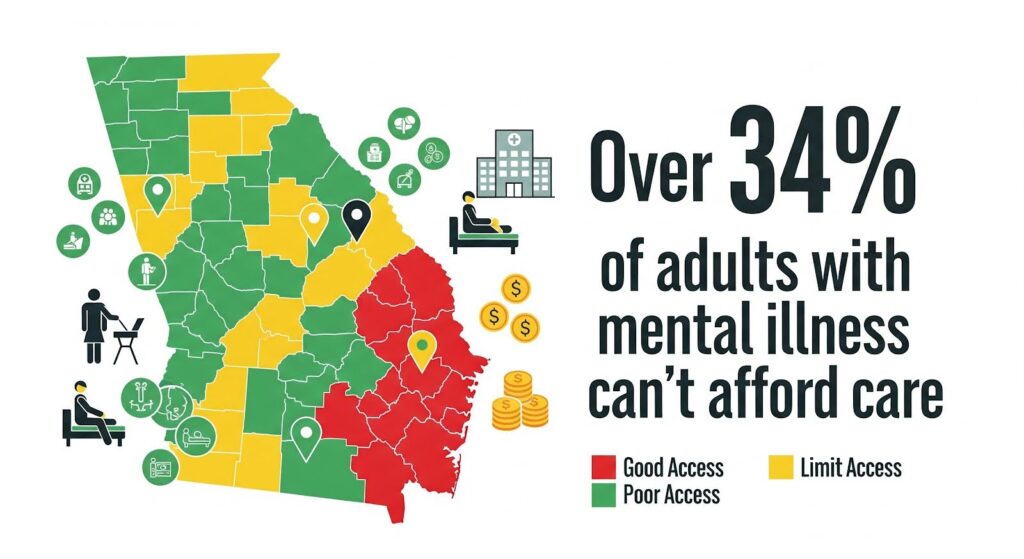
Table: Key Depression and Access Indicators in Georgia
| Indicator | Value | Source |
| U.S. adults with lifetime depression diagnosis | 18.5% | CDC MMWR 2023 |
| County-level prevalence range | 10.7% to 31.9% | CDC MMWR 2023 |
| Georgia Medicaid enrollment | 2,185,620 | DCH July 2025 |
| Adults reporting affordability barriers | 33.1% | PLOS One 2015 |
| Mental health parity violations identified | 6,000+ | OCI August 2025 |
| Fines levied for parity violations | Over $20 million | OCI August 2025 |
However, lifetime diagnosis prevalence is not the same as current need for treatment. The most recent methodology in the 2024 PLACES release uses 2022 BRFSS data and 2020 Census boundaries, which affects comparability across years. For depression treatment gap analysis, what matters most is not just who has ever been diagnosed, but who currently needs care and meets criteria for minimally adequate treatment.
Globally, only 9.1% of people with major depressive disorder receive minimally adequate treatment, defined as at least one month of antidepressant medication plus four physician visits, or eight psychotherapy sessions within twelve months. High income countries achieve coverage above 30% in some cases, while many nations remain below 5%. Georgia’s position in this spectrum depends on closing the financial, network, and workforce gaps that prevent diagnosed individuals from receiving sustained, quality care.
Geographic Disparities in Mental Health Access
The treatment gap widens dramatically outside metro Atlanta. Rural counties face a triple burden: fewer behavioral health providers per capita, greater distances to specialty care, and weaker broadband infrastructure that limits telehealth as a stopgap solution. Mental Health Professional Shortage Area designations cover much of rural Georgia, and targeted workforce incentives prioritize these counties for loan repayment and recruitment.
Federally Qualified Health Centers serve as crucial access points in underserved areas. In Georgia, total patients at FQHCs grew from 624,774 in 2020 to 747,928 in 2024, with mental health patients increasing from 23,035 to 32,006 in the same period. Yet mental health patients still represent only 4.3% of the total patient population, suggesting substantial unmet need even within the safety net. The proportion receiving substance use disorder services fell from 1.55% to 1.12% between 2020 and 2024, a troubling reversal given rising overdose mortality.
Telehealth expanded dramatically during the COVID-19 public health emergency and has been sustained through continued federal policies that allow Medicare coverage of annual depression screening via telehealth starting January 2025. For rural Georgians, this removes a major access barrier. But telehealth cannot fully substitute for in person care, particularly for crisis intervention, medication management requiring physical examination, and therapeutic modalities that depend on environmental context. It remains a bridge, not a destination.
School based behavioral health programs like Georgia’s Apex initiative embed clinicians directly in public schools, improving early detection and reducing referral bottlenecks. Combined with pediatric consultation programs that strengthen primary care capacity, these efforts address the severe shortage of child psychiatrists. Nonetheless, when a positive school based screening leads to a six month wait for specialty care, the system has not closed the gap, it has simply measured it more accurately.

The Path Forward: Enforcement, Investment, and Integration
Closing Georgia’s depression treatment gap requires simultaneous action on three fronts. First, continued rigorous enforcement of mental health parity must eliminate discriminatory insurance practices that inflate costs and delay access. The $20 million in fines announced in 2025 sent a clear market signal, but sustained oversight and public reporting of parity metrics will keep plans accountable. Consumers and providers can report suspected violations through the state insurance department’s portal, creating a feedback loop that captures ongoing compliance failures.
Second, workforce investments must scale to meet documented shortages. Expanding the loan repayment program, increasing residency slots for psychiatry, and removing scope of practice barriers for qualified mental health professionals can increase supply. Equally important is stabilizing the existing workforce through fair reimbursement, administrative burden reduction, and support for clinician wellbeing. A provider who burns out and leaves the field represents not just one lost position, but the dozens of patients per week who lose continuity of care.
Third, system integration must connect crisis response, primary care, specialty behavioral health, and insurance data into a coherent continuum. Georgia’s 988 crisis line and statewide crisis infrastructure provide strong front door access, with 24/7 availability and mobile crisis dispatch. But if post crisis follow up encounters network adequacy failures or parity violations, the system achieves triage without treatment. Bidirectional data sharing between crisis systems, Medicaid managed care, and commercial insurers can identify where breakdowns occur and target remediation.
The state’s recent parity enforcement and updated federal rules create a rare policy window. If Georgia combines aggressive insurer accountability with workforce development targeted to shortage areas and network adequacy standards that match crisis system capacity, the treatment gap can narrow measurably within three to five years. The alternative is continued growth in unmet need, preventable disability, and excess mortality from a treatable condition.
Depression treatment works when people can access it, afford it, and sustain it long enough to achieve remission. Georgia now has the regulatory tools, data infrastructure, and enforcement precedent to dismantle the barriers that have kept treatment out of reach for more than a third of adults who need it. The question is whether the state will apply these tools with the intensity and coordination the problem demands.
If you or someone you know is struggling to access depression treatment in Georgia, explore our treatment options that accept insurance and provide flexible outpatient care designed to fit your schedule and needs.

