
Suicide prevention in Atlanta depends on two critical factors: knowing when to ask for help and having a crisis system ready to respond.
Recent federal and state data show that while Georgia’s 988 Suicide & Crisis Lifeline answers calls in under 10 seconds, only about 16% of Georgians fully understand what the line does or when to use it.
This article examines Atlanta-area suicide mortality patterns, crisis-line performance, and awareness gaps to help residents, families, and providers understand how to access timely support and what the data reveal about opportunities to save lives.
Atlanta Suicide Mortality Data: What the Numbers Show
National suicide deaths reached a provisional 49,449 in 2022, a 3% increase over 2021, with the age-adjusted rate rising to 14.3 per 100,000.
Georgia’s 2023 suicide rate was nearly 15 per 100,000, slightly above the national average, with disproportionate impact among youth aged 10–14 and working-age adults 25–44.
For Atlanta’s core counties, Fulton, DeKalb, Cobb, Gwinnett, and Clayton, public health analysts can track local trends using the CDC’s WISQARS Fatal Injury Data platform, which provides county-level suicide counts and age-adjusted rates with confidence intervals to assess whether differences across time or geography are statistically meaningful.
Because suicide mortality data typically finalize 11 months after year-end and small-area rates can be unstable, Atlanta stakeholders should use three- to five-year moving averages to detect genuine trends rather than year-to-year noise.
Method-specific patterns also matter: firearms remain the leading means nationally, especially among males, while poisoning and suffocation contribute to the overall burden.
These patterns inform local prevention strategies, from lethal means safety campaigns to overdose prevention partnerships.
Atlanta Suicide Prevention Data: Crisis System Performance
Georgia’s crisis infrastructure centers on the Georgia Crisis & Access Line (GCAL), a statewide hub that coordinates phone, text, and chat crisis support, dispatches GPS-enabled mobile crisis teams, and maintains a real-time bed registry for rapid placement.
When the national 988 Suicide & Crisis Lifeline launched in July 2022, Georgia achieved 86–88% in-state answer rates in the first two months, with average speed to answer near 20 seconds and minimal call flowout to national backup centers.
In the first 12 months after 988 went live, Georgia maintained an average response time under 10 seconds despite a 12% increase in demand, demonstrating that the state’s operational capacity kept pace with rising awareness.
Youth represented about 10% of known callers, and rural Georgians reached out at higher rates than urban residents, suggesting that text and chat modalities are resonating with younger help seekers and that Atlanta’s urban population may benefit from more targeted, hyperlocal outreach.
Atlanta Mental Health Hotline Trends
Nationally, the 988 Lifeline answered nearly 5 million contacts in its first year and more than 10 million across two years, with significant growth in texts and chats.
In the first six months after launch, answered calls rose 48% year-over-year, chats increased 263%, and texts surged 1,445% compared to the same period in 2021.
Average time to answer improved from minutes to under a minute by December 2022, reflecting network scaling to meet awareness-driven demand.
For Atlanta, these trends mean that residents who learn about 988 and GCAL can expect rapid, in-state answering and access to local mobile crisis teams, urgent appointments, and crisis stabilization beds.
The system’s performance metrics, average speed to answer, abandonment rate, in-state answer rate, and follow-up completion, are tracked on Georgia’s public 988 data dashboard, providing transparency and accountability for continuous improvement.
Atlanta Crisis Support Data: The Awareness Gap
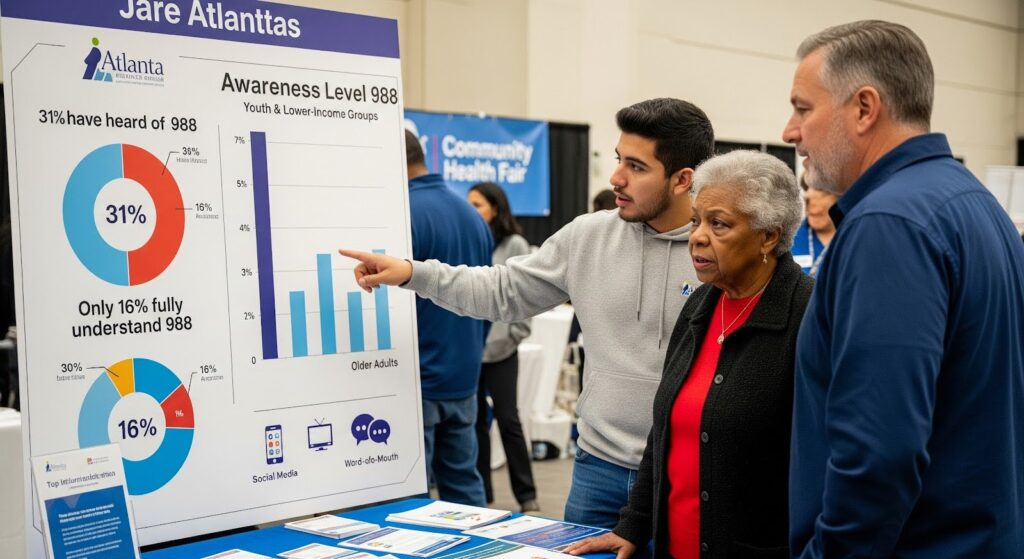
Despite strong operational performance, a May 2023 statewide survey revealed a critical awareness gap: only 31% of Georgians had heard of 988, and among those, just 54% correctly identified it as the Suicide & Crisis Lifeline, translating to about 16% of the population with full understanding.
Younger and lower-income residents showed higher awareness, with social media, television, and word-of-mouth as the top information sources. Nearly 70% of those who correctly identified 988 expressed confidence in knowing when to use it versus calling 911.
This awareness gap is particularly significant for Atlanta, where the metro area’s diverse, high-density population offers both a challenge and an opportunity.
The data suggest that targeted campaigns in schools, universities, transit systems, faith communities, and workplaces, using bilingual messaging and emphasizing text and chat options, can close the knowledge gap and drive help-seeking among under-aware segments, especially older adults and communities of color.
Georgia anticipated that increased awareness could double call volumes in the first year, and the state’s sub-10-second average speed to answer indicates that the system has the capacity to absorb higher demand without degrading performance.
GCAL reported increased referrals to outpatient services (up 18%) and inpatient services (up 12%) in the first year, evidence that awareness and access are translating into care engagement and linkages.
Suicide Prevention Programs Atlanta: How Awareness Drives Outcomes
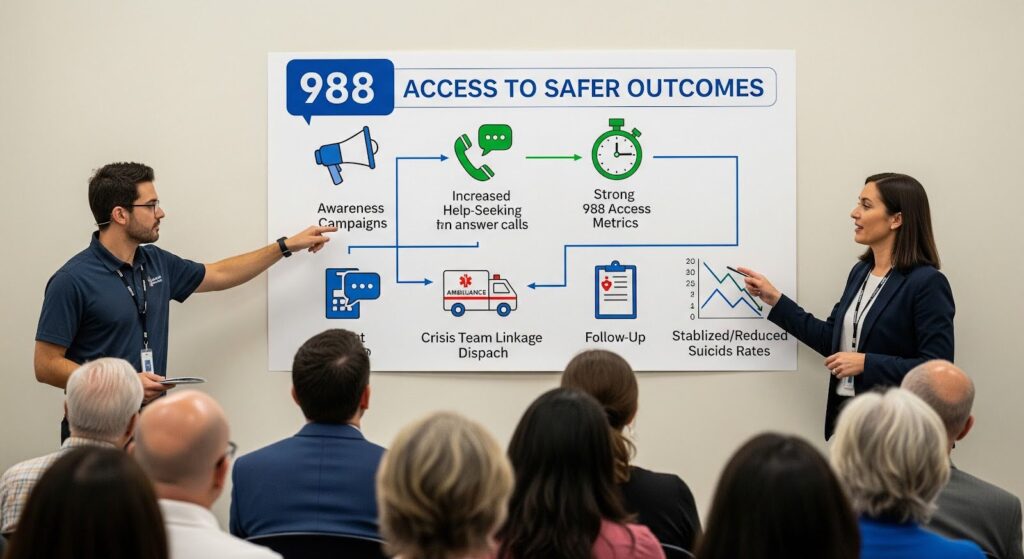
The pathway from awareness to reduced suicide risk involves multiple steps: public knowledge of 988 and GCAL, rapid answering and de-escalation, multimodal access via call, text, and chat, local linkage to mobile crisis and urgent care, and follow-up to sustain safety.
Each step is measurable, and Atlanta’s mature service ecosystem, anchored by GCAL’s integrated hub model, positions the metro area to convert awareness into meaningful outcomes.
Key mechanisms include:
- Awareness activation: Campaigns such as 988 Day (September 8), school-based outreach, and community partnerships normalize help-seeking and increase recall of the three-digit code.
- Rapid response: Georgia’s sub-10-second average speed to answer reduces the likelihood that callers will disengage or escalate, enabling timely safety planning and risk assessment.
- Equity and access: Text and chat modalities lower barriers for youth and those who prefer written communication, while Spanish-language services and ASL videophone options expand reach.
- Local linkage: GCAL’s ability to dispatch mobile crisis teams, make urgent appointments, and place individuals via the real-time bed board diverts people from emergency departments and law enforcement, reducing system burden and improving care appropriateness.
- Follow-up: Georgia’s performance targets include follow-up for suicidal individuals, reinforcing safety plans and fostering adherence to ongoing care.
While mortality reductions may take years to detect due to data lags and multi-factorial causation, intermediate outcomes, faster response, lower abandonment, increased linkages, fewer ED diversions, are already observable and consistent with the mechanisms required to reduce suicide risk at scale.
Connecting Awareness, Utilization, and Outcomes in Atlanta
To evaluate whether rising awareness and strong crisis response translate into measurable improvements in Atlanta’s suicide indicators, stakeholders should adopt a metrics-driven approach that tracks both process and outcome measures over time.
| Metric Category | Indicator | Data Source | Frequency |
| Mortality | Age-adjusted suicide rate (per 100,000) | CDC WISQARS | Annual |
| Access | In-state answer rate; average speed to answer; abandonment | 988 Lifeline state reports; SAMHSA dashboard | Monthly/Quarterly |
| Linkage | Mobile crisis dispatches; urgent appointments; bed placements | GCAL/DBHDD dashboard | Quarterly |
| Awareness | % heard of 988; % correct understanding | DBHDD surveys | Semiannual |
| Equity | Youth share of contacts; modality mix (call/text/chat) | GCAL/DBHDD dashboard | Quarterly |
By monitoring these indicators in parallel, Atlanta can assess whether awareness campaigns correlate with increased help-seeking, whether the system maintains performance under higher demand, and whether county-level suicide rates stabilize or decline over multi-year windows.
Transparent public reporting via Georgia’s 988 data dashboard and local coalition briefs will build accountability and sustain momentum.
Why Does This Matter for Atlanta?
Atlanta’s near-term leverage point is not core call center performance, which is already strong, but public awareness and engagement.
Given Georgia’s robust in-state answer rates, mobile crisis capacity, and GCAL integration, the more binding constraint on help-seeking in the Atlanta area appears to be public knowledge of 988 and precise understanding of when to use the line versus calling 911.
A strategic, equity-conscious awareness push targeted to under-aware demographic and geographic segments in the Atlanta media market, paired with continuous monitoring of county-level age-adjusted suicide rates and 988 engagement indicators, is likely to yield the greatest marginal reductions in crisis burden and mortality, provided that capacity scaling keeps pace with induced demand from outreach.
For Atlanta residents, the message is clear: if you or someone you know is experiencing suicidal thoughts, severe emotional distress, or a substance-use crisis, call or text 988 or chat at 988lifeline.org for free, confidential support 24/7.
The line is answered in-state, often in seconds, and can connect you to local mobile crisis teams, urgent appointments, and crisis stabilization services designed to keep you safe and supported.
Taking the Next Step
If you or a loved one is struggling with mental health challenges or substance use, you don’t have to face it alone. Summit offers compassionate, evidence-based treatment in Atlanta, blending individual therapy, group support, and holistic care to help you build a path to recovery and wellness.

