
Anxiety often spikes in the first weeks after men stop drinking or using drugs. This surge is not a sign of weakness, it is a predictable neurobiological rebound that occurs when alcohol or opioids are removed and the brain’s stress systems overreact.
Research shows that approximately 21.5 million U.S. adults have co-occurring mental health and substance use disorders, with anxiety and mood disorders being the most common mental health conditions.
This article explains why anxiety increases after sobriety, identifies risk factors specific to recently sober men, and outlines evidence-based treatments that can reduce symptoms and prevent relapse.
The Neurobiological Rebound: Why Anxiety Peaks After Cessation
When men stop drinking or using opioids, the brain enters a state of hyperexcitability. Chronic alcohol use suppresses excitatory glutamate signaling and enhances inhibitory GABA activity.
The brain compensates by reducing baseline GABA function and upregulating glutamate receptors. Abrupt cessation unmasks this imbalance, producing a rebound state dominated by excitatory signaling.
This manifests as anxiety, agitation, insomnia, and autonomic hyperactivity, the hallmark symptoms men report in early sobriety.
Stress systems also overreact. Alcohol dependence dysregulates corticotropin-releasing factor (CRF) and central noradrenergic signaling, particularly in the extended amygdala. During withdrawal, CRF and noradrenaline levels surge, driving negative affect, hyperarousal, and anxiety-like behavior.
These changes are not psychological, they are measurable neurochemical shifts that directly cause the intense anxiety men experience in the first days and weeks of sobriety.
Anti-stress systems also fail. Neuropeptide Y, which normally dampens anxiety, is downregulated in the central amygdala during withdrawal. Dynorphin, a peptide that produces dysphoria, increases in the nucleus accumbens.
This dual hit, overactive stress systems and underactive anti-stress systems, creates a neurochemical environment primed for anxiety and relapse.
Acute and Protracted Withdrawal Timelines
Acute withdrawal symptoms typically begin within 6 to 24 hours of the last drink, with peak autonomic hyperactivity and anxiety occurring in the first 48 hours.
Severe complications like seizures or delirium tremens can emerge between 6 and 96 hours. However, affective symptoms, anxiety, dysphoria, and insomnia, often persist for up to four weeks even after the acute autonomic features recede.
For some men, this evolves into post-acute withdrawal syndrome (PAWS), characterized by persistent anxiety, depression, irritability, and sleep disturbances lasting weeks to months.
National guidance emphasizes that psychoeducation and engagement during early sobriety are critical because co-occurring symptoms are common and coping skills may be underdeveloped at this stage.
Clinical Trajectories: Not All Men Follow the Same Path
A 2025 study of 1,005 individuals with alcohol use disorder identified three distinct anxiety and depression trajectory subgroups during early abstinence.
Approximately 70 to 73 percent showed low, rapidly improving symptoms. Another 22 to 24 percent had high symptoms that slowly improved. A critical 5 to 6 percent remained in a sustained-high symptom group throughout treatment.
Subgroup membership was influenced by age, sex, co-occurring disorders, and PTSD severity, indicating that clinically meaningful heterogeneity exists and that early identification of the sustained-high subgroup is essential to improve outcomes and reduce relapse risk.
In early treatment for opioid use disorder, similar patterns emerge. A study of 5,795 individuals found three classes: persistent moderate-to-severe symptoms, remitting severe symptoms, and persistent minimal/mild.
Persistent trajectories were predicted by female sex and heavy past-month benzodiazepine co-use. For men, chronic pain increases withdrawal severity across timepoints, and higher withdrawal correlates with overpowering craving, each a pathway to heightened anxiety and relapse pressure during the first nine days.
The Sustained-High Subgroup: A Critical Target
The sustained-high anxiety subgroup represents a small but high-risk population. These men do not improve with standard care alone and require targeted interventions such as adjunctive pharmacotherapy, sleep-focused therapy, or neuromodulation.
Without early identification and aggressive treatment, this group faces elevated relapse risk and prolonged suffering.
Comorbidity and Underrecognition in Men
Independent mood and anxiety disorders are prevalent in alcohol dependence, approximately 39 percent of individuals have co-occurring mental health conditions.
Yet typical randomized controlled trials exclude over 60 percent of such patients.
In treatment-seeking samples, roughly 97 percent would have been ineligible for RCTs due to comorbidities, sharply limiting the generalizability of conventional trial findings.
For men, culturally reinforced stoicism and lower likelihood of early help-seeking can hide persistent or high symptoms, delaying intervention until relapse occurs. For many men, internalized beliefs about strength, self-reliance, and emotional control can make men seeking therapy feel unfamiliar or even threatening.
Men in high-demand occupations, especially safety-sensitive roles, may face additional barriers. Identity anchored in competence and control can complicate disclosure and help-seeking.
This sociocultural context can mask clinically significant anxiety in recently sober men, allowing PAWS-related anxiety to take root and delaying appropriate treatment of independent anxiety disorders.

Sleep Disruption: A Mediator and Amplifier of Anxiety
Acute alcohol withdrawal is associated with increased sleep onset latency, reduced slow-wave sleep, and reduced REM sleep.
Sleep defects can persist into early abstinence and protracted periods, and repeated cycles of drinking and withdrawal worsen baseline sleep architecture.
This produces a feedback loop where sleep disruption perpetuates anxiety and negative affect, increasing relapse risk.
A recent randomized controlled trial in Veterans in early recovery compared cognitive behavioral therapy for insomnia (CBT-I) and an active placebo therapy.
Both interventions improved insomnia robustly and promoted abstinence and improved next-day functioning.
Across treatment groups, remission from insomnia was associated with reduced alcohol craving for up to six months, suggesting sleep improvement may indirectly reduce anxiety and relapse pressure.
For men reluctant to engage in formal psychiatric care, accessible sleep-focused interventions can be an acceptable entry point that reduces arousal and indirectly improves anxiety and craving.
Brain Recovery and Relapse Risk
Prospective neuroimaging during weeks one to four of abstinence indicates that early frontal lobe tissue volume recovery is associated with subsequent long-term abstinence, whereas greater morphological abnormalities near treatment inception are seen among eventual relapsers.
These findings suggest that early neurobiological recovery is a biomarker of resilience. Conversely, blunted recovery may track with persistent negative affect and cognitive control deficits, both anxiety-relevant, that forecast relapse.
Functional neuroimaging in alcohol use disorder shows that alcohol cue-reactivity and anhedonia are robust predictors of relapse.
Emerging neuromodulation evidence using intermittent theta-burst stimulation (iTBS) to the left dorsolateral prefrontal cortex demonstrates reduced cue-reactivity in the insula and thalamus and decreased anhedonia, coinciding with reduced relapse over three to six months.
These effects likely reflect enhanced top-down control of limbic reactivity and improved reward processing, which can reduce anxiety tied to cue-induced arousal and anticipatory stress about craving.
Evidence-Based Treatments for Anxiety in Early Sobriety
Evidence-based treatments for anxiety in early sobriety focus on calming the nervous system while protecting against relapse. Combining targeted medications, structured psychotherapies, and neuromodulation options offers a balanced path to reduce anxiety without returning to substance use:
Pharmacotherapies Targeting Anxiety Mechanisms
Gabapentin (adjunct): Randomized evidence in acute withdrawal shows high-dose gabapentin reduces odds of drinking, craving, anxiety, and daytime sedation compared with lorazepam.
Scoping reviews emphasize benefit for negative affect and sleep in PAWS but caution against use as stand-alone therapy for seizure prophylaxis. Mechanistic plausibility includes modulating hyperexcitability and improving sleep, indirectly reducing anxiety.
However, gabapentin carries misuse and diversion risks and, when combined with opioids, has been associated with increased risk of opioid-related death, necessitating careful patient selection.
Mirtazapine: In recently detoxified outpatients, adding mirtazapine 30 to 60 mg for four weeks produced faster and greater improvement in depression and anxiety symptoms versus standard therapy alone. Noradrenergic and specific serotonergic mechanisms may directly mitigate PAWS-driven affect and insomnia.
Buspirone: A placebo-controlled trial in anxious alcoholics found buspirone improved retention, reduced anxiety, slowed return to heavy drinking, and reduced drinking days during follow-up.
Buspirone’s non-sedating, non-addictive profile is advantageous in early recovery and in men with occupational constraints.
SSRIs (cautious, targeted use): Systematic reviews suggest SSRIs can be effective for comorbid anxiety disorders, notably PTSD, but should be used with caution if patients are actively drinking, as they may increase alcohol consumption in some.
In abstinent patients with clear independent anxiety disorders, SSRIs may be appropriate, especially given low abuse potential.
Acamprosate: Targets glutamatergic dysregulation and supports abstinence maintenance. Pilot data suggest benefits in reducing PAWS severity alongside craving and relapse reduction, consistent with its intended role in normalizing excitatory tone, indirectly mitigating anxiety in some patients.
Naltrexone: Robust evidence base for relapse prevention. While not an anxiolytic, reductions in heavy drinking and cue-driven responding can indirectly lower anxiety associated with craving and loss of control.
Adherence is improved with long-acting injectable formulations, which may be particularly relevant in men reluctant to take daily pills.
Psychotherapies
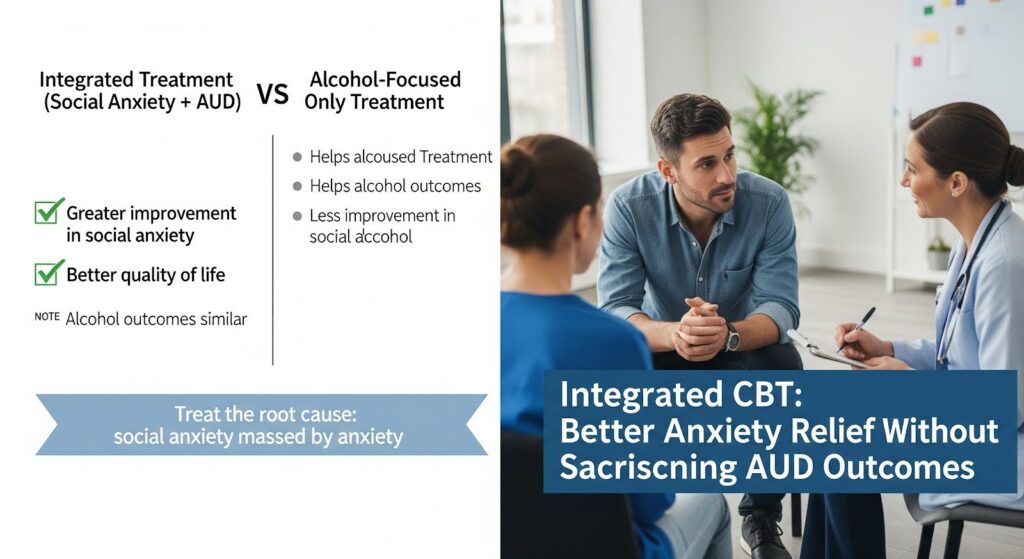
Integrated CBT for Social Anxiety and AUD: A randomized trial comparing integrated treatment for social anxiety and alcohol use disorder to alcohol-focused treatment showed greater improvements in social anxiety and quality of life with the integrated approach, though alcohol outcomes were similar.
For men whose anxiety surge in early sobriety reflects longstanding social anxiety masked through alcohol, integrated therapy likely addresses the root cause more directly and may improve medium-term outcomes.
Relapse Prevention and Skills: Psychoeducation about PAWS, distress tolerance, and emotion regulation should be emphasized early, especially because early sobriety is precisely when negative affect intensifies and many lack coping skills.
Embedding anxiety management within relapse prevention aligns with real-time needs of recently sober men.
Neuromodulation: iTBS to Left DLPFC
Two studies in Veterans with alcohol use disorder indicate that 20 sessions of iTBS to the left dorsolateral prefrontal cortex, administered over two weeks, reduced relapse risk at three to six months, decreased anhedonia, and attenuated fMRI-measured alcohol cue-reactivity.
Treatment was feasible and tolerable in residential settings. For men with persistent anxiety linked to cue-reactivity, diminished top-down control, and anhedonia, DLPFC iTBS is a promising adjunct that may directly address neurocircuit mechanisms of negative affect and arousal during early abstinence.
Practical Recommendations for Recently Sober Men
Screen early and often: Use GAD-7, PHQ-9, and PCL-5 at intake and weekly for four weeks to identify sustained-high trajectories. Screen for independent anxiety disorders and PTSD. Evaluate benzodiazepine co-use.
Educate about PAWS: Normalize early anxiety as a neurobiological rebound. Set expectations for symptom courses and sleep recovery. Teach coping skills. Involve family and support to reduce stigma and encourage help-seeking in men.
Address sleep immediately: Implement CBT-I principles. Consider adjuncts like gabapentin or mirtazapine when indicated. Monitor for improvement in craving and anxiety as sleep normalizes.
Target hyperarousal: Consider buspirone for anxious men without sedative needs. Use adrenergic strategies judiciously when hyperadrenergic symptoms predominate. Avoid benzodiazepines beyond acute detox.
Support abstinence biologically: Initiate acamprosate or naltrexone as indicated. Consider injectable naltrexone for adherence in men ambivalent about daily pills.
Treat comorbidity integratively: For social anxiety, integrate CBT with motivational enhancement therapy. For PTSD, consider sertraline once abstinent. Monitor for alcohol changes with SSRIs. Refer to trauma-focused psychotherapy where appropriate.
Consider neuromodulation: Where available, add iTBS to left DLPFC for men with persistent negative affect and cue-reactivity despite first-line measures.
The First Four Weeks: A Critical Window
In a secondary analysis of the COMBINE trial, continuous abstinence achieved in weeks one to four predicted fewer drinking and heavy drinking days and longer time to first drink and first heavy drinking day.
Effects were evident within the first week and scaled with each additional week of early abstinence.
Analyses used Cox time-to-event models adjusting for sex and other covariates, underscoring early use as a robust early index of poor response and a signal to personalize treatment.
For men, linking early lapses to immediate treatment intensification, including medication optimization, CBT-I for insomnia-driven anxiety, and higher-frequency contacts, aligns with a precision approach and reduces downstream risk.
Why Does This Matter?
The intersection of high comorbidity prevalence and underreporting tendencies in men creates a perfect storm for persistent, under-treated anxiety during early sobriety.
Trials excluding such complexity have constrained evidence-based guidance precisely where it is most needed.
Clinical systems should assume comorbidity until ruled out in recently sober men and proactively treat anxiety disorders alongside alcohol or opioid use disorder.
The single most important proximal driver of heightened anxiety after sobriety is the excitatory-dominant neurochemical rebound, reduced GABA and increased glutamate with stress-axis upshift.
But the persistence and clinical impact in men are amplified by underrecognized comorbidities, sleep disruption, occupational and identity pressures, and delayed care-seeking.
Treatment plans for recently sober men should combine early mechanistic pharmacotherapy, sleep-focused care, neuromodulation when available, and integrated psychotherapy for anxiety disorders, with vigilant monitoring to identify and treat the sustained-high symptom subgroup before relapse.
If you or someone you care about is struggling with anxiety in early recovery, know that effective help is available. At The Summit Mental Health Center, we offer integrated, evidence-based treatment that addresses both substance use and co-occurring anxiety disorders.
Our compassionate team understands the unique challenges men face in early sobriety and can help you build a foundation for lasting recovery. Contact us today to learn more about our outpatient programs in Atlanta and Roswell.

