
Quitting cannabis can feel overwhelming, especially when sleep problems and mood swings hit hard in the first few weeks.
Within one month of verified abstinence, adolescents and young adults show measurable improvements in learning and memory, and adults with depression often experience relief from both depressive symptoms and cognitive fog.
This article walks you through the timeline of mental, physical, and sexual health gains after quitting weed, backed by the latest research on what improves, when, and why.
Mental Health Improvements After Quitting Cannabis
Mental health improvements after quitting cannabis can emerge surprisingly quickly and continue to build over time. As depression, anhedonia, and anxiety recede, many people also see fewer crises and emergency department visits, especially youth whose brains are still developing:
Depression and Anhedonia Lift Within Four Weeks
For people with major depressive disorder who also have cannabis use disorder, stopping weed brings concrete relief.
In a study using urine verification to confirm abstinence, 8 of 11 participants achieved 28 days without cannabis and showed significant improvements in depressive symptoms and anhedonia.
These same individuals also gained measurable cognitive benefits in visual search speed, sustained attention, response inhibition, and visuospatial working memory.
The clinical message is clear: if you are depressed and using cannabis regularly, even one month of abstinence can improve both mood and mental clarity.
A separate analysis of 307 outpatients with depression found that those using cannabis for medical purposes had worse mental and physical functioning at the end of treatment compared to non-users, suggesting that routine cannabis use may not deliver the functional benefits many people expect.
Anxiety Decreases With Sustained Abstinence
A 2021 systematic review and meta-analysis of longitudinal studies concluded that cannabis use is prospectively associated with greater subsequent anxiety.
While the review does not prove causation, the directional implication is that reducing or stopping use could lower anxiety risk over time.
In treatment-seeking users, reductions in cannabis use are associated with improvements in anxiety, depression, and sleep quality.
A 2024 critical review notes that THC can be anxiogenic at higher doses and that long-term controlled data showing sustained anxiety relief with cannabis are lacking.
For cessation counseling, this means explaining that while some people report short-term relief, the balance of evidence points toward higher long-term anxiety risk with ongoing use and toward improvements with abstinence.
Memory and Cognitive Function Recover by Two to Four Weeks
Prospective studies in adolescents and young adults show domain-specific cognitive recovery across the first month of abstinence.
Over three weeks, marijuana-using adolescents improved in verbal learning by week two and verbal working memory by week three, though attention accuracy deficits persisted through three weeks relative to controls.
Abstinence was verified by serial urine THC metabolite declines, strengthening causal interpretation.
A Massachusetts General Hospital study reported that 30 days of abstinence improved learning and memory in adolescents and young adults.
Urine biomarkers verified abstinence in 89% of the abstinent group, and improvements were specific to memory during the abstinence period.
In adults, a meta-analysis found that while small neurocognitive effects persist beyond acute intoxication, studies evaluating users after 25 days or more of abstinence observed no residual deficits, failing to support long-term persistent neuropsychological effects from heavy use. Effect sizes were generally small, and high-quality studies remain limited.
Youth Emergency Department Visits Drop With Reduced Use
From a public health standpoint, pediatric emergency department data raise concerns about acute harms, particularly with edibles and polysubstance use.
In a California tertiary hospital review from 2013 to 2020, 71% of pediatric cannabinoid-positive cases occurred after legalization. Among 15 to 17 year olds, 43% presented with suicidal ideation, and polysubstance coingestion was common.
For families and communities, reductions in youth access and use likely reduce risk for acute toxicity and suicidality-linked emergency presentations.
Physical Health Benefits of Stopping Weed
Physical health benefits of stopping weed extend far beyond the brain and mood, touching lungs, heart, and overall vitality. Within weeks to months, people often notice easier breathing, better sleep, and fewer inflammation-related problems as their body begins to repair itself:
Respiratory Symptoms Improve Rapidly
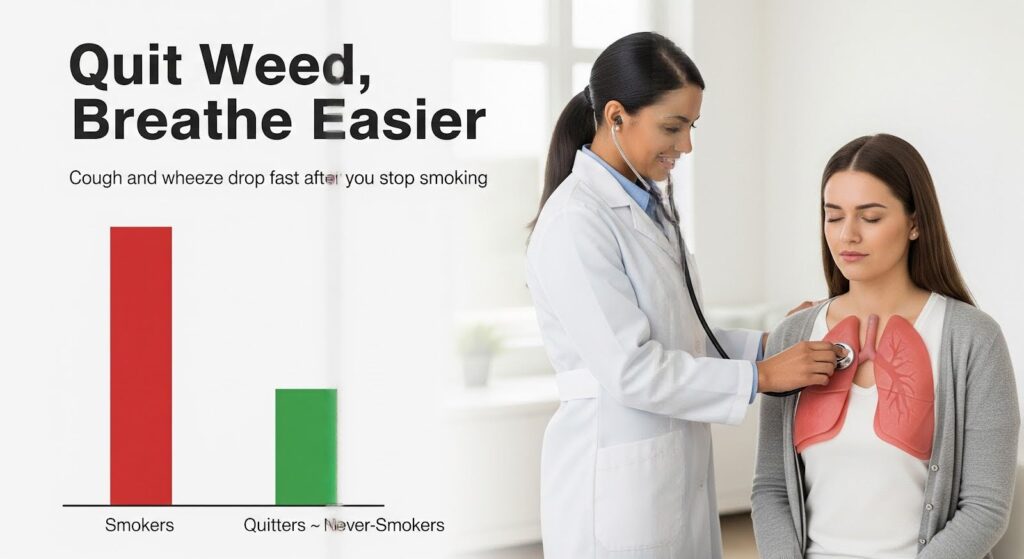
Several lines of evidence support a symptomatic benefit of quitting smoked cannabis. In a population birth cohort followed to age 38, quitting cannabis was associated with significant reductions in morning cough, sputum, and wheeze.
Symptoms in quitters approximated those of never-users. These improvements were observed whether individuals quit cannabis alone or cannabis plus tobacco.
In a convenience sample with about 9.8 years of follow-up, individuals who became non-smokers of both cannabis and tobacco had no increased risk of chronic bronchitis compared with never-smokers.
Those continuing to smoke either substance had increased risk, highlighting the importance of complete abstinence from smoked products.
Some spirometric parameters may not fully normalize. Prior cannabis smokers exhibited persistent reductions in FEV1, FEV1/FVC, and Vmax50 compared with never-smokers in an earlier study, even though current smokers did not show these reductions, possibly due to acute bronchodilatory effects.
This suggests that symptoms respond more readily to cessation than certain spirometric indices, or that structural or functional airway changes may persist in some individuals.
The clinically meaningful message is clear: quitting smoked cannabis reduces bronchitic symptoms and can normalize chronic bronchitis risk over time, though the extent of spirometric reversibility is less certain and may be incomplete, especially in heavier or longer-duration users.
COPD Progression Does Not Worsen in Older Adults
The SPIROMICS longitudinal analysis of older adult tobacco smokers with and without COPD found that neither former nor current marijuana smoking across lifetime exposure categories was associated with accelerated COPD progression, increased incident COPD, worse annual FEV1 decline, or more exacerbations versus never marijuana smokers.
Heavy marijuana exposure of 20 joint-years or more did not show differential decline in this analysis.
These findings do not endorse marijuana smoking. Rather, they suggest that in tobacco-experienced older adults, marijuana use status may not be a dominant driver of COPD progression metrics over several years, and that quitting tobacco remains paramount.
For cannabis users, cessation still reduces bronchitic symptoms and avoids additive airway injury seen with combined cannabis-tobacco smoking.
Sleep Quality Improves After Withdrawal Period
Cannabis affects sleep in a time and dose-dependent fashion. Acute THC can reduce sleep onset latency and increase slow wave sleep while suppressing REM.
However, with chronic use, tolerance and dependence can lead to withdrawal-related sleep disturbances upon cessation.
Withdrawal typically begins within 24 to 72 hours, with sleep fragmentation, reduced total sleep time, decreased slow wave sleep, decreased REM latency, vivid dreams or nightmares, and sometimes increased periodic limb movements.
These disturbances can persist up to six or seven weeks in heavy users and are major drivers of relapse.
Importantly, reductions in cannabis use in treatment-seeking users are associated with improvements in sleep quality, anxiety, and depression.
This underscores that while the initial withdrawal period can be rough on sleep, sustained reductions or abstinence are associated with downstream improvement.
In practical terms, prepare for one to six weeks of sleep disruption during early abstinence and plan coping strategies such as sleep hygiene, cognitive-behavioral techniques for insomnia, and cautious short-term pharmacologic support when appropriate.
Emphasize that sleep quality typically improves with sustained abstinence and coincides with improvements in anxiety and mood.
Sexual and Reproductive Health Benefits for Men
Sexual and reproductive health benefits for men extend well beyond immediate physical changes, influencing fertility, long-term offspring health, and overall hormonal balance. Improvements in sperm quality, reversal of harmful epigenetic changes, and thoughtful preconception planning all depend on sustained lifestyle changes and periods of abstinence:
Sperm Quality and DNA Integrity Improve
Human observational studies and recent translational work converge on a consistent signal: cannabis use is associated with adverse semen parameters, including lower sperm concentration, abnormal morphology, and reduced motility and viability.
New evidence in 2025 from a Scientific Reports study comparing non-smokers, tobacco smokers, and cannabis smokers found that cannabis smokers had worse sperm morphology and motility and showed higher markers of DNA and chromatin damage, with worse impairment than tobacco smokers in some measures.
Notably, the study did not find differences in mitochondrial COX gene variants between groups, suggesting that cannabis-related sperm damage reflects epigenetic or chromatin integrity rather than changes in nuclear or mtDNA coding sequence.
The authors recommend quitting cannabis for at least three months before assisted reproductive treatments.
Epigenetic Changes Reverse After 74 to 77 Days
The most compelling advances are in sperm epigenetics. Human cohort studies from Duke University show that cannabis users exhibit altered sperm DNA methylation at genes involved in early development and neurodevelopment. Crucially, refraining from use diminishes these epigenetic changes.
After about 74 to 77 days of abstinence, one spermatogenic cycle, epigenetic alterations were markedly reduced and closer to non-user controls, though a small residual pool of changes persisted whose developmental significance is not yet known.
Translational primate evidence from a 2023 rhesus macaque study demonstrated that cessation of chronic delta-9-THC partially reverses adverse impacts on male fertility and sperm epigenome after approximately two spermatogenic cycles.
While not complete, many THC-associated differentially methylated regions improved with abstinence, and selected fertility-relevant sperm proteins shifted toward pre-exposure levels.
These epigenetic data transform preconception counseling. Even in the absence of randomized controlled trials on conception rates, the weight of evidence indicates that abstinence for at least one spermatogenic cycle meaningfully reduces cannabis-associated sperm methylation changes and correlates with improvements in semen protein expression relevant to fertility, with likely additional benefit from longer abstinence.

Preconception Abstinence Recommendations
Given the converging evidence, advise at least one spermatogenic cycle of 74 to 77 days of abstinence prior to attempting conception. Where feasible, consider multiple cycles to maximize reduction of residual epigenetic alterations.
For couples pursuing assisted reproduction, a three-month abstinence recommendation is reasonable and in line with professional opinion statements on substance use and fertility.
Communicate uncertainties: we do not yet know whether the residual post-abstinence epigenetic changes persist through fertilization or reprogramming or impact offspring development.
However, abstinence clearly reduces the majority of observed changes.
Timeline of Expected Benefits After Quitting
| Domain | Days 1–14 | Weeks 3–6 | 1–3 Months | 3–12+ Months |
| Mood | Irritability possible; mood may fluctuate | Emerging improvements in depressive symptoms and anhedonia, especially by 4 weeks | Further mood stabilization; reduced anxiety with maintained abstinence | Sustained gains with continued abstinence |
| Anxiety | Possible rebound anxiety | Gradual improvement with coping strategies; sleep improves | Lower anxiety with sustained reduction or abstinence | Maintained improvements; relapse prevention focus |
| Cognition | Attention and working memory may feel foggy initially | Measurable improvements by 4 weeks in attention, inhibition, visuospatial working memory | Continued cognitive recovery | Plateau and maintenance with abstinence |
| Sleep | Withdrawal insomnia, vivid dreams, reduced total sleep time and slow wave sleep; onset 24–72 hours | Sleep disruption can persist up to 6–7 weeks in heavy users | Sleep quality typically improves with sustained abstinence | Maintained improvements; consider CBT for insomnia for residual issues |
| Respiratory | Less cough may be noticeable within days | Reductions in sputum and wheeze become apparent | Symptoms approximate never-smokers with abstinence | Sustained symptom relief; spirometric changes may not fully normalize |
| Male Fertility | No immediate changes | Early improvements in semen function possible | Marked reduction in sperm epigenetic alterations by 74–77 days | Potential incremental benefit with multiple cycles of abstinence |
Managing Withdrawal and Supporting Recovery
Common cannabis withdrawal symptoms include craving, irritability or anger, anxiety, depressed mood, restlessness, and sleep disturbance.
Symptom severity correlates with pre-quit consumption levels. Patients with comorbid psychiatric disorders may have a higher withdrawal burden.
Set expectations: withdrawal starts 24 to 72 hours after cessation, and sleep disruption can last four to six or more weeks in heavy users.
Offer coping strategies such as exercise, mindfulness, structured daily routines, cognitive-behavioral therapy for insomnia, short-term pharmacotherapy with caution, and peer or contingency-based support.
Monitor co-use shifts and watch for increased alcohol or tobacco during early abstinence, and counsel proactively.
Use brief, repeated measures for mood, anxiety, sleep, and cognitive complaints. Consider objective cognitive tasks when feasible.
Reinforce physiological timelines, such as 74 to 77 days for sperm epigenetics, to maintain motivation for preconception goals. Celebrate symptom wins, such as fewer morning cough episodes by week two or three, to build adherence.
What the Evidence Shows?
Based on the most reliable and recent evidence, quitting cannabis confers clinically meaningful benefits across mental health, respiratory symptoms, sleep quality after the withdrawal period, and male reproductive biology.
The benefits begin within days to weeks for respiratory symptoms and over four to eight weeks for mood and sleep, with notable cognitive gains by four weeks in individuals with major depressive disorder and cannabis use disorder.
For male fertility, at least one full spermatogenic cycle of abstinence, about 74 to 77 days, substantially reduces cannabis-linked sperm epigenetic alterations.
Multiple cycles likely confer additional benefit. In the absence of definitive trials on conception rates, these mechanistic and clinical improvements justify routine preconception abstinence counseling.
Although older adult COPD progression did not differ by marijuana use status in SPIROMICS, quitting cannabis still reduces bronchitic symptoms and avoids additive airway damage with tobacco.
The principal caveat is the initial withdrawal phase: sleep worsens transiently, mood may fluctuate, and relapse risk is highest. With anticipatory guidance and support, these barriers are surmountable and give way to sustained gains.
For most regular users, stopping cannabis is more likely than not to improve quality of life and key health outcomes, especially if abstinence is maintained for at least several weeks to months and paired with comprehensive support.
The upside is greatest for people with depression, sleep problems, respiratory symptoms, and those planning conception in the near future.
If you or someone you care about is ready to quit cannabis and wants structured support through the withdrawal period and beyond, reach out to our team to explore outpatient treatment options personalized to your needs.

