
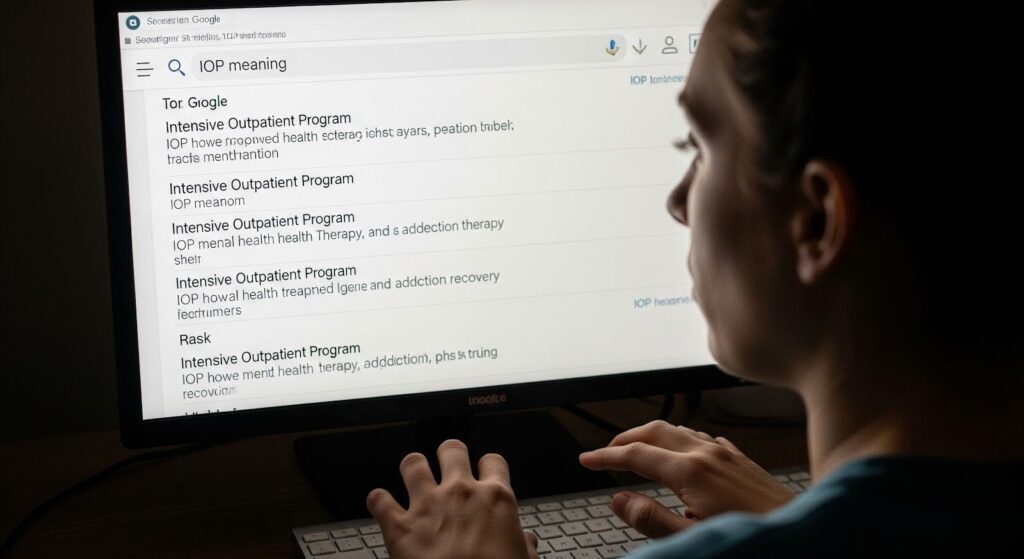
Many people searching for “IOP” are confused by results about eye pressure or unsure what the treatment involves.
In behavioral health, an intensive outpatient program (IOP) is a structured treatment providing nine or more hours of therapy weekly while you live at home.
This article explains how IOP works, who it helps, and how to navigate insurance coverage.
What is IOP in Mental Health Treatment?
The acronym IOP stands for Intensive Outpatient Program. It is a specific level of care in behavioral health designed for people who need more support than weekly therapy but do not require 24-hour supervision.
Confusion often arises because the same acronym is used in ophthalmology to mean “intraocular pressure.” If you search for “IOP” without adding “mental health,” you might find irrelevant medical information.
In the context of mental health and addiction recovery, an intensive outpatient program focuses on stabilizing symptoms and building coping skills while allowing you to maintain your daily life.
In 2024, Medicare formalized this definition. Federal rules now classify IOP as a distinct benefit that provides approximately nine or more hours of services per week.
This change helped standardize the “op meaning mental health” definitions across the country, ensuring patients receive a consistent level of care regardless of where they live.
Core Components of an IOP
Most programs run three to five days a week. A typical session lasts three hours, totaling between 9 and 19 hours of treatment weekly. Services usually include:
- Group therapy: The primary format for building skills and peer support.
- Individual counseling: One-on-one sessions to address personal goals.
- Medication management: Oversight by a physician or nurse practitioner.
- Family therapy: Sessions that include loved ones to improve home dynamics.
How Does IOP Differ From Other Levels of Care?
Understanding where IOP fits in the treatment system helps you choose the right option. It sits right in the middle of the care continuum.
Standard Outpatient vs. IOP vs. PHP
| Feature | Standard Outpatient | Intensive Outpatient (IOP) | Partial Hospitalization (PHP) |
| Weekly Hours | Less than 9 hours (often 1 hour) | 9 to 19 hours | 20 or more hours |
| Setting | Clinic or office | Hospital outpatient or community center | Hospital outpatient or community center |
| Primary Goal | Maintenance and mild symptom relief | Stabilization and skill-building | Alternative to inpatient care |
| Living Situation | Home | Home | Home (but days are spent in treatment) |
While standard outpatient care involves visiting a therapist once a week, partial hospitalization programs (PHP) are much more demanding.
PHP is often called “day treatment” because it operates like a school or work day, typically requiring attendance four to five days a week for at least five hours a day.
IOP offers a middle ground, providing substantial structure without taking up the entire day.
Who is a Good Candidate for Mental Health IOP?
IOP is not for everyone. It is best suited for individuals who are medically and psychiatrically stable enough to be safe at home.
If someone is at immediate risk of self-harm or requires medical detox, inpatient care is usually the necessary first step.
Common conditions treated in IOP include:
- Depression and Anxiety: For those whose symptoms affect their ability to function at work or school.
- Substance Use Disorders (SUD): For people needing strong support to maintain abstinence.
- Eating Disorders: For individuals who need meal support and therapy but are medically stable.
Recent data shows that IOP is effective for diverse groups. For example, remote IOP programs for youth have shown large symptom reductions in depression, with similar success rates across different ages and gender identities.

Effectiveness and Telehealth Options
The evidence supporting IOP is strong. Studies indicate that for many people, intensive outpatient care is as effective as residential treatment for substance use disorders, provided the person has a safe home environment.
The Rise of Virtual IOP
Since 2020, telehealth has transformed how this care is delivered. Virtual IOP allows patients to join group therapy and individual sessions from home.
This is particularly helpful for people in rural areas or those without reliable transportation.
However, there is a policy gap to watch. While commercial insurance and Medicaid often cover virtual IOP, Medicare’s specific IOP benefit currently requires services to be delivered in person.
Beneficiaries should check their specific plan details, as broader telehealth flexibilities do not always apply to the new benefit level established for IOP.
Barriers to Accessing IOP Mental Health
Despite its benefits, starting an IOP can be difficult due to logistical and financial hurdles.
Prior Authorization
Insurance companies often require “prior authorization” (PA) before they agree to pay for IOP. This means the provider must submit clinical details proving the care is medically necessary.
This process can cause delays. Fortunately, some states have laws to speed this up. For instance, Alabama and Alaska have specific timelines that require insurers to make prior authorization decisions within a few days to prevent treatment gaps.
Cost and Coverage
Cost varies by location and insurance plan. The 2024 Medicare expansion helped close a major coverage gap for seniors, who previously had to pay out-of-pocket or skip this level of care.
Patients with private insurance should verify their deductible and copayments, as these can add up over a multi-week program.
Stigma and Confusion
The “IOP” acronym itself can be a barrier. Patients searching for help might get confused by medical terms or fear that “intensive” means “institutional.”
In reality, IOP is designed to keep people connected to their community, not separate them from it.
Why Does It Matter?
IOP mental health treatment fills a critical need in the healthcare system. Without it, patients are often forced to choose between one hour of therapy a week, which may not be enough, and 24-hour hospitalization, which is restrictive and expensive.
By offering a structured, supportive environment for several hours a week, IOP helps people manage crises and build long-term recovery skills while sleeping in their own beds.
If you or a loved one needs more support than a weekly therapy session can provide, Summit’s intensive outpatient program might be the right step toward stability and recovery.

