
Where you live in Metro Atlanta shapes your mental health care experience more than many realize.
Georgia’s crisis infrastructure delivers 24/7 access statewide through 988 and GCAL, yet rural residents with employer insurance had 1.8 to 2.4 fewer outpatient visits than urban peers from 2005 to 2018.
This article unpacks how urban vs suburban vs rural mental health data Atlanta reveals patterns across emergency response, specialist availability, and telehealth adoption that directly affect your ability to get timely care.
Urban Mental Health Access in Metro Atlanta
Atlanta’s urban core concentrates psychiatric specialists, crisis centers, and hospital emergency departments within a compact footprint. The Georgia Crisis & Access Line operates a statewide bed registry that logged roughly 250,000 calls in 2019, with approximately 15,000 mobile crisis dispatches and nearly 3,500 facilitated placements into treatment beds. Urban residents benefit from faster response times and proximity to Behavioral Health Crisis Centers that offer walk-in assessment and temporary observation up to 24 hours.
However, high call volumes during peak hours can strain in-state answer capacity, occasionally routing calls to national backup. Urban crisis pathways work well when systems coordinate, but boarding in emergency departments remains a challenge when inpatient psychiatric beds fill. The city’s large employer-sponsored insurance population shows the highest baseline use of outpatient mental health services compared to suburban and rural areas, reflecting both greater need and better access to multidisciplinary teams.
Fulton and DeKalb counties anchor this urban ecosystem, with robust Federally Qualified Health Center networks expanding behavioral health integration. Georgia’s 35 FQHCs served more than 747,000 patients in 2024, with growing engagement of homeless and public housing populations who face compounded barriers. The state’s homeless count identified 5,856 literally homeless persons in 2022, a 40 percent increase from 2019, with two-thirds unsheltered and many concentrated in the metro core.
Suburban Challenges in Gwinnett, Cobb, and Beyond
Suburban counties around Atlanta face a distinct access puzzle. Population growth in Gwinnett, Cobb, Clayton, Henry, Cherokee, and Forsyth outpaces specialist recruitment and in-network provider expansion. These counties are classified as non-rural by state metrics yet exhibit suburban land use, commuting patterns, and school district governance that create pockets of workforce shortage even amid overall higher provider density than rural Georgia.
A major study tracking privately insured adults from 2005 to 2018 found suburban residents landed between urban and rural extremes on utilization. They accessed care more readily than rural peers but faced emerging network gaps as fast-growing corridors strained capacity. Suburban residents increasingly rely on primary care physicians to manage mental health conditions when specialist appointments stretch weeks or months out, a pattern that mirrors rural dynamics but with different root causes.
Crisis infrastructure reaches suburban areas through the same statewide 988 system, yet mobile response times vary by distance and traffic. Behavioral Health Crisis Centers and Crisis Stabilization Units distribute regionally, with average stays around six days providing short-term residential stabilization. Suburban families often travel to urban emergency departments for pediatric crises, adding transport time and potential boarding delays while awaiting psychiatric placement.
School-based mental health programs through Georgia’s Apex initiative help detect needs earlier in suburban districts. These partnerships improve access and coordination of services, expanding coverage in settings where specialty providers remain scarce. As upstream detection improves, demand for crisis line support and intensive outpatient services rises, a positive signal of earlier help-seeking that requires midstream capacity to keep pace.
Rural Barriers and the Role of Distance
Rural Georgia confronts the starkest access challenges. Counties with fewer than 50,000 residents qualify as rural under state definitions and show persistent mental health shortage designations. The evidence is clear: rural enrollees with employer-sponsored insurance were less likely than urban counterparts to use outpatient services for depression by 1.2 percentage points in 2005 and 0.6 percentage points in 2018, and among those who did seek care, rural patients had significantly fewer visits across depression, anxiety, and substance use disorder.
Distance compounds every step. Rural residents face longer travel to Crisis Stabilization Units, limited local psychiatric specialists, and greater reliance on primary care to deliver mental health treatment. When crises escalate, mobile crisis teams cover vast territories with response times stretched by geography. Placement in crisis beds or psychiatric hospitals often requires transport of an hour or more, with law enforcement sometimes involved when 911 activation becomes necessary.
Rural areas benefit from the same statewide crisis call infrastructure as urban centers, but area-code-based routing can mismatch caller location with response resources, especially as residents retain non-local cell numbers. Audio-only telehealth allowances matter more in rural settings where broadband remains inconsistent and older adults may lack video-capable devices. Federal Medicare telehealth flexibilities through September 30, 2025 preserve audio-only behavioral health visits, a lifeline for connectivity-limited regions.
Safety-net capacity through FQHCs is critical but spread thin. Integrated behavioral health teams at rural health centers absorb some demand, yet the mix tilts toward primary care managing conditions that would see specialist care in urban settings. Rural patients also incur a higher share of out-of-pocket costs despite lower total annual spending, reflecting narrower networks and higher cost-sharing when specialists are out-of-network or distant.
Statewide Crisis Infrastructure Levels the Field
Georgia’s 988 and GCAL system represents a structural equity win. Launched in July 2022, 988 routes calls to trained in-state responders 24/7/365, with protocols to warm transfer to 911 when imminent danger exists and stay on the line until help arrives. The state projected up to a 100 percent increase in call center volume during the first year, a forecast that drove strategic capacity investments to reduce health care spending through early intervention and lessen reliance on law enforcement for behavioral health crises.
Performance monitoring through real-time dashboards tracks key indicators including call volume, referrals, time-to-answer, abandonment rates, and service accessibility. These data-driven operations enable rapid course correction when metrics flag bottlenecks, such as high abandonment or delayed mobile dispatch. An electronic tracking system within the Behavioral Health Link platform captures utilization and outcomes data to assess crisis work volume and interaction quality, feeding quality improvement initiatives that have shortened mobile crisis response times and improved assessment completion rates.
The statewide bed registry established in 2012 coordinates roughly 580 treatment beds through a web-based referral board, streamlining medical clearance, hospital partnerships, and placement coordination. This infrastructure functions uniformly across urban, suburban, and rural geographies, creating near-universal front-door access regardless of where a Georgian lives. Mobile Crisis Response Services provide on-site assessment, de-escalation, consultation, and post-crisis follow-up, bridging acute needs with appropriate levels of care and reducing unnecessary emergency department use.
Mental Health Data Across Metro Atlanta’s Geography
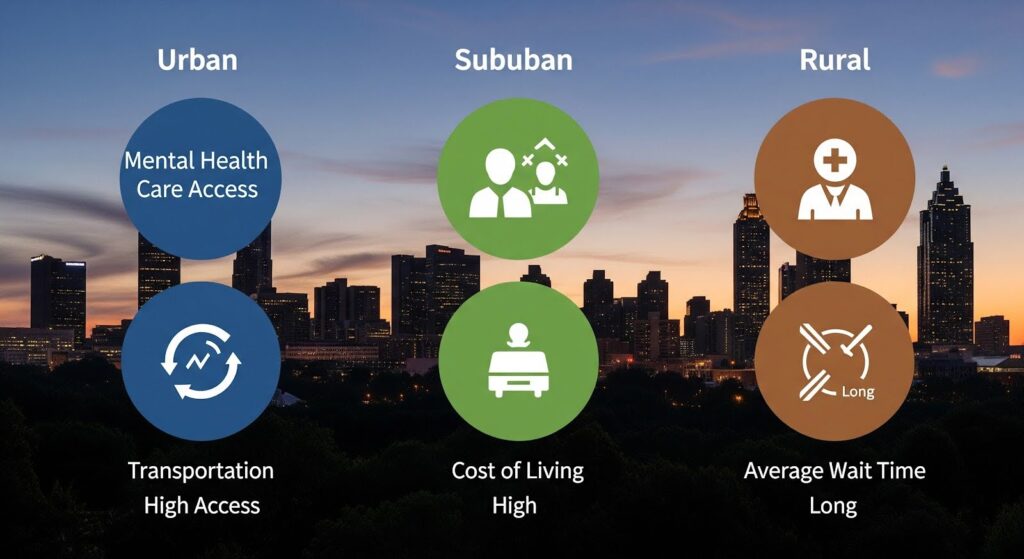
| Access Dimension | Urban Core | Suburban Metro | Rural Georgia |
| Crisis access (988/GCAL) | 24/7/365 statewide; highest call volumes; fast answer targets | Same statewide system; moderate mobile response times | Same statewide access; longer mobile dispatch; distance to CSUs |
| Outpatient utilization | Highest use and visit counts among privately insured | Intermediate; network growth lags population | Lower use; fewer visits; higher primary care reliance |
| Specialist density | Greatest concentration; multidisciplinary teams | Many specialists but corridor gaps | Persistent workforce shortages |
| Telepsychiatry supply | Multiple local providers; 48-hour or same/next-day access | Accessible; expands in-network options | Essential for distance; audio-only critical |
| Safety-net (FQHC) | Large integrated centers | Expanding suburban coverage | Critical backbone; BH integration rising |
| Key bottleneck | ED boarding; inpatient psych bed limits | Capacity lag vs demand; specialist wait times | Distance; transport burden; fewer local resources |
This table synthesizes utilization patterns, workforce distribution, and infrastructure strength documented across state administrative data, employer-sponsored insurance claims, and federal shortage designations.
Telehealth as the Access Equalizer
Telehealth has emerged as the most scalable lever to narrow geographic disparities. Atlanta-area telepsychiatry practices now offer initiation within 48 hours, with some providing same-day or next-day appointments across Georgia and neighboring states. These services use HIPAA-compliant platforms and integrate with insurance networks, reducing the multi-month specialist waits that plague suburban growth corridors and rural counties alike.
Federal policy has sustained this momentum. Medicare telehealth flexibilities maintained through September 30, 2025 waive in-person visit requirements within six months of initiation and annually thereafter, and permit audio-only services when patients cannot or will not use video. For FQHCs and Rural Health Clinics, the in-person requirement delay extends to January 1, 2026. These allowances matter deeply for older adults, those with limited broadband, and rural residents where connectivity remains inconsistent.
Hospital-led digital networks scale specialty access into rural communities. Wellstar’s Digital Care Network and Rural Hospital Virtual Care Network partner with 16 hospitals to deliver subspecialty services including cardiology, stroke, pediatrics, and behavioral health, enabling care closer to home and helping more than 2,000 patients receive local treatment. Community telehealth partnerships provide 24/7 access to primary care and mental health counselors, enroll thousands of patients, and address social needs alongside clinical care.
Telepsychiatry practices explicitly serving Georgia highlight rapid access as a competitive differentiator. While practice websites are not peer-reviewed sources, they demonstrate supply-side innovation that benefits suburban and rural patients facing long waits for in-person psychiatry. Integration with referral platforms and managed care networks expands in-network access for commercially insured patients, a critical step to reduce out-of-pocket burdens that disproportionately affect rural users.
Socioeconomic Layers and Payer Accountability
Geographic differences in mental health access intersect with socioeconomic factors. Georgia’s Medicaid managed care program enrolls more than 1.59 million members as of July 2025, with accountability mechanisms including managed care organization annual reports, encounter data reporting, and external quality review. NCQA-accredited CMOs are expected to maintain network adequacy across regions and professions, with performance improvement projects targeting behavioral health availability where gaps persist.
External Quality Review Organizations validate performance measures, network access, and encounter data, producing Annual Technical Reports that analyze access and availability. While Georgia-specific EQR documents were not provided, multistate examples demonstrate contemporaneous methods for validating network adequacy and performance improvement projects. These oversight tools can embed geographic equity metrics such as time from 988 contact to outpatient first appointment by region, mobile crisis response times by density, and post-crisis engagement rates at day seven and day 30 by urban, suburban, and rural classification.
Parity enforcement through managed care contracts and EQR-led validation would accelerate convergence in access outcomes. Requiring CMOs to report mental health network adequacy by region and profession, and implementing performance improvement projects in suburban growth corridors and rural health professional shortage areas with targeted incentives for recruitment, retention, and telehealth adoption, translates policy into measurable improvement.
Social determinants of health compound access barriers. The state’s 2022 homeless count identified a 40 percent increase from 2019, with two-thirds unsheltered. Crisis walk-in access, mobile response, warmlines, and peer support through the GCAL/988 continuum provide critical entry points for individuals experiencing homelessness, who concentrate in urban cores but also appear in suburban and rural counties. FQHC data show expanding services to homeless populations, and hospital-community telehealth initiatives add after-hours capacity and social determinant navigation.

What Urban, Suburban, and Rural Differences Mean?
The data tell a clear story: Georgia’s crisis continuum flattens geographic barriers for immediate behavioral health access, yet persistent rural-urban disparities in outpatient utilization reflect deeper structural issues around workforce distribution, narrower provider networks, higher relative out-of-pocket burdens, and greater reliance on primary care in rural settings. Suburban corridors show intermediate patterns and face latent scarcity where numeric provider counts lag population growth and network participation.
Telehealth and hospital digital networks are material mitigators but require deliberate payer alignment, parity enforcement, and workforce incentives to sustain and scale. The most efficient path to narrowing access gaps fuses crisis continuum strengths with routine outpatient capacity-building operationally through GCAL/988 warm handoffs to primary care and telepsychiatry, financially via managed care parity and targeted incentives in shortage areas, and digitally via continued investment in bed registries, referral platforms, and community telehealth hubs.
Suburban bridge zones surrounding Atlanta should be explicit targets for next-level access interventions. Bolstering capacity there will unburden the urban core and reduce the length and cost of rural travel to care. Given the data and governance capacity demonstrated by real-time dashboards and Medicaid managed care transparency, Georgia is well positioned to establish geographic equity key performance indicators that embed access parity into contract incentives and validation processes.
The convergence of statewide crisis access, emerging telepsychiatry supply, and federal policy flexibility through 2025 creates a window to institutionalize these gains. Standardizing 988/GCAL warm referrals to telepsychiatry partners with 48-hour or same-day capacity, developing shared care protocols where primary care manages common conditions with psychiatric consultative support in rural settings, and preserving audio-only allowances beyond 2025 would lock in structural equity.
Youth and older adults benefit from tailored approaches. Youth-appropriate Crisis Stabilization Units and school-based mental health partnerships through the Apex program detect needs earlier and link to outpatient services. Federal telehealth policies sustaining behavioral care for older adults, especially audio-only allowances for those with limited broadband or devices, matter deeply for connectivity-limited rural regions and less tech-fluent populations across all geographies.
Moving Forward with Equity and Data
Understanding mental health care access data Atlanta requires looking beyond averages to see how infrastructure, utilization, workforce, and policy intersect across urban cores, suburban growth corridors, and rural heartlands. The statewide crisis system provides a strong foundation, but routine outpatient care reveals gaps that telehealth narrows but does not erase. Suburban residents face growing pains as demand outstrips specialist supply, while rural Georgians navigate distance, workforce shortages, and higher cost burdens.
The path forward is clear: align Medicaid managed care contracts with behavioral access key performance indicators, validate through external quality review, target workforce investments using federal shortage intelligence, institutionalize crisis-to-primary-care-to-telepsychiatry linkages, maintain and expand telehealth enabling policies beyond 2025, and expand community telehealth hubs modeled after hospital-community partnerships. These steps translate Georgia’s crisis access excellence into durable outpatient access gains across the Atlanta metro and the state’s rural regions.
If you or someone you care about is navigating mental health challenges across Metro Atlanta’s diverse communities, know that support exists regardless of where you live. The crisis system is there 24/7, telehealth is expanding reach, and treatment programs are working to meet you where you are. Explore Summit’s treatment options that fit your needs and take the next step toward recovery.

