
When severe depression leaves someone immobile, mute, or locked in rigid postures for hours, it’s more than profound sadness.
Catatonic depression is a major depressive episode that meets diagnostic criteria for catatonia, a psychomotor syndrome requiring at least three specific motor and behavioral signs such as stupor, mutism, posturing, or waxy flexibility.
This article explains how to recognize catatonic depression, what causes it, and which treatments offer the fastest, most effective relief.
Understanding Catatonic Depression
Catatonic depression occurs when a major depressive episode is accompanied by catatonia, a severe motor and behavioral syndrome.
Modern diagnostic systems, including DSM-5-TR and ICD-11, define catatonia as the presence of three or more characteristic signs from a list that includes stupor, catalepsy, waxy flexibility, mutism, negativism, posturing, mannerisms, stereotypy, agitation not influenced by external stimuli, grimacing, echolalia, and echopraxia.
Both systems now recognize catatonia across psychiatric and medical conditions, ending the historical restriction of catatonia to schizophrenia.
The Bush–Francis Catatonia Rating Scale provides standardized definitions and severity anchors for catatonic signs, making bedside assessment more reliable. For example, pathological staring is graded by duration: repeated brief gazes under 20 seconds score 1, gaze held more than 20 seconds with occasional shifting scores 2, and fixed non-reactive gaze scores 3.
Posturing is similarly timed: holding a posture under one minute scores 1, over one minute but under 15 minutes scores 2, and 15 minutes or more or bizarre posture scores 3.
ICD-11 provides explicit guidance to separate catatonia from overlapping constructs. Psychomotor retardation in depression generally exhibits global slowing without sustained posturing, waxy flexibility, echophenomena, or marked negativism.
Delirium features fluctuating consciousness and attention deficits that predominate, whereas catatonia presents with preserved arousal and fixed motor signs.
Catatonic Depression Symptoms
The psychomotor disturbance in catatonic depression goes beyond the slowed movement and speech typically labeled psychomotor retardation in melancholic depression.
Distinguishing features include quantified mutism, negativism, stupor, posturing or catalepsy, and pathognomonic phenomena such as echolalia, echopraxia, stereotypies, mannerisms, and grimacing.
Core Catatonic Signs
- Stupor: Absence of psychomotor activity; not interacting with environment
- Mutism: Near or complete absence of verbal output despite wakefulness
- Negativism: Active or passive resistance to instruction or repositioning
- Posturing and catalepsy: Sustained posture against gravity; maintenance of imposed posture
- Waxy flexibility: Allowing an examiner to place a limb in a position and maintaining it passively
- Echophenomena: Repeating others’ speech (echolalia) or mimicking gestures (echopraxia)
- Stereotypies: Repetitive, non-goal-directed movements
- Non-reactive staring: Fixed gaze with defined durations per standardized scales
In one descriptive study of 135 inpatients, catatonia prevalence was 11.9%, with the Bush–Francis scale demonstrating higher inter-rater reliability and diagnostic pickup compared with DSM-5 criteria alone.
Among psychiatric inpatients, roughly 43% of catatonia cases are associated with bipolar disorder and approximately 30% with schizophrenia, emphasizing catatonia’s strong mood disorder linkage.
How Catatonic Depression Differs from Other Depressive Subtypes?
Catatonic depression is distinguished from melancholic, atypical, psychotic, and agitated depression by the presence of at least three catatonic signs measured with standardized methods.
Melancholic depression features psychomotor retardation or agitation without sustained posturing or catalepsy. Atypical depression shows variable psychomotor activity, often with reactive mood and leaden paralysis. Psychotic depression may include psychomotor changes but not typically catalepsy or posturing unless catatonia is also present.
Agitated depression involves prominent pacing and goal-directed restlessness, not the purposeless agitation or sustained immobility seen in catatonia.
Catatonia remains frequently underrecognized in medical and psychiatric settings. In one retrospective medical inpatient sample using DSM-5 criteria, more than half of catatonia cases were initially missed.
The presence of agitation, grimacing, or echolalia paradoxically increased the odds of underdiagnosis, perhaps due to attribution to delirium or behavioral disturbance rather than catatonia.
What Causes Catatonic Depression?
Modern models conceptualize catatonia, including catatonic depression, as network-level dysregulation of cortico–striato–thalamo–cortical circuits modulated by GABA, dopamine, and glutamate.
The robust and often rapid response to benzodiazepines and electroconvulsive therapy supports central roles for GABAergic deficits and network-level resetting.
Neurotransmitter Dysfunction
Lorazepam’s rapid action in many cases suggests that insufficient GABA-A receptor–mediated inhibition underlies motor and behavioral dysregulation in catatonia.
Dopamine D2 receptor blockade precipitates neuroleptic malignant syndrome, a hyperthermic–rigid–autonomic syndrome that overlaps clinically and biochemically with malignant catatonia, highlighting dopaminergic hypofunction’s capacity to produce catatonic features.
The therapeutic signal for NMDA receptor antagonists such as amantadine and memantine in refractory catatonia suggests that excess glutamatergic tone through NMDA receptors may contribute to catatonic motor–behavioral pathophysiology.
Functional neuroimaging shows decreased activation in contralateral motor cortex and reduced regional cerebral blood flow in right frontoparietal cortex during catatonic states. Decreased GABA-A receptor density in sensorimotor and parietal cortices has been reported.
These abnormalities map to psychomotor circuitry rather than mood circuitry per se, consistent with catatonia as a psychomotor syndrome superimposed on depression.
Autoimmune and Inflammatory Causes
Since 2007, more than 500 cases of anti-NMDA receptor encephalitis have been described, often presenting with prominent psychiatric symptoms including psychosis and catatonia, autonomic instability, seizures or dyskinesias, memory deficits, and mild lymphocytic cerebrospinal fluid pleocytosis.
Young females, tumor associations such as ovarian teratoma, and dyskinesias or seizures are red flags. Diagnosis hinges on serum or CSF anti-NMDAR antibodies. Anti-NMDAR encephalitis can produce malignant catatonia or mimic neuroleptic malignant syndrome.
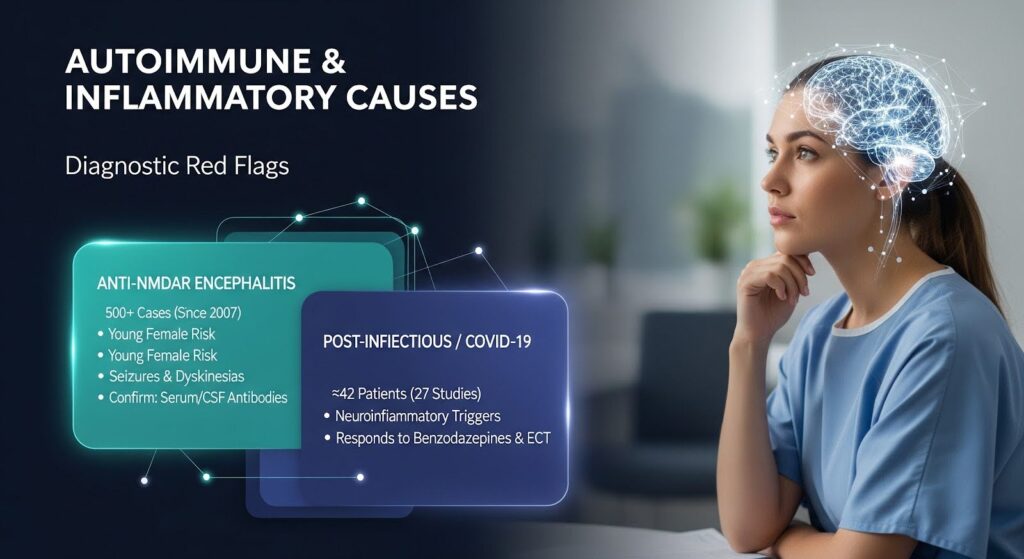
Case-based evidence and scoping reviews document catatonia during and after COVID-19, including malignant catatonia and catatonia–delirium overlaps.
Mechanisms may involve CNS immune activation and cytokine cascades. One scoping review identified approximately 42 patients across 27 included studies, with evidence highlighting neuroinflammatory precipitants and responsiveness to benzodiazepines or electroconvulsive therapy.
Medication-Induced Catatonia
Any antipsychotic, typical or atypical, can precipitate neuroleptic malignant syndrome, a rare but life-threatening condition presenting with rigidity, hyperthermia, autonomic instability, leukocytosis, and elevated creatine phosphokinase.
Catatonia and neuroleptic malignant syndrome share overlapping features and may coexist. Abrupt clozapine withdrawal can also induce catatonia, sometimes resolved by reintroduction.
Catatonic Depression Treatment
Consensus across major guidelines converges on benzodiazepines and electroconvulsive therapy as foundational, first-line treatments for catatonia, including catatonic depression.
The phenomenology and neurobiology of catatonia support treating catatonic depression as depression plus a psychomotor syndrome that often responds to GABAergic augmentation and circuit-modulating therapies, not primarily antidepressants or antipsychotics.
Benzodiazepines: First-Line Treatment
Lorazepam is the immediate first-line treatment. Many patients show rapid improvement after a diagnostic challenge of 1 to 2 mg intravenous, intramuscular, or oral lorazepam, followed by scheduled dosing often ranging from 6 to 16 mg per day.
Response rates in Western cohorts range from 66% to near 100% across catatonia, though chronic catatonia and schizophrenia-associated catatonia respond less robustly. In older adults, lower doses may suffice. If no meaningful improvement occurs within approximately five days at adequate doses, escalate to electroconvulsive therapy.
Electroconvulsive Therapy: Definitive Treatment
Electroconvulsive therapy is definitive and life-saving, with response rates of 80 to 100% across catatonia, including catatonic depression. Indications for immediate electroconvulsive therapy, bypassing prolonged benzodiazepine trials, include malignant catatonia, severe malnutrition from food refusal, excited catatonia with dangerous agitation, and rapid clinical deterioration.
In practice, many catatonic depression cases benefit from early electroconvulsive therapy if benzodiazepines do not promptly reverse core signs.
NMDA Antagonists and Other Options
When catatonia is refractory to lorazepam and electroconvulsive therapy, consider NMDA receptor antagonists such as amantadine or memantine. Emerging case reports and small series show memantine can resolve catatonia after electroconvulsive therapy nonresponse, including in schizophrenia and major depressive disorder.
Case series also document memantine-responsive catatonia due to medical causes such as stroke and hyponatremia, with relapse upon discontinuation and re-response upon re-initiation, suggesting a glutamatergic contribution and potential for maintenance in select cases.
Zolpidem, a GABA-A positive allosteric modulator with distinct receptor subtype affinities, is sometimes effective when lorazepam response is inadequate.
Additional adjuncts with limited evidence include dopamine agonists or precursors, anticonvulsants, and noninvasive neuromodulation such as transcranial direct current stimulation or repetitive transcranial magnetic stimulation.
Antipsychotics: Use with Caution
Avoid typical antipsychotics acutely in catatonia because of risks of worsening catatonia and precipitating neuroleptic malignant syndrome. If psychosis persists after catatonia resolves, cautious introduction of an atypical antipsychotic may be considered, monitoring for recurrence of catatonic signs.
A 2025 systematic review of 175 trials found antipsychotics were reported as beneficial in 60.0%, neutral in 29.1%, and harmful in 10.9% of cases, with amisulpride, clozapine, and risperidone tending toward beneficial reports, while haloperidol and quetiapine had more detrimental outcomes.
Complications and Why Early Recognition Matters?
Catatonia incurs risks of dehydration, malnutrition, pressure ulcers, deep venous thrombosis and embolism, aspiration pneumonia, rhabdomyolysis, renal failure, and malignant catatonia with autonomic instability.
These outcomes are not typical of non-catatonic depression or less severe psychomotor retardation. Early recognition and specific treatment markedly reduce morbidity and mortality.
Malignant catatonia presents with catatonic features accompanied by autonomic instability, hyperthermia, and clouded consciousness.
Labs often show creatine phosphokinase elevation and leukocytosis. High mortality without rapid intervention makes electroconvulsive therapy life-saving, with high-dose benzodiazepines also beneficial.
Differential Diagnosis: Ruling Out Other Conditions
Timely differentiation among malignant catatonia, neuroleptic malignant syndrome, and autoimmune encephalitis avoids catastrophic management errors. Malignant catatonia is triggered by severe psychiatric or medical illness, sometimes antipsychotics.
Neuroleptic malignant syndrome classically follows dopamine antagonist exposure or abrupt dopamine withdrawal. Anti-NMDAR encephalitis often has a paraneoplastic association, particularly ovarian teratoma in young women, and requires immunotherapy alongside symptomatic catatonia care.
When febrile catatonia is suspected, cerebrospinal fluid analysis with neuronal autoantibodies may be necessary to exclude encephalitides. Electroencephalography and neuroimaging assist with differential diagnoses such as non-convulsive status epilepticus and structural causes.
Non-convulsive status epilepticus can present with DSM-5 catatonia features, particularly with frontal lobe seizures. Routine electroencephalography may be normal; therefore, high-suspicion cases warrant continuous video electroencephalography, sleep-deprived electroencephalography, or, rarely, nasopharyngeal leads.
Special Populations
Older Adults
Catatonia in older adults often presents with greater predominance of immobility or stupor, staring gaze, rigidity, mutism, withdrawal, posturing, and negativism. These features can be mistaken for severe depression or dementia-related apathy without a structured catatonia exam.
Older adults often respond to lower benzodiazepine doses. Electroconvulsive therapy remains effective and is recommended for nonresponders to benzodiazepines. Vigilance for medical etiologies such as infection and electrolyte disturbances is essential.
Perinatal Catatonic Depression
Electroconvulsive therapy is a viable, often preferred choice to rapidly reverse catatonia and stabilize maternal–fetal health. Lorazepam safety is comparatively favorable but individualized, multidisciplinary planning involving psychiatry, obstetrics, and anesthesia is essential.
A Practical Treatment Algorithm
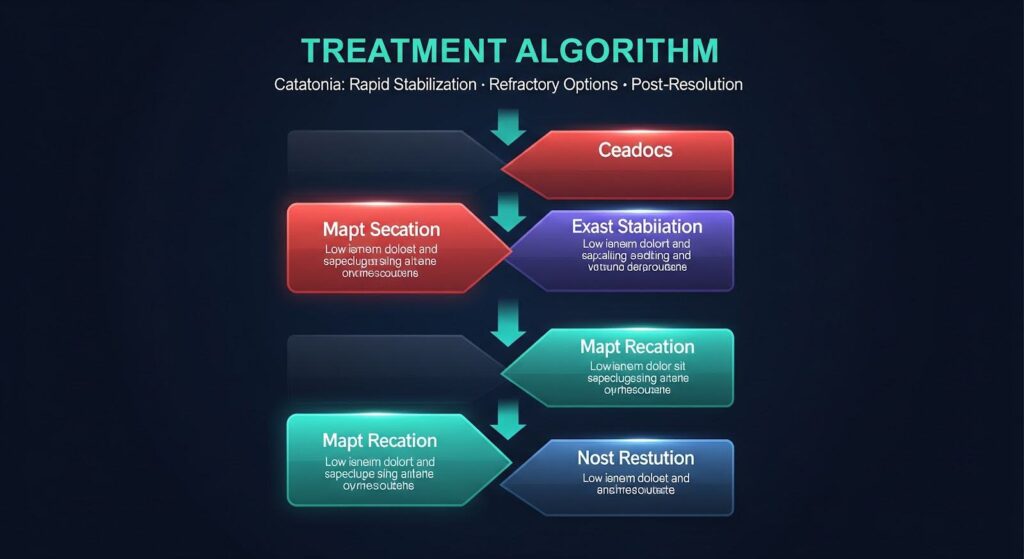
Immediate steps include confirming three or more catatonia signs via the Bush–Francis Catatonia Rating Scale, hydrating the patient, preventing deep venous thrombosis, and initiating a lorazepam challenge with scheduled dosing.
If partial or no response occurs within approximately five days, or earlier if malignant or severe features are present, initiate electroconvulsive therapy. Consider bilateral placement for speed in critical cases.
For refractory cases or when electroconvulsive therapy is unavailable, consider memantine or amantadine. Evaluate for seizure mimics such as non-convulsive status epilepticus if presentation is atypical.
After catatonia resolution, re-evaluate the depressive syndrome, optimize antidepressant or mood stabilizer regimens, and consider cautious antipsychotic use only if psychosis persists.
When to Seek Professional Help?
Catatonic depression is a medical and psychiatric emergency. If you or someone you know shows signs of immobility, mutism, sustained odd postures, or marked resistance to movement alongside depressive symptoms, immediate evaluation is critical.
Structured assessment using standardized tools, rapid stabilization, and etiology-oriented evaluation can prevent life-threatening complications.
Recovery from catatonic depression is possible with prompt, appropriate treatment. Benzodiazepines and electroconvulsive therapy offer the highest probability of rapid, decisive remission and survival in severe catatonia.
If you’re struggling with severe depression or catatonic symptoms, reach out to Summit Mental Health’s professionals who can provide comprehensive assessment and evidence-based care.
