
Depression doesn’t follow a neat emotional script. Many people search for “five stages of depression” expecting a roadmap like the stages of grief, but that model was never meant for depression and can actually delay the help you need.
The real progression of major depressive disorder moves through measurable clinical phases, from early warning signs to acute episodes, treatment response, remission, and ongoing relapse prevention, each requiring different actions to prevent worsening and restore function.
This article explains the evidence‑based stages of depression, how to recognize where you are, and what to do next at each phase.
What Are the Stages of Depression?
Depression unfolds as a dynamic clinical course, not a fixed emotional sequence. Psychiatry uses a standardized framework to describe the progression: prodrome (early subclinical symptoms), acute major depressive episode, treatment response, remission (partial or full), recovery, and maintenance with relapse or recurrence risk.
These stages are measurable with validated tools like the PHQ‑9 screening questionnaire and carry different prognostic risks and recommended interventions.
The popular “five stages” borrowed from grief, denial, anger, bargaining, depression, acceptance, were never intended as a depression framework. Applying that template can pressure people to conform to a “correct” emotional sequence, conflate grief with depressive disorder, and neglect the core prognostic targets: residual symptoms and functional impairment.
Research shows that residual subthreshold symptoms triple the odds of early relapse and accelerate time to recurrence, making their elimination the single strongest modifiable predictor of long‑term stability.
A more accurate five‑stage model aligns with clinical course terminology and emphasizes function‑first goals, proactive symptom elimination, and ongoing digital relapse surveillance.
Stage 1: Prodrome and Subclinical Depression
What It Looks Like
Prodromal depression appears as subthreshold symptoms, low mood on some days, anhedonia that comes and goes, fatigue, difficulty initiating sleep, irritability, reduced social engagement, and diminished drive, but not yet meeting full diagnostic criteria.
You might notice fewer than five symptoms or duration short of two weeks. Function erodes subtly: work or school performance dips, weekend routines fall apart first, exercise and hobby routines fade.
Sleep and circadian patterns often shift. Inconsistent bed and wake times, weekend drift, increased variability, and longer time to fall asleep are especially notable in youth at higher risk of chronic or relapsing courses.
Objective actigraphy measures show day‑to‑day sleep phase variability and reduced amplitude of daytime activity in people at elevated risk.
Why This Stage Matters
Subclinical depression is not “nothing.” It carries significant functional impairment and doubles the risk of developing a full major depressive episode, making it a prime prevention target.
In older adults and those with familial risk, objective indicators in activity patterns can signal latent vulnerability. The goal in Stage 1 is to prevent transition to Stage 2.
How to Recognize Stage 1
Use standardized screeners like PHQ‑2 or PHQ‑9, or age‑appropriate tools in adolescents. Repeat screening captures trajectory and informs early intervention.
Population guidance from the U.S. Preventive Services Task Force supports screening adolescents and adults with follow‑up plans.
Objective indicators include:
- Actigraphy: day‑to‑day sleep phase variability and reduced amplitude of daytime activity
- Wearables and smartphones: reduced movement, irregular routines, decreased social mobility, altered screen‑use rhythms
- Youth risk profile: female sex, higher baseline severity, suicidal thoughts or behaviors, lower global functioning, and longer sleep‑onset latency predict relapsing or chronic courses
- Late‑life profile: cognitive impairment may precede or co‑occur with depression via neurodegenerative mechanisms
What to Do in Stage 1
Implement measurement‑based monitoring by re‑administering PHQ‑9 every four to eight weeks and tracking functioning using the Sheehan Disability Scale or role performance indicators.
Address sleep and circadian hygiene with consistent bed and wake times, limited weekend drift, morning light exposure, and moderate afternoon or evening stimulant use. Objective tracking with actigraphy or wearables can help.
Early psychosocial interventions include behavioral activation, brief cognitive behavioral therapy for sleep, stress reduction, and problem‑solving therapy. Escalate if symptoms persist or worsen, functional impairment grows, suicidality emerges, or objective markers deteriorate.
Stage 2: Acute Major Depressive Episode
What It Looks Like
An acute major depressive episode meets diagnostic criteria: at least five symptoms for at least two weeks with distress or impairment.
Symptoms include depressed mood, anhedonia, sleep disturbance (insomnia or hypersomnia), psychomotor changes, fatigue, impaired concentration, feelings of worthlessness or guilt, appetite or weight changes, and suicidal ideation or behavior.
Function shows marked impairment, missed work or school, social withdrawal, lost role functioning, reduced self‑care. Special features may include psychotic features in a subset, severe suicidality, catatonia (rare), peripartum or postpartum contexts, and late‑life cognitive overlap.
How to Recognize and Measure Stage 2
Diagnostic confirmation uses structured or semi‑structured interviews where feasible, or validated clinician assessment plus standardized symptom rating such as PHQ‑9, HAMD‑17, or MADRS.
Functional assessment with the Sheehan Disability Scale or equivalent highlights that symptomatic remission does not guarantee functional recovery.
Risk stratification addresses suicidality, psychosis, comorbidities, substance use, medical contributors, and social determinants.
Age‑tailored flags include tracking sleep‑onset latency, suicidal thoughts or behaviors, and impairment in youth, and cognitive screening (memory and executive tests) and neurodegenerative signs in late life.
Treat to Target
First‑line treatments include evidence‑based antidepressants, psychotherapy such as cognitive behavioral therapy or interpersonal therapy, or combined treatment if moderate to severe.
Address comorbidities, implement safety planning, and use collaborative care models to improve remission and recovery.
Set functional targets from day one. Explicitly plan for functional recovery, not just symptom remission, by setting role‑based goals and activities.
For severe or urgent cases, rapid‑acting options include intravenous ketamine or intranasal esketamine. Both provide rapid symptom reduction and can serve as bridges while standard treatments take effect.
A 2025 meta‑analysis of observational studies found no significant difference in response or remission between the two, with point estimates nonsignificantly favoring IV ketamine. Real‑world cohorts report similar response and remission but potentially faster time to remission with IV ketamine.
Safety and tolerability profiles show common, transient adverse effects, dissociation, dizziness, blood pressure increases, for both, with no significant difference in serious adverse events.
Choice should be individualized: IV ketamine when rapid relief or short‑term bridging is needed and infusion monitoring is feasible and affordable; intranasal esketamine when REMS‑certified care, insurance coverage, and needle‑free delivery are priorities.
Stage 3: Treatment Response
What It Looks Like
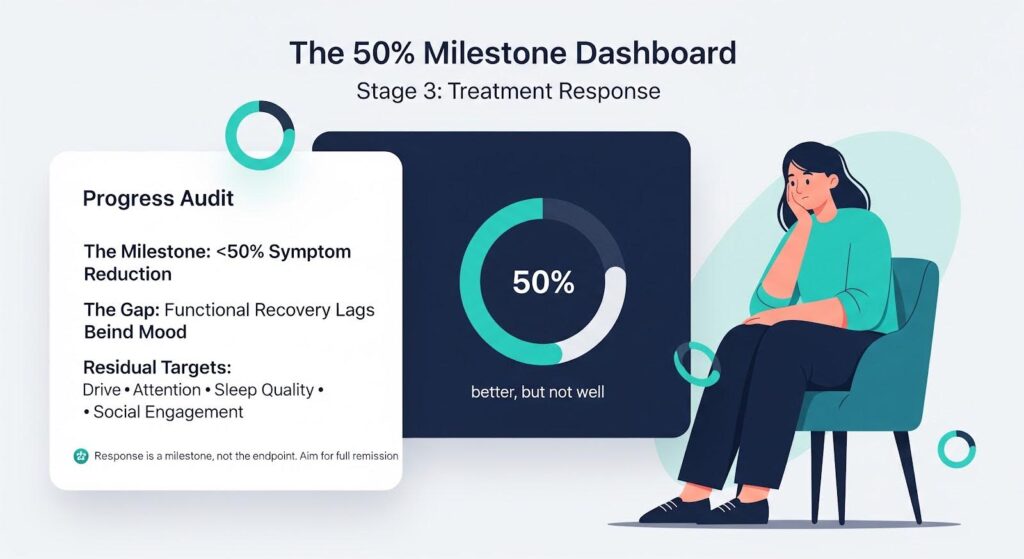
Treatment response means approximately 50 percent reduction in depressive symptom severity. The lived experience is often “I’m better, but not well.”
Energy improves and crying spells decrease, but drive, attention, sleep quality, or social engagement remain impaired. Functional recovery often lags behind symptom changes.
Why This Stage Matters
Response is a milestone, not an endpoint. Patients who plateau at “response” are often still meeting diagnostic criteria or have residual symptoms.
Without specific action, they are at higher risk of relapse and persistent functional disability. The treatment plan must aim beyond response to full remission and recovery.
Recognizing Stage 3
Re‑assess with the same standardized symptom scale used at baseline (PHQ‑9, HAMD‑17, or MADRS) to confirm approximately 50 percent reduction.
Measure function with the Sheehan Disability Scale to detect lagging role recovery. Monitor sleep, circadian regularity, and activity with actigraphy or wearables; early improvements predict trajectory, while persistent irregularity flags elevated risk.
What to Do in Stage 3
Optimize antidepressant dosing and duration. Consider augmentation or switching based on side effect profile and partial response.
Target residuals explicitly and introduce skills‑based psychotherapy to consolidate gains and address cognitive or behavioral patterns maintaining symptoms.
Maintain momentum by scheduling follow‑ups, engaging caregivers or peers with permission, and using digital tools to sustain activity and sleep routines.
For treatment‑resistant cases benefiting from rapid‑acting agents, plan transition from induction to maintenance strategies while building durable remission with standard therapies.
Stage 4: Remission and Recovery
Definitions That Matter
Partial remission means no longer meeting full diagnostic criteria, but residual symptoms persist, sleep disturbance, low energy, concentration difficulties, or anhedonia. Full remission means minimal or asymptomatic. Recovery is sustained remission for at least six months.
These distinctions are not semantics. In a seminal prospective study, patients who “recovered” with residual, subthreshold symptoms relapsed three to five times faster than those who reached asymptomatic recovery (median 33 versus 184 weeks to any depressive episode). Residual symptoms function as an active illness state; eliminating them is a key target.
Functional Recovery: The Often‑Missed Goal
Even after symptom remission, psychosocial functioning frequently remains impaired. Work productivity, social connections, and quality of life may lag behind mood improvements.
Early definitions of recovery did not require functional recovery; contemporary practice should. Trials should adopt functional outcomes as co‑primaries, and clinicians should plan for role restoration.
In late life, cognitive impairment may precede or accompany depression due to neurodegenerative processes. Even after mood remission, cognitive and functional vulnerabilities can persist and shape recurrence risk.
Cognitive assessment and pro‑cognitive strategies, behavioral, rehabilitation, and emerging pharmacological approaches, may be needed to achieve true recovery.
Recognizing Stage 4 and Acting Decisively
Assess for residual symptoms: sleep, anhedonia, cognitive complaints, and fatigue commonly linger and predict relapse. Measure functioning with the Sheehan Disability Scale and role performance (return to work or school, social participation).
Intervene on residuals with cognitive behavioral therapy for insomnia, behavioral activation for anhedonia, cognitive remediation or compensation strategies, exercise prescriptions, and social rhythm therapies.
Maintain pharmacotherapy or psychotherapy to consolidate recovery (at least six to twelve months or longer based on history and risk). Tapering should be a strategic, monitored decision with a relapse plan in place.
Stage 5: Maintenance and Recurrence Prevention
The Reality of Recurrence
In midlife clinical samples, the median time to recurrence after response is approximately 2.8 years. Fewer than 40 percent maintain remission for five years, and over 15 years, up to 85 percent may experience recurrence. Recurrence risk remains even after long remissions.
Relapse is a return to major depressive episode within the first six months post‑remission. Recurrence is a new episode after achieving recovery (at least six months).
Predictors to Watch
Residual symptoms at “recovery” triple the odds of early relapse and accelerate time to recurrence; eliminating residuals is the single strongest, modifiable predictor.
In youth, female sex, higher baseline severity, suicidal thoughts or behaviors, lower functioning, and longer sleep‑onset latency warrant tailored monitoring and prevention intensity. In late life, co‑occurring cognitive impairment implies distinct mechanisms and higher recurrence risk; incorporate cognitive monitoring and dementia risk reduction.
Objective, Ecological Monitoring
Higher day‑to‑day variability in sleep timing and lower daytime activity amplitude associate with relapse. Consider long‑term wearable monitoring to detect early deviations from personal baselines.
Passive smartphone and wearable data, mobility, sleep, communication patterns, and machine learning can forecast symptom changes and flag increased risk, though clinical translation is growing and requires careful validation and privacy safeguards.
Maintenance Strategies
Continue effective treatments at therapeutic doses for adequate duration (often six to twenty‑four months or longer depending on history and risk).
Combine with psychotherapy focused on relapse prevention. Maintain routines, social roles, exercise, and sleep regularity; schedule protection around known stressors.
Build individual early warning sign lists from symptom diaries and actigraphy or sensor trends. Pre‑authorize action plans such as calling a clinician, brief medication adjustment, or intensifying therapy.
If tapering, do so slowly with monitoring of symptoms, function, and sleep or activity metrics, and have a rapid re‑initiation plan in case of relapse signals.
How Many Stages of Depression Are There?
The evidence‑based model presented here defines five pragmatic stages that align with clinical course terminology and translate into recognition and action steps:
1. Prodrome and Subclinical Depression
2. Acute Major Depressive Episode
3. Treatment Response
4. Remission and Recovery (with a crucial split: partial versus full remission and functional recovery)
5. Maintenance and Recurrence Prevention (including recognizing relapse versus recurrence)
This is not a rigid sequence. People may move forward or backward, or linger at boundaries. But each stage is measurable, carries differential risk, and prescribes different, evidence‑informed next steps.
Stages of Depression in Order: A Quick Reference
| Stage | What to Recognize | What to Do Next |
|---|---|---|
| 1. Prodrome/Subclinical | Subthreshold symptoms; sleep timing changes; reduced activity and engagement | Screen, monitor; address sleep; early psychosocial interventions; watch risk markers |
| 2. Acute MDE | At least five symptoms for at least two weeks, marked functional impairment, suicidality risk | Diagnostic confirmation; urgency‑based treatment; consider rapid‑acting options if severe |
| 3. Response | Approximately 50 percent symptom reduction; still meeting some criteria | Optimize or augment treatment; plan next steps to eliminate residual symptoms |
| 4. Remission/Recovery | Partial: residual symptoms persist; Full: minimal or asymptomatic; Function may lag | Target residuals; prioritize functional recovery; psychotherapy; continue treatment to consolidate |
| 5. Maintenance & Recurrence Prevention | Stable remission at least six months; relapse or recurrence risk persists | Ongoing monitoring; relapse‑prevention plan; digital or wearable signals; taper decisions cautiously |
Special Populations and Overlapping Conditions
Youth: High‑Risk Signals and Trajectories
Predictors of relapsing, recurrent, or chronic course in youth include female sex, greater baseline severity, suicidal thoughts or behaviors, lower global functioning, and longer sleep‑onset latency, consistent across 46 cohorts.
These should trigger early, intensive, developmentally attuned interventions, caregiver involvement, school accommodations, and tight monitoring of sleep and function.
Late‑Life Depression: Cognitive Heterogeneity and Recurrence
Late‑life depression is heterogeneous. Cognitive impairment may precede or drive depression via neurodegenerative pathways or co‑occur as part of a major neurocognitive disorder trajectory.
This implies different mechanisms and recurrence profiles compared with midlife major depressive disorder. Measure cognition at baseline and throughout care, embed pro‑cognitive strategies, and consider transdiagnostic approaches.
Grief Versus Depression
Prolonged grief disorder is distinct from major depressive disorder and PTSD. It is a valid, unidimensional syndrome with reliable measures.
Using validated grief assessments when indicated helps avoid labeling grief as depression by default and ensures appropriate treatment. The “stages of grief” are neither universal nor sequential; do not import them to depression care.
How to Recognize Your Stage Now?
Use the following self‑checks and, where possible, standardized measures. If at any point suicidal thoughts or behaviors are present, seek urgent professional help.
Step A: Are you meeting criteria for an acute episode (Stage 2)? Over the past two weeks, do you have at least five depressive symptoms nearly every day (including low mood or anhedonia), with significant impairment? If yes, you are in Stage 2: Acute major depressive episode. If no, proceed to Step B.
Step B: Are you experiencing subthreshold symptoms with meaningful impairment (Stage 1)? Fewer than five symptoms, or duration less than two weeks, but noticeable decline in function, especially on unstructured days; sleep timing variability; longer sleep‑onset latency (especially in youth). If yes, you are in Stage 1: Prodrome or Subclinical; prioritize prevention. If no, proceed to Step C.
Step C: If you are in treatment, have your symptoms improved by approximately 50 percent (Stage 3) or resolved (Stage 4)? Approximately 50 percent reduction but still symptomatic means Stage 3: Response; don’t stop here—optimize. Minimal or asymptomatic for more than two weeks means Remission; if at least six months, Recovery (Stage 4). Residual symptoms present post‑remission means Partial remission with high relapse risk; target residuals.
Step D: Have you maintained remission for at least six months (Stage 5), and do you have a relapse‑prevention plan? If yes, you are in Stage 5: Maintenance; implement objective monitoring (sleep and activity), maintain routines, and keep an action plan. If symptoms return before six months, that is Relapse; return to Stage 2 treatment intensity. If a new episode occurs after recovery, that is Recurrence; reassess and treat as Stage 2, with a refined prevention plan.
Measurement‑based care supports this recognition path. For clinicians, CMS MIPS quality measure 134 tracks screening and timely follow‑up. Repeating validated tools at intervals (for example, at least eight weeks after initiating treatment) informs adjustment and tracks change.
Moving Forward With Clarity and Action
Depression does not unfold in five emotional stages. It unfolds as a dynamic, measurable clinical course punctuated by prodromal changes, acute episodes, early treatment response, remission that may be partial or full, and long maintenance periods where relapse and recurrence remain a real risk.
Replacing the “five stages of grief” narrative with this five‑stage course‑and‑function model offers a more honest, humane, and actionable way to know where you are, and, crucially, what to do next to prevent depression from reclaiming your life. Make residual symptom elimination and functional recovery co‑equal to symptom remission.
Embed objective sleep, circadian, and activity monitoring into prevention and maintenance, pairing data with predefined action plans. Tailor strategies by age: address sleep‑onset latency and suicidality promptly in youth; incorporate cognitive evaluation and pro‑cognitive care in late‑life depression.
If you or someone you care about is navigating any stage of depression, you don’t have to do it alone. Reach out to Summit Mental Health’s professionals who can provide individualized, evidence‑based care and support your path to recovery.

