
Many people struggling with inner conflict describe feeling pulled in opposite directions. One part wants to open up, while another shuts down.
One part pushes for perfection, while another collapses in exhaustion. Parts work therapy treats these contradictions not as confusion but as meaningful signals from an organized internal system that can be understood and healed.
Parts work is a therapeutic approach that views the mind as naturally composed of multiple internal parts, each carrying distinct emotions, memories, and protective roles. The most widely recognized form today is Internal Family Systems, developed by Richard Schwartz in the 1980s, which helps people access a compassionate core Self to heal wounded parts and reduce extreme protective behaviors.
This article explains what parts work therapy is, how it conceptualizes trauma and inner conflict, what happens in actual sessions, and how it supports healing for complex emotional struggles.
What Parts Work Therapy Actually Means?
Parts work therapy refers broadly to therapeutic approaches that engage multiple internal parts or subpersonalities rather than treating the mind as a single unified voice. These approaches assume that different parts can hold different emotions, needs, fears, and memories, often shaped by development, attachment, and trauma.
The goal is not to eliminate inner conflict but to identify, understand, heal, and integrate wounded or polarized parts so a person functions with greater coherence and less suffering.
Several models fall under the parts work umbrella, including Internal Family Systems, Ego State Therapy, Parts Psychology, Voice Dialogue, and psychosynthesis.
While they vary in language and technique, they converge on a key assumption: inner conflict is not necessarily pathology. Rather, it may reflect understandable interactions among internal systems that developed to protect, adapt, and survive.
Why the Parts Idea Resonates?
The reason parts work resonates so strongly is that it maps onto common subjective experience. People routinely say things like “part of me wants to leave, part of me wants to stay” or “I know better, but another part of me keeps doing it.”
Parts work formalizes this phenomenology. Rather than collapsing contradictory impulses into confusion, it treats them as organized internal dynamics that can be explored and transformed.
The Historical Roots of Parts Work
Although Internal Family Systems dominates contemporary public discussion, parts-based therapy predates it by decades. Historical accounts trace roots to psychoanalytic ego state ideas associated with Paul Federn and Edoardo Weiss, later developed into Ego State Therapy by John and Helen Watkins in the 1970s.
This formalized trauma-focused work with internal states combined psychodynamic psychotherapy and hypnotherapy, especially for traumatized clients.
Richard Schwartz developed IFS in the early 1980s while working as a family therapist. He noticed that clients described inner experiences as if different parts of them were in conflict.
Rather than dismissing this as metaphor, he interpreted it systemically: these inner voices resembled patterns of alliance, conflict, and role allocation familiar from family systems therapy. A 2023 peer-reviewed article explicitly describes IFS as emerging from Schwartz’s work as a Structural/Strategic family therapist, anchoring it in a legitimate psychotherapy lineage.
Core Principles of Internal Family Systems
IFS distinguishes between parts and Self. Parts carry reactions, burdens, fears, and strategies. Self is described as an innate, undamaged healing presence characterized by calm, curiosity, clarity, connectedness, confidence, courage, creativity, and compassion.
Healing occurs not when parts are eradicated, but when Self can relate to them, understand them, and eventually lead the system.
The Three Main Categories of Parts
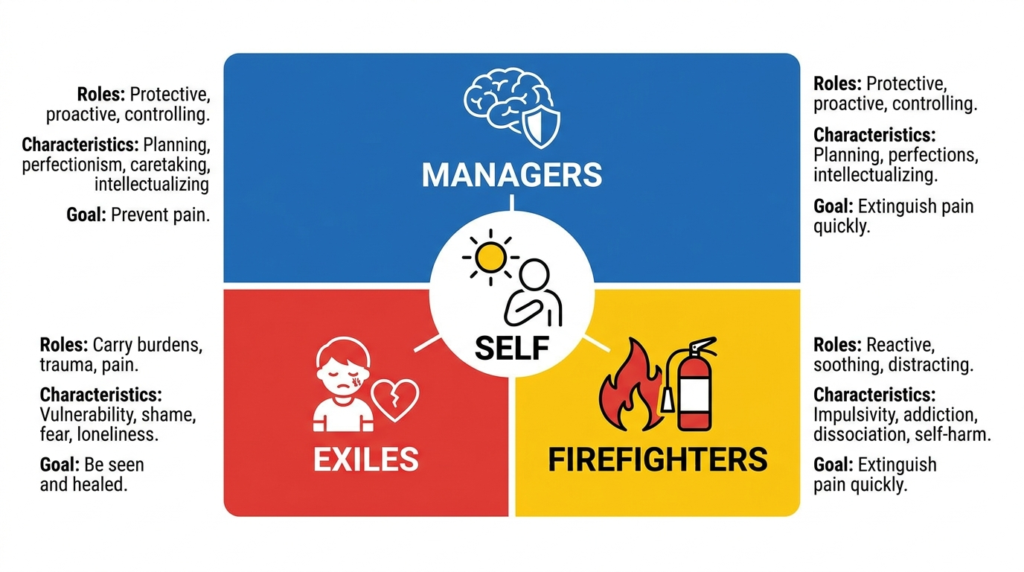
IFS commonly organizes parts into three functional categories:
- Managers are proactive protectors that try to maintain control and prevent vulnerability. They may appear as perfectionism, overthinking, people-pleasing, high achievement, chronic planning, or emotional control.
- Exiles are wounded parts that carry pain, shame, terror, loneliness, grief, unmet needs, or trauma-related burdens. They are often pushed out of awareness because their affect is overwhelming.
- Firefighters are reactive protectors that emerge when exiled pain breaks through. They aim to rapidly extinguish distress, often with impulsive or extreme methods such as dissociation, substance use, rage, binge eating, self-harm, compulsive behaviors, and emotional numbing.
The No Bad Parts Principle
A central IFS principle is “No Bad Parts.” Even disruptive or self-sabotaging parts are understood as trying to protect the person in some way. This does not mean all behavior is healthy or harmless. Rather, it means the behavior is interpreted as a strategy that once made sense within a survival context.
For example, binge eating may protect against intolerable shame, rage may protect against helplessness, dissociation may protect against overwhelm, and self-criticism may protect against rejection by pushing perfection.
Clinical Applications: What Problems Parts Work Addresses?
Trauma and PTSD
IFS is strongly associated with trauma treatment. Many sources frame it as especially relevant for complex trauma, developmental trauma, attachment trauma, dissociative symptoms, and PTSD.
The model’s emphasis on protectors, exiles, pacing, and self-compassion makes it particularly appealing in trauma care. A 2021 pilot effectiveness study of 17 adults with PTSD following multiple childhood traumas showed significant improvements across PTSD and multiple related domains after 16 sessions, though the study was uncontrolled and small.
However, it is equally important to note that IFS is not limited to trauma treatment. It is also used with individuals and partners both with and without trauma histories.
Depression, Anxiety, and Panic
IFS is potentially effective for depression, anxiety, panic, fears, phobias, substance use, and general functioning and well-being.
The IFS Institute notes that multiple studies have demonstrated gains in self-compassion, while statistically significant improvement across multiple pilot RCTs has been shown most clearly for depression.
Substance Use and Compulsive Coping
Firefighter concepts are particularly relevant here. Firefighters attempt to shut down pain rapidly through impulsive or numbing strategies such as substance use, binge eating, rage, dissociation, self-harm, and compulsions.
This framework is clinically intuitive for addiction and relapse cycles because it interprets the addictive behavior as a pain-management strategy rather than simple irrationality.
Relationships, Couples, and Families
IFS is used not only with individuals but also with couples and families. When both partners have more access to Self, they gain greater space to respond rather than react.
The underlying theory is straightforward: internal reactivity spills into external relationships. If a person can recognize “a protector part of me is activated,” interpersonal conflict may become less automatic.
The Research Evidence: What is Actually Supported?
The fairest synthesis of the evidence is this: IFS has emerging empirical support, some pilot studies and small trials show promising results, the overall evidence base remains limited compared with more established treatments like CBT, and popularity currently exceeds guideline-level certainty.
What the IFS Institute Itself Admits?
A highly important source is the IFS Institute’s research page, because it is favorable to IFS yet still concedes limits.
It states that the current body of research is limited in scope and that well-designed randomized controlled trials with replication are required to establish IFS as an evidence-based intervention for specific mental health indications.
It also notes that, to date, reductions in depression are the only mental health condition showing statistically significant improvement across multiple pilot RCTs.
PTSD Evidence
There is promising but still preliminary evidence for PTSD applications. The IFS Institute summarizes a pilot effectiveness study involving 17 adults with PTSD and multiple childhood traumas who received 16 sessions of IFS, showing positive effects on PTSD symptoms and associated outcomes such as depression, dissociation, and affect dysregulation.
There are also more recent group-based and online studies. A 2025 article on an online group-based IFS intervention for comorbid PTSD and substance use notes that early research suggests preliminary efficacy for PTSD and related symptoms, but also explicitly states that no studies had yet established efficacy for IFS groups in treating comorbid PTSD-SUD or substance use disorder alone.
Depression Evidence
Depression appears to be the strongest specific condition area in the available IFS research. The Haddock pilot study is repeatedly cited by research-facing and professional sources as showing significant reductions in depressive symptoms. Even here, however, the evidence is still pilot-level and requires replication in larger samples.
Many people struggling with inner conflict describe feeling pulled in opposite directions. One part wants to open up, while another shuts down.
One part pushes for perfection, while another collapses in exhaustion. Parts work therapy treats these contradictions not as confusion but as meaningful signals from an organized internal system that can be understood and healed.
Parts work is a therapeutic approach that views the mind as naturally composed of multiple internal parts, each carrying distinct emotions, memories, and protective roles. The most widely recognized form today is Internal Family Systems, developed by Richard Schwartz in the 1980s, which helps people access a compassionate core Self to heal wounded parts and reduce extreme protective behaviors.
This article explains what parts work therapy is, how it conceptualizes trauma and inner conflict, what happens in actual sessions, and how it supports healing for complex emotional struggles.
How Parts Work Sessions Actually Unfold?
Parts work is generally more experiential than standard talk therapy. Sessions do not only analyze behavior from a distance; they ask clients to focus directly on an activated part, sense it in the body or mind, and develop a relationship with it.
This often involves noticing bodily sensations, identifying inner voices or images, checking how one feels toward a part, unblending from reactive states, and asking a part what it fears or protects.
A Typical Session Structure
A session often begins by identifying what parts were active recently or what is present in the room right now. The therapist then helps the client focus on one part, separate from it enough to observe it clearly, and notice whether the client is relating from Self or from another reactive part.
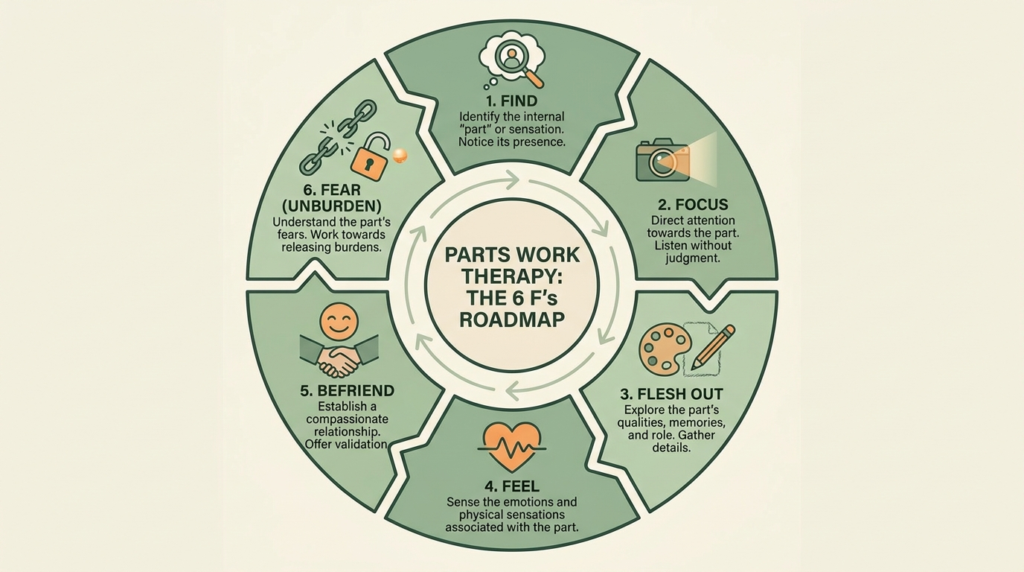
A commonly described roadmap is the 6 F’s: Find a part, Focus on it, Flesh out its qualities, Feel toward it and assess whether Self is present, befriend it, and explore its Fear, what would happen if it stopped its role.
An especially important IFS concept is blending versus unblending. When blended, a part’s feelings and beliefs dominate awareness. When unblended, the person can notice the part without being consumed by it. This creates distance without dissociation. In effect, unblending says: you are not identical to the whole of what you feel in the moment.
How Parts Work Helps Healing?
Reframing Symptoms as Protective Adaptations
One of the most significant healing mechanisms in parts work is reframing symptoms as adaptations rather than moral failures or mere dysfunctions.
If a client’s rage, shutdown, drinking, or relentless self-criticism is understood as a protector rather than “the bad part of me,” shame often decreases and curiosity increases. This shift can be clinically powerful because shame is often itself a barrier to treatment.
Internal Attachment Repair
IFS implicitly functions as an internal attachment model. When Self relates to vulnerable parts with curiosity and compassion, the person experiences an internal corrective relationship.
This is one reason many sources describe parts work as particularly useful for developmental trauma and attachment wounds.
Reduced Internal Polarization
Parts often become polarized. One part may demand achievement while another collapses in exhaustion. One part seeks intimacy while another fears closeness. Healing occurs when each part is understood in context and no longer has to operate in an extreme role. This is a direct extension of family systems logic into the intrapsychic domain.
Trauma Processing Without Immediate Flooding
A widely cited advantage of IFS-informed trauma work is pacing. Protectors are engaged first, and vulnerable exiles are approached only when the system is ready. This allows painful material to be processed without the same degree of abrupt exposure or overwhelm sometimes seen in less titrated trauma work.
The best-supported version of this claim is not that IFS is universally superior, but that its structure may offer a natural safety mechanism for some trauma survivors: protective parts can slow down the work.
Strengths and Limitations of Parts Work
Practical Advantages
Parts work can transform “What is wrong with me?” into “What is this part trying to protect?” For many trauma survivors, reframing is immediately regulated.
Clients with strong ambivalence often find parts mapping far more intuitive than linear problem models. Because IFS can work with aspects of trauma experience without explicit retelling, it may feel safer for clients who cannot yet tolerate direct narrative exposure.
Important Limitations
The most justified criticism is not that parts work is obviously ineffective, but that its research base is still smaller than that of older therapies such as CBT. IFS is more popular than fully proven. That does not make it invalid. It simply means the scientific and public timelines are misaligned.
Parts work can be emotionally intense. Multiple sources warn that unburdening trauma parts or approaching exiles without support may overwhelm the person or escalate protective responses.
Signs self-practice may be inappropriate include severe dissociation, feeling flooded after practice, losing time, suicidal parts, major disruptions in eating, sleep, or basic functioning, and intense childhood trauma activation.
What Well-Conducted Parts Work Looks Like?
The IFS model outline identifies several therapist mistakes and safety principles, including not working with exiles before the system is ready, not mistaking a part for Self, assessing dangerous firefighters, negotiating pace with protectors, respecting the concerns of protective parts, and attending to external context and support constraints. These are not minor details.
They indicate that competent parts work is not just “talking to your parts.” It requires sequencing, pacing, and differential assessment.
Based on the source synthesis, parts work appears especially well-suited for clients who experience strong inner conflict, struggle with shame or self-criticism, have trauma-linked patterns, find internal multiplicity intuitive, want a self-compassionate framework, and have not fully responded to symptom-focused approaches alone.
Why Does It Matter?
Parts work therapy is best understood not as one technique but as a family of psychotherapeutic approaches that treat the mind as naturally multiple.
Its modern mainstream form, Internal Family Systems, arose from Richard Schwartz’s application of family systems principles to intrapsychic life, but the broader field extends back at least to Ego State Therapy and earlier ego state ideas.
Across models, parts work reframes inner conflict as understandable organization rather than defect, and healing as relationship, integration, and internal leadership rather than suppression.
The strongest available conclusion from the present evidence is that parts work, especially IFS, is a clinically meaningful and conceptually coherent framework for inner conflict, trauma-related adaptations, self-criticism, and relational reactivity, but its public reputation currently exceeds the maturity of its research base.
My concrete judgment is that parts work should be regarded as a promising, non-pathologizing therapeutic family of approaches with real clinical value, especially for trauma-linked internal conflict, but not yet as a uniformly established evidence-based solution across all conditions. It is best used by trained clinicians, particularly when dissociation, severe trauma, or destabilization risk are present.
If you recognize yourself in these patterns and want to explore how parts work might support your healing, consider reaching out to our trained professionals who can guide you through this process safely and effectively. The Summit Wellness Group’s trauma-informed care offers a compassionate path toward understanding and integrating the parts of yourself that have been working so hard to protect you.

