
Many people feel stuck when words fail to capture their pain. Art therapy offers a structured way to express what cannot be said, using creative processes within a therapeutic relationship to support mental health recovery.
Recent research shows that art therapy can reduce symptoms of PTSD, anxiety, and depression in children and adolescents, while also improving emotion regulation, self-awareness, and communication.
What is Art Therapy?
Art therapy is a mental health profession that uses active art-making, the creative process, applied psychological theory, and a psychotherapeutic relationship to support assessment and treatment.
According to the American Art Therapy Association, art therapists are credentialed mental health professionals with master’s-level or higher training in both art and therapy, guided by ethical standards and scope of practice.
This definition establishes four essential elements that distinguish clinical art therapy from recreational art activities: active art-making, psychological theory, therapeutic intent, and a psychotherapeutic relationship.
Art therapy is not simply making art, talking about art, or using crafts as distraction. It becomes art therapy when art processes are intentionally used by a trained clinician within a therapeutic frame to support treatment goals.
The field’s active ingredients include not only the art product but the therapist’s behavior, the use of materials and structure, and the mechanisms of change embedded in the intervention. Art therapy emphasizes the process of image-making rather than artistic quality.
That emphasis lowers performance pressure and reorients the activity from artistic achievement toward expression, reflection, regulation, and relational work.
How Does Art Therapy Work?
Art therapy works through multiple pathways that support mental health recovery. While researchers do not yet know with confidence which specific components explain outcomes across all populations, several plausible and partially supported mechanisms emerge from the evidence.
Expression Beyond Verbal Limits
One of the strongest themes in the research is that art-making helps express experiences that are difficult to verbalize. Arts therapies are appealing partly due to their non-intrusive nature and ease of interaction with children and adolescents.
Nonverbal creative activity provides a way to express traumatic experiences that may be hard to articulate verbally, especially relevant for children with limited verbal abstraction, trauma survivors with fragmented recall, and patients who feel shame or avoidance around direct disclosure.
Externalization and Emotional Distance
Art allows expression through symbol, metaphor, image, shape, and color, which can soften direct exposure while still making emotional themes accessible. Art can turn diffuse internal states into visible and tangible forms, which may support observation, distancing, and reprocessing.
This is not a trivial advantage. For some people, drawing fear as a weather system is more tolerable than describing trauma in full detail.
Emotion Regulation
Emotion regulation is one of the most plausible and repeatedly observed mechanisms. A systematic review of art therapy in children and adolescents with acute or severe mental health conditions found improvements in emotion regulation across studies.
This mechanism links observed gains in distress tolerance and self-awareness with benefits in anxiety and PTSD through the psychotherapeutic use of sensory, symbolic, and reflective activity.
Therapeutic Alliance and Engagement
Recent research reported high acceptability, with young participants describing high enjoyment, engagement, and satisfaction.
In child and adolescent mental health, engagement itself is often a major barrier. An intervention that young people are willing to attend and participate in has a practical advantage over one they resist.
What Happens in Art Therapy Sessions?
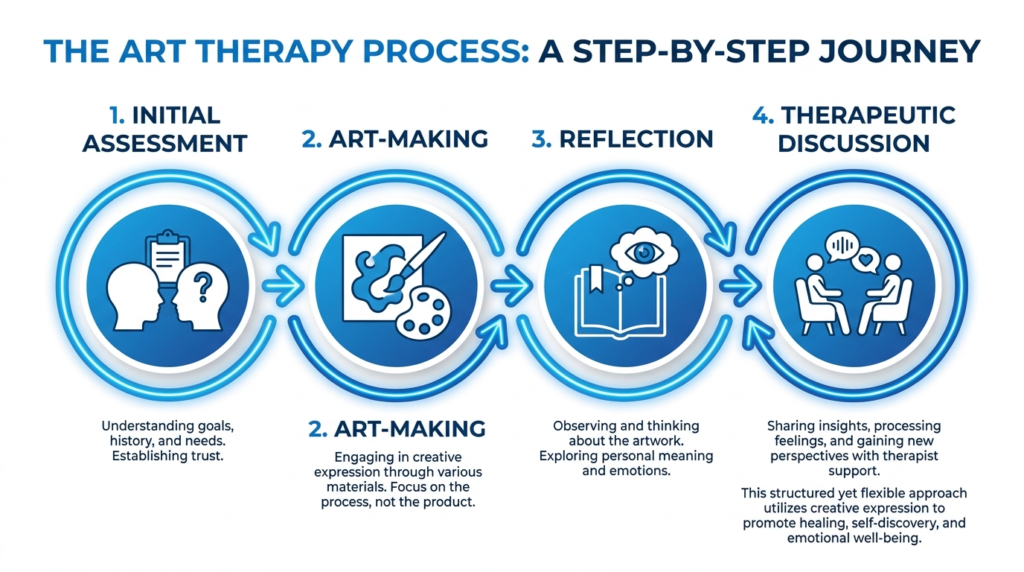
Clinical descriptions indicate that early sessions often involve collaboratively developing a treatment plan, including frequency and goals, with weekly sessions during the first four to six weeks often recommended to build therapeutic momentum and alliance. Art therapists may also use a series of images as part of assessment to better understand treatment needs.
While sessions vary widely, a typical structure may include check-in, invitation or prompt, art-making, reflection or verbal processing, and closure. The evidence shows that a broad range of materials, techniques, structures, and verbal processing formats are used successfully, with no specific art materials or techniques consistently standing out.
This finding implies that art therapy likely does not work because one medium is universally best. Instead, benefit appears to depend more on broader therapeutic processes such as fit between client and activity, therapist stance, containment and structure, capacity for expression and reflection, relational safety, developmental appropriateness, and integration with treatment goals.
Art Therapy Activities and Examples
Art therapy activities are matched to clinical goals and emotional states rather than following a one-size-fits-all approach. Here are examples organized by therapeutic purpose:
Regulation and Grounding Activities
- Repetitive line drawing: Slow, repeated curved or parallel lines while tracking breath to reduce anxiety and settle overactivation
- Boundary or container image: Creating images of containers, rooms, shields, or circles that represent emotional protection
- Five-senses grounding collage: Dividing a page into sections for sight, sound, touch, smell, and taste filled with grounding images
- Texture-based clay work: Focusing on pressure, temperature, and resistance to improve present-moment awareness
Emotional Identification Activities
- Feelings as color map: Assigning colors to current feelings and creating a map showing where each feeling is strongest
- Mood sculpture: Creating a quick sculpture representing today’s mood, then making a second version showing what support would look like
- Emotion wheel drawing: Drawing a circle with wedges representing primary feelings filled with imagery and words
Trauma-Related Activities
- Safe place drawing: Creating a place that feels calm, protected, and resourced with sensory details
- Then-and-now image pair: Creating abstract or symbolic images distinguishing past threat from present reality
- Trauma metaphor collage: Building a collage that captures experience through metaphor rather than literal scenes
Self-Esteem and Identity Activities
- Strengths mandala: Filling a circle with symbols of strengths, survival, values, roles, and supports
- Self-portrait in symbols: Creating a self-portrait using only symbols, colors, objects, or textures
- Values collage: Creating a collage of what matters most in life now
The evidence includes both individual and group interventions. For PTSD in youth, examples range from short individual bedside sessions after trauma to 16 weekly trauma-focused group sessions in inpatient settings.
Seven of 10 studies in one PTSD systematic review explicitly used group therapy settings, suggesting that group formats are common and may add mechanisms such as shared experience, belonging, and reduced isolation.
Art Therapy for Adults
While much of the recent high-quality evidence focuses on children and adolescents, art therapy also serves adults across multiple settings. Art therapists work in medical institutions, schools, wellness centers, and private practice.
Common practice settings include hospitals and inpatient psychiatry for trauma and acute distress, schools for emotional regulation and behavior support, community clinics for accessible psychosocial support, and private practice for individualized therapy.
A notable pattern across settings is integration with other care systems. In clinical environments, art therapists collaborate with other healthcare professionals to support people dealing with mental health issues, chronic illness, and trauma. This supports a view of art therapy as an interdisciplinary modality rather than a stand-alone isolated service.
Who Provides Art Therapy?
Art therapists are mental health clinicians with master’s degrees or higher who work across settings. The pathway begins with advanced graduate-level training in art therapy or a related mental health field plus additional graduate-level art therapy coursework.
The Art Therapy Credentials Board lists qualifying mental health coursework areas such as human growth and development, theories of counseling and psychotherapy, psychopathology, psychological assessment, research, and clinical field experience.
In the current U.S. pathway, the major credentials are ATR-P (Provisional Registered Art Therapist), ATR (Registered Art Therapist), and ATR-BC (Board Certified Registered Art Therapist). The Art Therapy Credentials Board identifies itself as a credentialing board whose mission is to protect the public by promoting competent and ethical art therapy practice through credentialing.
While ATCB credentials are voluntary in principle, they are often required by employers and some state licensure boards. In many professions, voluntary credentialing can still become functionally indispensable because employers use it as a hiring filter, states incorporate it into licensure pathways, consumers use it as a quality signal, and insurers or institutions may prefer standardized professional verification.
Limitations of the Evidence Base
Across reviews, a major recurring limitation is heterogeneity in intervention type, frequency, duration, content, outcome measures, populations, settings, and study design. This makes pooled conclusions possible at a broad level but harder to translate into precise protocol recommendations.
Much of the older evidence consisted of case studies, case series, or small quasi-experimental studies, with few randomized controlled trials and no replication studies. More recent reviews improve the picture but do not erase these issues. The anxiety meta-analysis specifically noted insufficient extended follow-up. Some PTSD studies show maintenance at three or six months, but long-term evidence remains limited.
The field still lacks robust mediator and biomarker evidence in pediatric populations. The anxiety review notes unresolved moderators such as age, gender, diagnosis, and background. This means what works for whom remains incompletely understood.
Benefits of Art Therapy
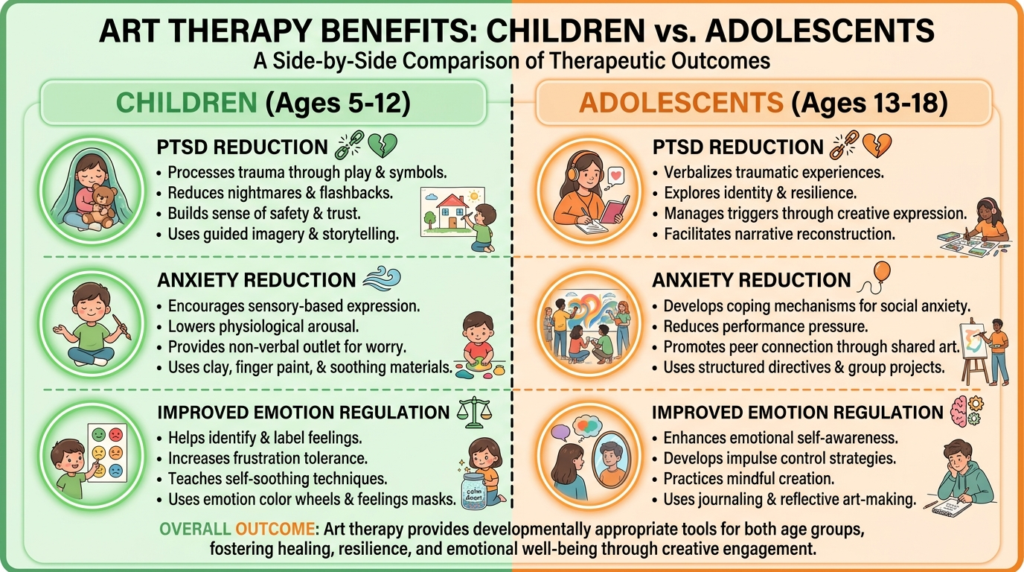
Recent systematic reviews support benefits across several psychological domains in children and adolescents.
The evidence is strongest for PTSD symptom reduction, anxiety reduction, depressive symptom reduction, improvements in emotional and psychosocial functioning, and high acceptability and engagement.
PTSD and Trauma-Related Symptoms
A 2025 pre-registered systematic review of arts therapy for children and adolescents with PTSD included 10 studies and concluded that arts therapies showed positive outcomes overall, with improvements not only in PTSD symptoms but also in related anxiety, depression, and emotional states.
A broader 2025 systematic review found that randomized controlled trials demonstrated effectiveness in reducing PTSD symptom severity, with gains maintained at three months in some studies.
A pilot randomized study of adolescents with PTSD symptoms in inpatient psychiatric settings compared trauma-focused art therapy with a treatment-as-usual arts-and-crafts control over 16 weekly one-hour group sessions.
The trauma-focused art therapy group showed greater reduction in PTSD symptom severity without increased behavioral problems during treatment.
Anxiety in Children and Adolescents
A 2024 meta-analysis on art therapy interventions for anxiety in children and adolescents found support for overall anxiety reduction. This is among the more persuasive contemporary findings because it aggregates across studies rather than relying on isolated positive trials.
The review strongly emphasized the need for larger multi-center randomized controlled trials, extended follow-up, analysis of variation by intervention type, and examination of age, gender, diagnosis, and background as moderators.
Depression
A 2025 systematic review and meta-analysis of art therapy interventions for depressive symptoms in children and adolescents reported a significant effect across 12 controlled trials, with a standardized mean difference of -0.72, indicating greater reduction in depressive symptoms relative to controls. This is a clinically meaningful effect size.
Broader Emotional and Psychosocial Benefits
The systematic review of art therapy with children and adolescents experiencing acute or severe mental health conditions found that quasi-experimental, cohort, and cross-sectional studies reported improvements in emotion regulation, self-awareness, distress tolerance, confidence, communication, and self-expression.
These are not trivial secondary outcomes. In child and adolescent mental health, these functions often mediate broader recovery, school functioning, interpersonal stability, and treatment engagement.
What Art Therapy is Not?
The American Art Therapy Association explicitly warns that self-guided activities such as adult coloring books or art therapy apps should not be conflated with art therapy services. This distinction is clinically important because many people seek low-cost support online and may assume they are accessing therapy when they are not.
Art therapy is distinct from recreational art classes, expressive arts enrichment, arts-in-health programming led by non-clinicians, and general self-care art practices. The field’s active ingredients likely include not only the art product but the therapist’s behavior, the use of materials and structure, and the supposed mechanisms of change embedded in the intervention.
Practical Implications
Art therapy may be especially worth considering when the child struggles to put feelings into words, trauma or avoidance makes direct verbal processing hard, anxiety or depression coexists with low engagement, the young person responds well to sensory or visual modes, or the goal includes emotional expression, confidence, and self-understanding in addition to symptom reduction.
Families should also verify practitioner credentials because not everyone offering art-based healing is an art therapist. Clinicians should think of art therapy as potentially adjunctive to CBT, EMDR, psychiatry, family therapy, or school supports, especially useful for engagement and regulation, flexible across individual and group formats, and not dependent on artistic skill.
Because art therapists commonly work in integrated settings and collaborate with other professionals, art therapy may fit well into inpatient psychiatry, school mental health, trauma programs, pediatric oncology, community mental health, and interdisciplinary care teams. Given the evidence for high acceptability, systems trying to improve youth engagement may find art therapy strategically valuable.
Future Directions
The most important research priorities emerging from the literature are large multi-center randomized controlled trials with longer follow-up, moderator analysis to clarify what works for whom across age, gender, diagnosis, cultural background, severity, setting, and delivery format, mechanism studies using psychological and physiological markers, comparative effectiveness research, and implementation science examining referral pathways, workforce needs, school implementation, telehealth adaptation, and cost-effectiveness.
Conclusion
Art therapy is a professionally regulated form of psychotherapy in which a trained clinician uses art-making and the creative process, together with psychological theory and therapeutic relationship, to assess and treat mental health needs.
It is not simply recreational art, self-help creativity, or arts-and-crafts. Its professional identity is grounded in graduate clinical training, supervised practice, ethical standards, and in many places credentialing and licensure structures.
The evidence base, while still developing, now supports more than a tentative endorsement. Recent systematic reviews and meta-analyses indicate that art therapy can reduce PTSD symptoms, anxiety, and depressive symptoms in children and adolescents, and may also improve suicidal ideation, emotion regulation, self-awareness, distress tolerance, confidence, communication, and self-expression.
Importantly, children and adolescents often find it highly acceptable and engaging, which may be one of its greatest practical strengths.
At the same time, the field should not be overstated. The most reliable reviews still emphasize heterogeneity, limited replication, uncertain moderators, underdeveloped mechanism science, and insufficient long-term follow-up.
No specific material or technique has emerged as universally superior, and art therapy should not be represented as having already displaced first-line evidence-based treatments such as CBT or EMDR for PTSD.
The most valid conclusion is clear: art therapy is a legitimate, clinically meaningful mental health intervention with especially strong promise for youth, trauma-related symptoms, anxiety, depression, and emotionally complex presentations, and its combination of symptom benefit plus high engagement makes it more important than skeptics often assume.
Its future importance will depend less on proving that art itself is magical and more on demonstrating, with increasing precision, how trained therapists use art processes to help particular people in particular contexts.
If you or someone you care about is struggling with trauma, anxiety, depression, or difficulty expressing emotions, consider reaching out to our qualified professional. At Summit Wellness Group, we offer trauma-informed therapy that integrates evidence-based approaches including art therapy to support your unique path to healing.

