
Trauma often lives in the body long after the mind understands what happened. You might know you’re safe now, yet your chest still tightens, your shoulders brace, or your breath catches when certain memories surface.
Somatic therapy addresses this gap by working directly with bodily sensations, nervous system patterns, and physical responses to help release trauma stored in the body.
Research shows that one specific somatic approach, Somatic Experiencing, produced large reductions in PTSD symptoms with effect sizes ranging from 0.94 to 1.26 in a randomized controlled trial.
This article explains what somatic therapy is, how it works, which techniques practitioners use, and when body-based healing may be especially helpful for trauma recovery.
What Somatic Therapy is?
Somatic therapy refers to a family of body-centered psychotherapies that treat trauma, stress, and emotional pain by focusing on physical sensations, posture, movement, breath, and nervous system states rather than relying solely on talk and memory.
The term comes from the Greek word *soma*, meaning body. Instead of asking only what you think or feel about a traumatic event, a somatic therapist asks what you notice in your chest, shoulders, jaw, or stomach when the memory arises.
The core premise is straightforward: trauma disrupts not only thoughts and emotions but also the autonomic nervous system, muscle tension, breathing patterns, and the body’s sense of safety.
A 2021 scoping review describes Somatic Experiencing as a body-oriented trauma therapy that aims to reduce post-traumatic symptoms by changing interoceptive and proprioceptive sensations linked to traumatic experience.
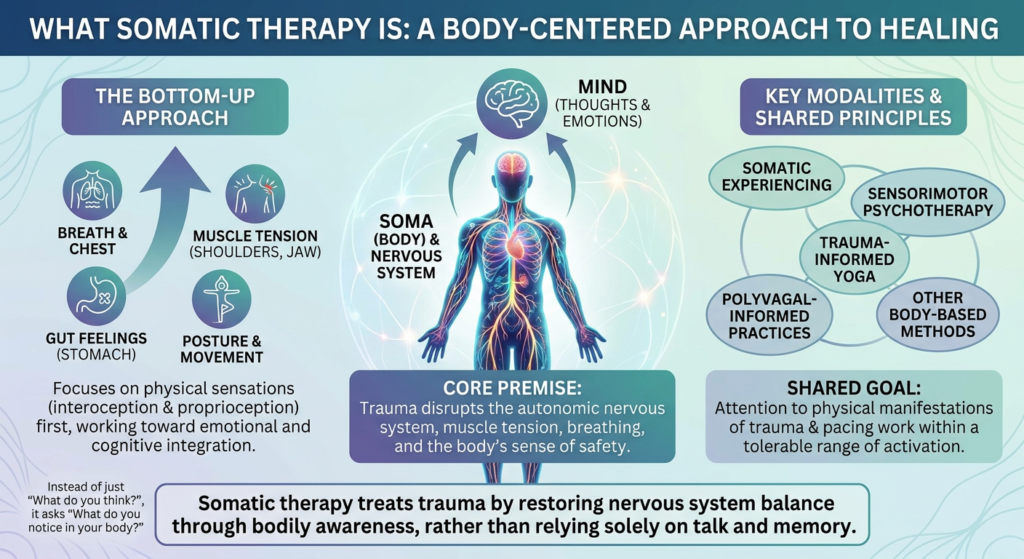
This bottom-up approach starts with the body’s signals and works toward emotional and cognitive integration, rather than beginning with narrative or belief systems.
Somatic therapy is not a single technique. It includes multiple modalities such as Somatic Experiencing, Sensorimotor Psychotherapy, trauma-informed yoga, polyvagal-informed practices, and other body-based methods.
What they share is attention to how trauma shows up physically and a commitment to pacing the work so clients stay within a tolerable range of activation.
How Somatic Therapy Differs From Traditional Talk Therapy?
Traditional talk therapy often emphasizes verbal processing, cognitive reframing, and exploring the narrative of what happened.
Somatic therapy, by contrast, prioritizes noticing and shifting bodily states. You might spend less time recounting details of a traumatic event and more time tracking sensations like tightness, warmth, trembling, or numbness as they arise in the present moment.
This difference matters because trauma can leave the nervous system stuck in survival mode even when the threat has passed. You may experience hypervigilance, exaggerated startle responses, shallow breathing, chronic muscle tension, dissociation, or a pervasive sense that danger is still present.
These symptoms are not simply thoughts to be challenged or emotions to be expressed. They are physiological patterns that require body-based intervention.
A professional overview notes that somatic psychotherapies view trauma as embedded in the nervous system and body, not only as cognitive or emotional memory, emphasizing bodily awareness, regulation, and completion of interrupted survival responses.
When someone freezes during an assault or cannot fight back during abuse, the body may hold that incomplete defensive response as ongoing tension or collapse. Somatic therapy helps the nervous system recognize that the danger has ended and supports the completion of those thwarted protective actions.
Core Principles of Somatic Therapy
Several principles guide somatic work across different modalities.
Bottom-Up Processing
Somatic therapy uses bottom-up processing, meaning it begins with bodily sensations and physiological states rather than starting with thoughts or beliefs.
This approach is especially relevant when trauma affects subcortical and autonomic systems that are not fully accessible through cognitive-focused therapies alone. For some trauma survivors, verbal processing can feel overwhelming or ineffective because the dysregulation lives below the level of conscious thought.
Titration
Titration means approaching traumatic material in very small, manageable doses. Instead of diving into the full intensity of a traumatic memory, a therapist might ask you to notice just the first sensation that arises when you think about a difficult moment.
If activation increases, you return to a sense of safety before continuing. This prevents flooding and retraumatization.
Pendulation
Pendulation involves moving attention back and forth between discomfort and safety, or between activation and settling.
Rather than staying fixed in distress, you learn to touch it briefly and then return to a steadier sensation. This rhythmic movement helps expand your capacity to tolerate difficult feelings without becoming overwhelmed.
Resourcing
Resourcing means identifying internal or external supports that promote stability. A resource might be a memory of a safe place, a supportive person, the feeling of your feet on the ground, or a comforting image.
Building resources before processing trauma helps ensure you have anchors to return to when the work becomes difficult.
Tracking
Tracking refers to noticing subtle shifts in breath, muscle tension, posture, temperature, or other bodily signals.
A therapist trained in somatic methods watches for these changes and helps you become aware of them. Tracking allows early detection of dysregulation so you can adjust before symptoms escalate.
What Somatic Experiencing is?
Somatic Experiencing is one of the most widely recognized somatic trauma therapies. Developed by Peter Levine, it focuses on restoring nervous system balance by helping clients notice and process bodily sensations rather than relying primarily on traumatic narrative.
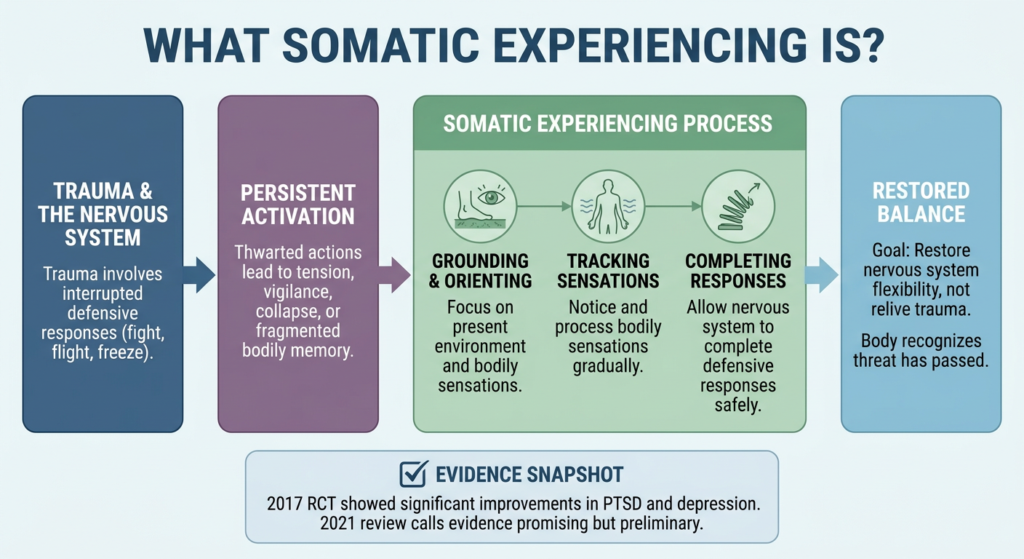
The approach is built on the idea that trauma often involves interrupted defensive responses such as fight, flight, or freeze. When these actions are thwarted or incomplete, the resulting activation may persist as tension, vigilance, collapse, or fragmented bodily memory.
A randomized controlled trial tested a 15-session Somatic Experiencing protocol for PTSD and found significant improvements in posttraumatic symptom severity and depression, with large effect sizes.
This study represents the first known RCT of Somatic Experiencing for PTSD and provides meaningful evidence that the approach can reduce trauma symptoms. However, a 2021 scoping review concluded that evidence for Somatic Experiencing is promising but still preliminary, and that more unbiased randomized controlled trials are needed.
Somatic Experiencing emphasizes gradual, sensation-focused work. Sessions typically involve grounding, orienting to the present environment, tracking bodily sensations, building resources, and allowing the nervous system to complete defensive responses in a safe, controlled way.
The goal is not to relive trauma but to help the body recognize that the threat has passed and restore flexibility to the nervous system.
What Sensorimotor Psychotherapy is?
Sensorimotor Psychotherapy is another major body-oriented trauma treatment. Developed by Pat Ogden, it emphasizes bodily experiencing such as sensation, posture, motor urges, and internal cues, while integrating psychodynamic, cognitive, and attachment-based elements.
A 2024 review describes Sensorimotor Psychotherapy as a somatic trauma-focused therapy that places less focus on cognitions than traditional trauma-focused psychotherapies but more explicitly integrates body awareness with attachment theory and relational repair.
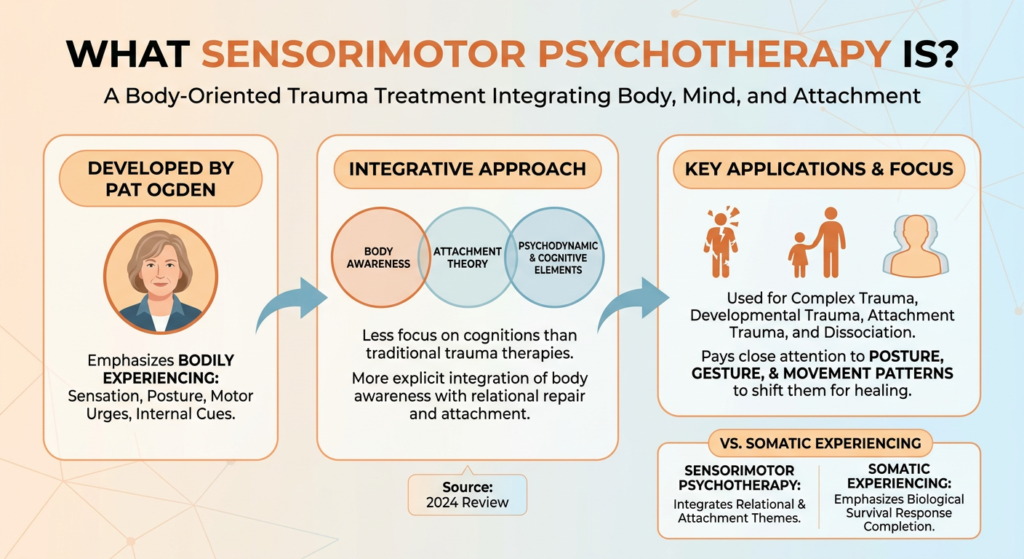
Sensorimotor Psychotherapy is often used for complex trauma, developmental trauma, attachment trauma, and dissociation. It pays close attention to how trauma is expressed through posture, gesture, and movement patterns, and it works to help clients become aware of these patterns and shift them in ways that support healing.
While Somatic Experiencing and Sensorimotor Psychotherapy overlap in their emphasis on body awareness and nervous system regulation, they differ in focus. Somatic Experiencing tends to emphasize biological survival response completion, while Sensorimotor Psychotherapy more overtly integrates relational and attachment themes.
Common Somatic Therapy Techniques
Somatic therapists use a range of techniques to help clients regulate their nervous systems and process trauma.
Grounding
Grounding involves bringing attention to the present moment through physical contact points. You might feel your feet on the floor, notice the support of the chair beneath you, or press your hands together. Grounding helps shift attention away from traumatic time and into current reality, especially during rising overwhelm or dissociation.
Orienting
Orienting is a practice where you slowly look around the environment, allowing your eyes and neck to move naturally, and notice cues that signal safety or neutrality. Trauma narrows attention toward threat. Orienting broadens it again and helps the nervous system recognize that the immediate environment is not identical to the traumatic past.
Breathwork
Breathwork in somatic therapy often involves slow exhale breathing, diaphragmatic breathing, or box breathing to downregulate arousal and improve present-moment regulation. Longer exhales can stimulate parasympathetic settling.
However, not all trauma survivors experience deep breathing as calming. For some, inward focus on breath can trigger panic or collapse, so breathwork should be introduced carefully.
Gentle Movement
Gentle movement may include stretching, rocking, weight shifting, or small posture adjustments. These interventions help restore agency, release bracing, and support body awareness. Movement is especially useful for freeze, collapse, numbness, or immobilization states.
Body Scanning
Body scanning involves noticing sensations in different parts of the body with curiosity and without judgment. You might start with a neutral area such as your hands or feet and gradually expand awareness.
Body scanning builds interoception and helps clients tolerate internal sensations without immediately interpreting them as threatening.
Touch and Self-Touch
Some somatic sessions include touch or self-touch, such as placing a hand on the heart or abdomen for anchoring. Ethical sources stress that touch must always be optional, transparent, and consent-based. Given trauma’s frequent involvement of violated boundaries, touch requires especially careful handling.
What Happens in a Somatic Therapy Session?
A typical somatic therapy session might include the following steps:
- Orientation and check-in
- Collaborative pacing and consent
- Grounding or settling
- Attention to body sensations
- Tracking activation, tension, emotion, or impulses
- Staying with manageable amounts of distress
- Returning to regulation and resources as needed
- Integration and reflection
Sessions are tailored to each person and often used alongside talk therapy. The therapist explains what to expect, checks your comfort level, and allows you to pause, redirect, or stop at any time.
Common interventions include body-awareness exercises, guided relaxation, noticing bodily responses while recalling trauma, and orienting toward people, places, or things that feel safe and calming.
Who Benefits Most From Somatic Therapy?
Somatic therapy appears especially relevant for trauma survivors whose symptoms are strongly expressed through the body. This includes people who experience:
- Hypervigilance, exaggerated startle, or panic
- Chronic muscle tension, bracing, or pain
- Dissociation, numbness, or feeling disconnected from the body
- Freeze or shutdown responses
- Difficulty tolerating direct verbal processing of trauma
- Co-occurring chronic pain and trauma symptoms
A 2025 study protocol is testing a group-adapted Somatic Experiencing intervention for Indonesian women survivors of sexual assault with PTSD symptoms, explicitly linking the approach to autonomic regulation, interoceptive and proprioceptive processing, and polyvagal-informed restoration of felt safety.
This marks an important shift from individual specialist treatment models toward potentially more accessible public health implementations.
Somatic therapy may also help when trauma is linked to developmental or attachment disruptions, when verbal therapies have not fully addressed symptoms, or when someone needs to build nervous system regulation before engaging in more direct trauma processing.
Evidence for Somatic Therapy
The evidence base for somatic therapy is promising but still developing. The strongest direct evidence comes from the 2017 randomized controlled trial of Somatic Experiencing for PTSD, which included 63 participants and reported large effect sizes for PTSD symptom reduction.
However, the sample was modest, the control was waitlist rather than active treatment, and replication remains limited.
A 2021 scoping review concluded that evidence for Somatic Experiencing is promising but still preliminary and that more unbiased randomized controlled trials are needed.
This review is important because it tempers enthusiastic claims. The correct synthesis is not that Somatic Experiencing has no evidence, nor that it is already as established as front-line trauma therapies. Rather, it has positive early evidence with insufficient high-quality replication.
Broader evidence for body-based interventions related to somatic principles, such as trauma-informed yoga, breathwork, and mindfulness-based movement, also shows support for reducing anxiety, depression, and trauma symptoms.
While these interventions are not identical to formal somatic psychotherapy, the convergence strengthens the overall rationale for body-based regulation in trauma care.
Major adult PTSD clinical practice guidelines generally prioritize established trauma-focused psychotherapies such as trauma-focused cognitive behavioral therapy and EMDR. Somatic therapy is not yet considered first-line by evidentiary standards, but it fills clinically important gaps that first-line therapies do not always address well.
Safety Considerations
Somatic therapy is generally safe when practiced by trained professionals, but it is not without risks. Even gentle body-focused work can intensify symptoms if approached too quickly. Strong inward focus or more activating exercises may worsen panic, dissociation, overwhelm, or flashbacks in some individuals.
The concept of the window of tolerance is central to safety in somatic work. This refers to the optimal zone of arousal in which a person can remain present, oriented, and able to process experience without becoming overwhelmed or shut down. Signs of leaving the window may include rapid heart rate, shallow breathing, disorientation, irritability, brain fog, zoning out, or inability to think clearly.
Somatic therapy may not be suitable as a standalone treatment for active psychosis, severe personality disorders without additional support, severe dissociation, or untreated substance use affecting awareness. In these cases, somatic methods may still be useful components of care but not necessarily sufficient primary treatment.
Consent is essential, especially when touch is involved. In trauma care, consent is not a procedural extra but part of the intervention itself. Methods that ignore or weaken client agency directly undermine the rationale of somatic treatment.
Self-Practice Versus Professional Guidance
Some simple somatic techniques can be practiced independently, while deeper trauma processing should generally be guided by a trained therapist. Grounding, orienting, slow exhale breathing, gentle body scans, and brief weight shifts or rocking are usually reasonable for self-practice.
However, revisiting traumatic memories, working directly with intense body memories, strong activation or discharge phenomena, complex relational trauma processing, and persistent dissociation or collapse states are better addressed with professional support.
It is highly recommended to start somatic therapy with the help of a trained therapist, though some tools can later be practiced independently. The online somatic wellness market often blurs the line between regulation tools and trauma therapy, and that blurring can be unsafe.
How Somatic Therapy Fits With Other Treatments?
Somatic therapy is frequently described as complementary rather than exclusive. It can work well alongside EMDR, Internal Family Systems, cognitive behavioral therapy, and other evidence-based treatments.
Somatic therapy may improve regulation and body awareness, while cognitive or trauma-focused therapies may help with meaning-making and memory integration. Combined care can address both physiological and narrative dimensions of trauma.
The most realistic clinical role for somatic therapy in many settings is not as a replacement for all evidence-based trauma treatment, but as a high-value component within integrated trauma care. If the clinical question is which treatment currently has the strongest evidence as a primary standalone treatment for PTSD, the answer is still trauma-focused CBT and EMDR.
However, if the clinical question is which therapy may help when trauma is heavily embodied, linked with chronic pain, or insufficiently responsive to purely verbal approaches, somatic therapy deserves serious consideration.
Practical Exercises to Try
Several beginner-friendly somatic exercises can support nervous system regulation and body awareness.
Orienting to safety: Sit or stand comfortably with your eyes open. Slowly let your gaze move around the room. Name five objects or features you notice. Pause on anything that feels neutral or pleasant. Notice whether your breathing or shoulders shift.
Feet and chair grounding: Sit upright or stand. Feel both feet making contact with the floor. If sitting, feel the chair supporting your pelvis and back. Press your feet slightly downward for five to ten seconds, then release and notice the rebound.
Extended exhale breathing: Breathe in gently for a count of four. Exhale slowly for six to eight. Repeat for one to three minutes. Stop if dizziness or distress increases.
Body scan with pacing: Start with a neutral body area such as your hands or feet. Notice temperature, pressure, tingling, heaviness, or absence of sensation. Do not force sensation. If distress increases, return to grounding.
Gentle rocking: Sit or lie down comfortably. Create a small rhythmic rocking motion. Continue for thirty to sixty seconds. Pause and notice the after-effects.
These exercises are intended to support regulation, not to replace professional trauma treatment. If you experience panic, severe dissociation, flashbacks, or feeling unreal or unsafe, stop and seek professional support.
Finding a Qualified Somatic Therapist
Because somatic therapy includes diverse methods and is less standardized than some manualized PTSD treatments, therapist training matters greatly. Look for a licensed mental health professional with specific training in a recognized somatic modality such as Somatic Experiencing or Sensorimotor Psychotherapy. Ask about their experience with trauma and, if relevant, dissociation or chronic pain.
A qualified therapist should be willing to explain their methods and pacing, use clear consent practices, and feel comfortable integrating somatic work with evidence-based trauma care when needed.
Before beginning, ask about credentials, methods used, and what a typical session involves. Somatic therapy should never be assumed to require touch, and any physical intervention demands explicit consent and trauma-informed care.
Why Somatic Therapy Matters?
Somatic therapy has become one of the most influential developments in contemporary trauma treatment because it addresses a clinical reality that many patients and therapists recognize: trauma often persists not only as a story but as a way the body breathes, braces, startles, numbs, collapses, scans, and moves. The strongest themes across the research are remarkably consistent.
Somatic approaches prioritize body awareness, autonomic regulation, titrated processing, and restoration of felt safety.
The empirical picture is mixed but meaningful. Somatic Experiencing has at least one important randomized controlled trial showing substantial PTSD symptom reduction and large effect sizes, along with reduced depression.
Recent work is moving toward culturally adapted group implementations in low-resource settings. Body-based interventions related to somatic principles also show broader support for anxiety, depression, and trauma symptom reduction. Together, these data justify serious clinical consideration.
At the same time, the field should be discussed with discipline. Claims that all trauma is literally stored in tissues, that any somatic intervention releases it, or that somatic therapy is already validated to the same degree as the strongest trauma treatments are not adequately supported by the evidence.
The most defensible conclusion is more precise: somatic therapy is an important, promising, and often practically effective trauma treatment domain, especially valuable for nervous system regulation and body-based recovery, but still uneven in empirical maturity across modalities.
Somatic techniques and exercises provide practical ways to release trauma-related tension when they are paced gradually, guided by consent, grounded in regulation, delivered by trained clinicians when trauma is complex, and integrated into a broader trauma-informed treatment plan.
If you’re struggling with trauma symptoms that show up in your body as tension, panic, numbness, or pain, you don’t have to face it alone. At Summit Wellness Group, our team offers trauma therapy that integrates somatic approaches with evidence-based care to support your healing. Reach out today to learn how we can help.

