
Can art therapy help when trauma, grief, or emotional numbness leave you unable to put feelings into words? Yes, research points to real promise here. One review of arts therapy for children with PTSD found a 42 percent drop in core symptoms after 12 sessions of visual art therapy. This article walks through how art therapy for trauma, grief, and emotional numbness actually works, what the science says, and how to tell if it might fit your situation.
Why Art Therapy for Trauma Works When Words Fail
Trauma is not always stored as a clear story with a beginning and an end. It often shows up as flashes of image, body sensation, sound, or fear without much order at all.
That matters because talk therapy assumes a person can access and narrate what happened. For many trauma survivors, that assumption does not hold. New work linking trauma narrative patterns to memory function in the brain shows that no two survivors process an event the same way. Some give detailed timelines with little visible emotion. Others offer only fragments and sensation.
There is also a body side to this. A person can know, logically, that danger has passed while their nervous system keeps reacting as though it has not. Clinical work on trauma related grief describes this gap directly. The mind says it is over. The body has not caught up yet.
Dissociation adds another layer. People with trauma related dissociation may feel detached, foggy, or unreal, and pushing them to describe an event in detail before they feel safe can backfire. Research on severe dissociation and trauma recommends a phased approach instead, one that builds stability and coping skills before any direct work on memories begins.
Art making offers a different route into all of this. A person can represent fear as a shape, a color, or a locked door instead of describing it in a full sentence. That kind of symbolic distance can make hard material more approachable.
When Talk Therapy Isn’t Enough
Some presentations make verbal processing especially hard, and it helps to name them clearly.
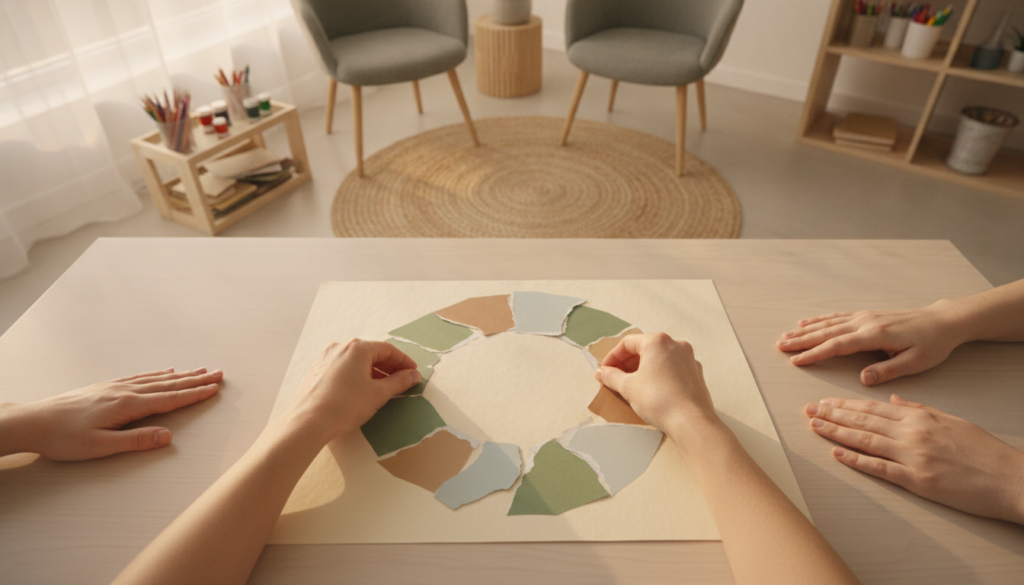
Alexithymia is one. It means a person struggles to identify or describe their own feelings, not because they lack insight, but because the internal signal is unclear or blocked. Asking “what do you feel” repeatedly may produce blank stares or frustration.
Blunted affect and emotional numbness are related but distinct. A person may look flat on the outside while carrying fear, grief, or shame underneath. Numbness is often a form of protection, not an absence of feeling.
Fragmented memory shows up when trauma is recalled as flashes, sounds, or physical sensations rather than a clear sequence. Demanding a tidy account from someone in this state can feel impossible, or even harmful.
In all three cases, credentialed art therapists are trained to work with the image as a shared object rather than pushing for direct disclosure. Standards from the Art Therapy Credentials Board call for therapists to build assessment, cultural awareness, and emotional closure into every session, not just artistic activity. The therapist might ask what a color feels like or what an image needs, rather than what the trauma meant. That shift alone can open a door that direct questioning cannot.
Art Therapy for Grief and Emotional Numbness
Grief after trauma rarely looks like ordinary sadness. It often carries guilt, anger, fear, and disbelief layered on top of loss. Someone might grieve a person, a sense of safety, a body that worked differently before, or a future they expected to have.
Clinical descriptions of trauma related grief note that memory work and mourning often overlap rather than happening in a neat order. A survivor may first need enough stability to recognize the danger has passed before they can even begin to mourn what was lost.
Art therapy can support this work through memorial images, symbols of ongoing connection to someone who died, or pictures that hold ambivalence a person cannot yet say out loud. None of this replaces grief. It gives grief a place to land when words feel disloyal, unbearable, or simply absent.
Emotional numbness responds to a gentler version of the same idea. Instead of asking someone to produce insight, a therapist might invite small choices: pick a color for today, map your energy on paper, choose which part of an image feels safest. These tiny acts of noticing can slowly rebuild a bridge to feeling that numbness had shut down.
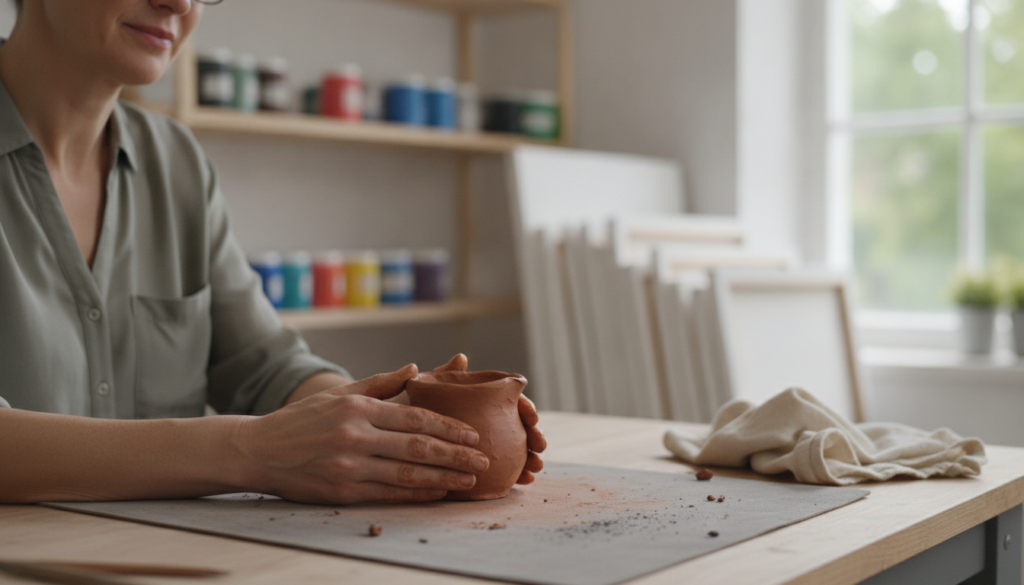
Inside a Session: What Actually Happens
A real art therapy session is not the same as a craft class or a coloring group, even though both involve materials and creativity.
A session usually opens with a check in on mood, safety, and recent events. From there, the therapist offers a directive, an intentional prompt chosen for a specific clinical reason, not just something fun to do. It might be as simple as mapping where anxiety lives in the body or as layered as building a safe place using collage.
During the making, the therapist watches closely: how the person handles frustration, what materials they avoid, whether they seem to settle or spiral. This observation feeds into how the session unfolds, not just what gets documented afterward.
Processing comes next, and it is client led. The therapist asks what the image means to the person rather than announcing a fixed interpretation. Closure follows, often with grounding, a plan for coping between sessions, and a decision about what happens to the artwork itself, since finished pieces are treated as protected clinical information rather than décor or take home crafts.
What the Research Says About This Approach
The honest picture here is promising but not settled. A systematic review of creative arts therapies for adults with PTSD found real potential but also noted that studies varied too much in design and quality to draw firm, pooled conclusions.
Smaller studies tell a more specific story. A trial using the Safe Place collage protocol with 22 trauma exposed clients found a statistically significant drop in anxiety, with the biggest gains among participants who learned to hold both comfort and distress at once rather than avoiding difficult feelings entirely.
Work with refugee children shows both the appeal and the limits of this field. A review of art therapy for refugee youth found that most existing studies lacked control groups, even though the population seems like an obvious fit given language barriers and cultural stigma around direct disclosure.
None of this means art therapy fixes PTSD on its own. Established treatments like Cognitive Processing Therapy, Prolonged Exposure, and EMDR still carry stronger evidence overall. The more accurate takeaway is that expressive arts therapy benefits show up most clearly as an addition to established care, or as a way to reach people who cannot yet tolerate direct verbal processing.
Is This Approach Right for You
Creative therapy for trauma tends to fit certain situations better than others. You might consider it if any of the following sound familiar.
- You feel disconnected from your own emotions or often say “I don’t know what I feel”
- Talking about a painful event triggers shutdown, panic, or a sense of leaving your body
- Your memories come as flashes, sensations, or images rather than a clear story
- You have tried talk therapy repeatedly and dropped out or felt stuck
- You are grieving a loss that is tangled up with fear, guilt, or intrusive images
- Language or cultural background makes direct verbal disclosure feel unnatural or unsafe
- You are a caregiver of a child who cannot yet explain big feelings in words
None of these signs guarantee a particular outcome. They simply suggest that a visual, symbolic route into the work may reach material that conversation alone has not.
Why This Matters
Trauma, grief, and numbness do not resist treatment because a person is stubborn or unwilling. They resist because the experience itself was never fully stored in words to begin with. Recognizing that changes the whole approach.
Art therapy will not replace stabilization, safety planning, or evidence based trauma treatment when those are needed. What it can do is meet someone where language cannot yet reach, build a bridge toward safety and self awareness, and make space for grief and numbness to become something a person can finally hold instead of carry alone.
If any of this feels familiar, you do not have to sort it out by yourself. Reach out to learn more about trauma informed therapy and find a path that actually fits where you are right now.

