
Trying to sort out DBT vs CBT can feel confusing since both therapies use homework, skill practice, and behavior focused tools. The real difference comes down to structure and risk: standard CBT targets one clear problem like anxiety, while full DBT adds weekly coaching calls and a full support team for anyone whose behavior threatens their safety or treatment. This guide breaks down what separates the two and helps you figure out which one actually fits what you’re dealing with.
DBT vs CBT: What Sets Them Apart
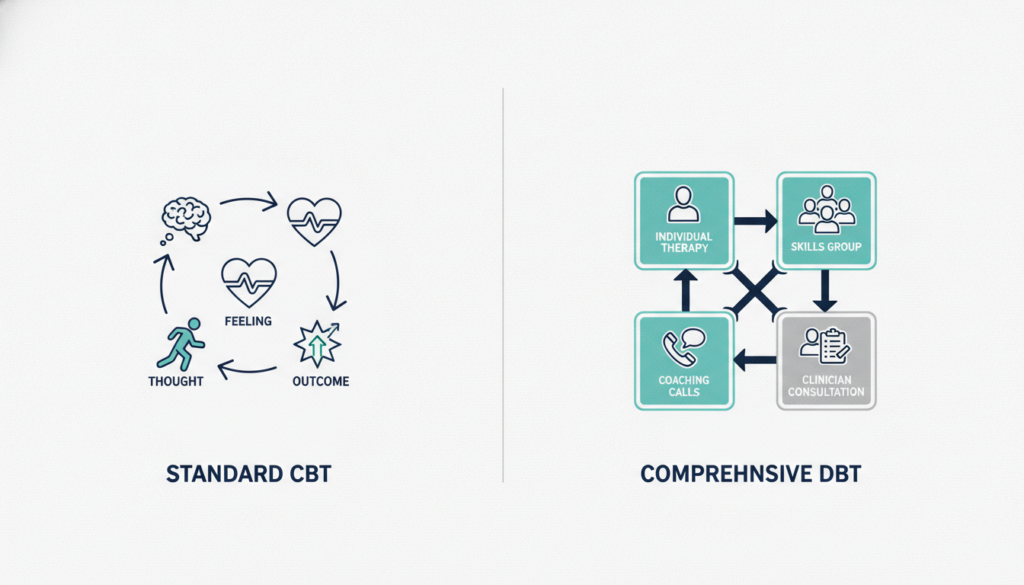
CBT and DBT grew from the same behavioral roots, and both rely on shared goal setting, tracking, and practice between sessions. Where they split is in what gets addressed first. Standard CBT usually starts with a shared picture of how thoughts, feelings, and actions keep a problem going, then works through that cycle step by step. DBT was built for a different situation. According to foundational treatment research from Dimeff and Linehan, it was developed for chronically suicidal people and gives formal priority to whatever behavior is most dangerous that week, even if it isn’t the topic the client planned to discuss. Treating crisis behavior as the main event rather than a distraction is the clearest difference between DBT and CBT.
How CBT Works: A Problem Focused Approach
Standard CBT maps out a specific cycle: a trigger, an automatic thought, an emotional reaction, a behavior, and a consequence that keeps the pattern going. From there, a therapist and client pick tools that interrupt the cycle, things like restructuring unhelpful thoughts, exposure, behavioral activation, or problem solving. This works well for panic, social anxiety, insomnia, obsessive thoughts, and depressive withdrawal, especially when someone can attend sessions reliably and finish homework without one crisis after another taking over the plan. CBT does not need a weekly group, phone coaching, or a therapist team. It’s often the leaner, faster option when the presenting problem stays fairly contained.
How DBT Works: Four Coordinated Parts
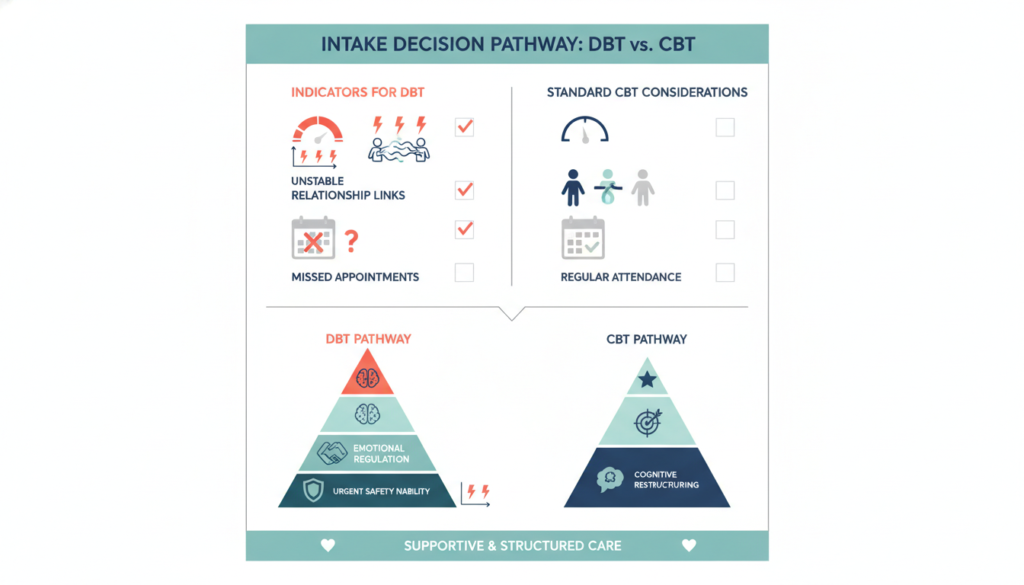
Full DBT is not one weekly appointment. It’s four coordinated pieces working together: weekly individual therapy, a weekly skills group covering mindfulness, distress tolerance, emotion regulation, and interpersonal skills, coaching calls between sessions so people can use skills during an actual crisis, and a weekly therapist team that keeps clinicians consistent, as described by the DBT clinic at the University of Washington. Individual sessions follow a strict order too: life threatening behavior comes first, then anything that interferes with therapy itself, then quality of life problems, then skill building. A program offering only a skills class, without the other three pieces, should be called DBT informed rather than full DBT, a distinction outlined by the DBT certification board that matters when someone needs the whole structure and not just the vocabulary.
Table: CBT and DBT at a Glance
| Feature | Standard CBT | Full DBT |
| Best for | Anxiety, depression, and other focused problems | Recurrent self harm, suicidal behavior, severe emotion swings |
| Structure | One weekly session built around a shared plan | Individual therapy, group, coaching calls, and a therapist team |
| Priority | Whatever the current plan targets | Life threatening behavior always addressed first |
| Session tools | Homework, behavioral experiments, exposure | Diary cards, chain analysis, crisis coaching |
| Typical length | Often shorter, symptom dependent | Frequently six months to a year or longer |
DBT vs CBT for Anxiety: What Fits Best
For most anxiety, standard CBT is the more proportionate choice. Panic kept alive by catastrophic thinking, social anxiety maintained by avoidance, and generalized worry all respond well to a focused CBT plan without needing DBT’s full intensity. Full DBT becomes more relevant only when anxiety travels alongside something bigger, like emotions that escalate fast and lead to self harm, substance use, or leaving therapy altogether. An early meta analysis of adult DBT trials found the clearest benefit was for reducing suicide attempts and self injury, not milder symptom categories, according to findings from Panos and colleagues that still hold up today. If your anxiety is intense but you can still use coping skills, keep appointments, and stay safe, standard CBT is probably enough.
DBT vs CBT for BPD: More Than Diagnosis
A borderline personality disorder diagnosis doesn’t automatically mean someone needs full DBT, and not having that diagnosis doesn’t rule it out either. The better question is behavioral: is there a pattern of recurrent suicide attempts, self injury, or therapy that keeps falling apart. In one major randomized trial of women with BPD and recent self harm, results from Linehan and colleagues showed participants receiving DBT were about half as likely to attempt suicide again, stayed in treatment longer, and used fewer emergency and inpatient services than those receiving expert talk therapy without a DBT structure. That said, DBT isn’t automatically the top pick for every BPD presentation. A trial comparing DBT with a suicide focused treatment called CAMS, run by Andreasson and colleagues, found no significant difference in new self harm between the two groups, suggesting that other specialty treatments can work just as well when acute suicidal thoughts aren’t tangled up with DBT’s wider target pattern.
Is DBT Better Than CBT? What Research Shows
The honest answer is that DBT isn’t universally better, it’s better matched to a specific kind of problem. A large network analysis covering more than three thousand participants, led by Klein and colleagues, found no single psychotherapy came out as the definitive best choice across every outcome for BPD, even though DBT was the best connected treatment in the evidence. A more recent head to head trial from Wibbelink and colleagues compared DBT with schema therapy over two years and found no significant difference in BPD severity between the two approaches, with dropout also similar in both groups. So the fair framing of DBT or CBT, or DBT versus other specialty care, isn’t a contest with one universal winner. It’s a matching question about what a person’s pattern of risk and disruption actually calls for.
Signs You Might Need DBT Over Standard CBT
A few patterns tend to point toward full DBT over standard CBT. Recent or repeated suicide attempts or self injury are the clearest signal, since that’s exactly what DBT’s research base was built around. Emotions that escalate fast and stay high, especially when they lead to impulsive or dangerous behavior rather than settling with normal coping, are another sign. So is a history of quitting therapy early, missing sessions after a crisis, or hiding dangerous behavior from a therapist out of shame. Relationship conflict that repeatedly triggers self harm, substance use, or a sudden urge to leave treatment fits this pattern too. None of these alone means DBT is required, but when several show up together and keep throwing off regular outpatient care, that combination is the strongest evidence based reason to move toward the fuller DBT structure rather than staying with standard CBT.
For teens, a similar logic applies. A 2021 review from Kothgassner and colleagues covering more than 1,600 adolescents found DBT adapted for teens produced meaningful drops in self harm and suicidal thinking, particularly when caregivers joined skills training. That family involvement is part of what makes adolescent DBT different from a typical teen CBT course, where parent participation is often optional rather than built into the model itself.
Why This Distinction Matters for Your Care
Getting this decision right isn’t just an academic exercise. Therapist follow through on DBT’s actual methods, not just familiarity with the concepts, has been linked to lower dropout and fewer later suicide attempts, according to multi trial research from Harned and colleagues spanning hundreds of patients. That means the difference between DBT and CBT, and the difference between full DBT and a program that only borrows DBT language, can directly affect whether treatment actually holds when things get hard. Choosing based on what your pattern of risk and engagement really looks like, rather than by name alone, gives you the best shot at a treatment that fits.
If you keep hitting crisis after crisis in regular therapy, or you’re just not sure whether DBT or CBT fits what you’re going through, it might help to talk it through with people who treat both every day. Reach out to The Summit Wellness Group and ask about DBT therapy program to find the right level of care for what you’re facing.

