
Emotional dysregulation means having a hard time noticing, accepting, or managing strong feelings in ways that fit the situation you are in. Research shows this pattern turns up across many mental health conditions, from ADHD to PTSD to borderline personality disorder, and a 36 item scale called the DERS helps clinicians see exactly which skills need work. This article covers the signs, common causes, and proven emotional dysregulation treatment options, including DBT, so you know what to expect next.
What Is Emotional Dysregulation?
If you looked up emotional dysregulation because your emotions feel bigger, faster, or harder to shut off than they should be, you are not imagining it. The term describes trouble noticing, accepting, or managing emotional states in ways that match what is actually happening around you. It can look like explosive anger, sudden tearfulness, panic, shutting down completely, or feeling numb for days at a time.
Here is something that surprises a lot of people. Emotional dysregulation is not its own diagnosis. The term does not appear as a standalone condition in the official diagnostic manual that most clinicians use in the United States. Instead, researchers describe it as a pattern that shows up across many mental health conditions, including ADHD, PTSD, bipolar disorder, borderline personality disorder, autism, anxiety, and depression.
Emotion regulation is not one single skill either. It includes noticing what you feel, understanding it, accepting it without shame, staying focused on what you need to do while upset, and recovering within a reasonable amount of time. A person can struggle in one of these areas while functioning fine in another, which is part of why one blanket label rarely fits everyone’s experience.
That distinction matters. If a clinician tells you only that you have emotional dysregulation and stops there, you have half an answer. The more useful question is what is driving it in your specific case.
Signs of Emotional Dysregulation in Adults
Signs of emotional dysregulation look different from person to person, and adults often hide more than they show. Some people react outward. Others shut down quietly while looking calm at work or in public.
Common signs include:
- Anger that feels out of proportion to what triggered it
- Crying spells or panic that seem to arrive out of nowhere
- Shutting down, going numb, or losing the ability to speak when overwhelmed
- Acting on impulse, like sending an angry message or spending money you did not plan to spend
- Taking hours or days to feel normal again after a stressful moment
- Feeling like you understand your emotions but have no idea how to change them
Emotional dysregulation in adults can also show up as exhaustion after socializing, sudden mood shifts after feeling rejected, or an inability to function at work right after conflict. Notice how many of these signs describe a mismatch, a reaction that feels far bigger than the moment calls for, or a recovery period that stretches on long after the trigger has passed. That mismatch, more than any single symptom, is usually what brings people in for an evaluation in the first place.
What Causes Emotional Dysregulation?
There is rarely one single cause. Sleep loss, hunger, chronic pain, hormone shifts, and money stress can all lower a person’s ability to stay regulated. So can trauma. A cue that resembles an old traumatic event, like a certain tone of voice or a specific smell, can trigger a reaction that looks disproportionate to someone watching from outside but makes complete sense given what happened to you.
Developmental history plays a role too. Trauma that occurred early in childhood can shape attention, memory, and the ability to regulate emotion well into adulthood, sometimes in ways that resemble ADHD or autism. Sensory overload, the exhaustion of masking around others, and rigid routines can also drain a person’s coping reserve long before an outburst or shutdown actually happens.
A trigger might be linked to a trauma memory, a sensory overload, a perceived rejection, or a broader shift in mood and energy. Two people can look almost identical during an outburst and still be dealing with completely different underlying causes. Because so many things can lower regulation capacity, cause and diagnosis are not the same question. A trigger tells you what set off a reaction. It does not tell you why your nervous system reacts that way in the first place.
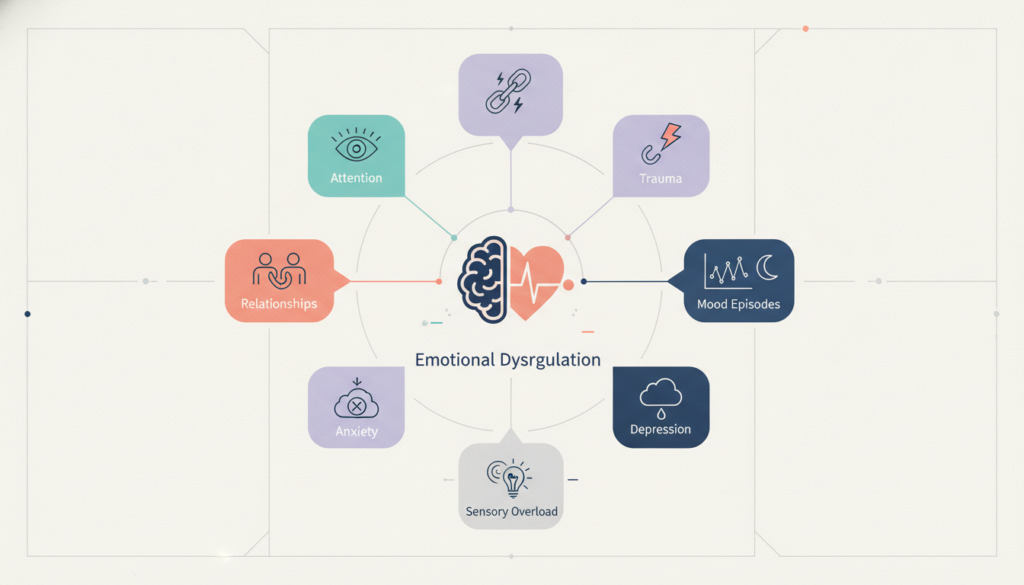
Conditions Linked to Regulation Problems
Emotional dysregulation shows up across a wide range of diagnoses, and figuring out which one fits usually depends on timing, pattern, and what happens between episodes.
ADHD often brings frustration intolerance, impatience, and impulsive reactions that trace back to childhood and continue across settings. PTSD tends to organize around trauma reminders, nightmares, and a nervous system stuck on high alert. Borderline personality disorder usually involves intense reactions tied to relationships, fear of abandonment, and a pattern that has been present since early adulthood. Bipolar disorder is different again, because it involves distinct episodes of mood and energy change rather than constant baseline reactivity. Autistic adults may experience shutdown or meltdown after cumulative sensory and social demand rather than a mood disorder at all.
Depression and anxiety belong on this list too. Some adults experience depression mainly as irritability and a short temper rather than sadness, especially under chronic stress. Anxiety can produce panic, avoidance, and reassurance seeking that looks like dysregulation from the outside but is driven by fear of a specific threat rather than mood instability itself.
Adults sometimes describe having had explosive anger since childhood, which raises questions about a condition called disruptive mood dysregulation disorder. That diagnosis only applies to children and teenagers, but the childhood history it describes can still help a clinician understand where an adult’s pattern started.
You may have noticed the phrase emotional regulation disorder used online. It is a helpful shorthand, but it is not a formal diagnosis. What matters clinically is the full pattern, not just the presence of big feelings.
How Doctors Diagnose the Pattern
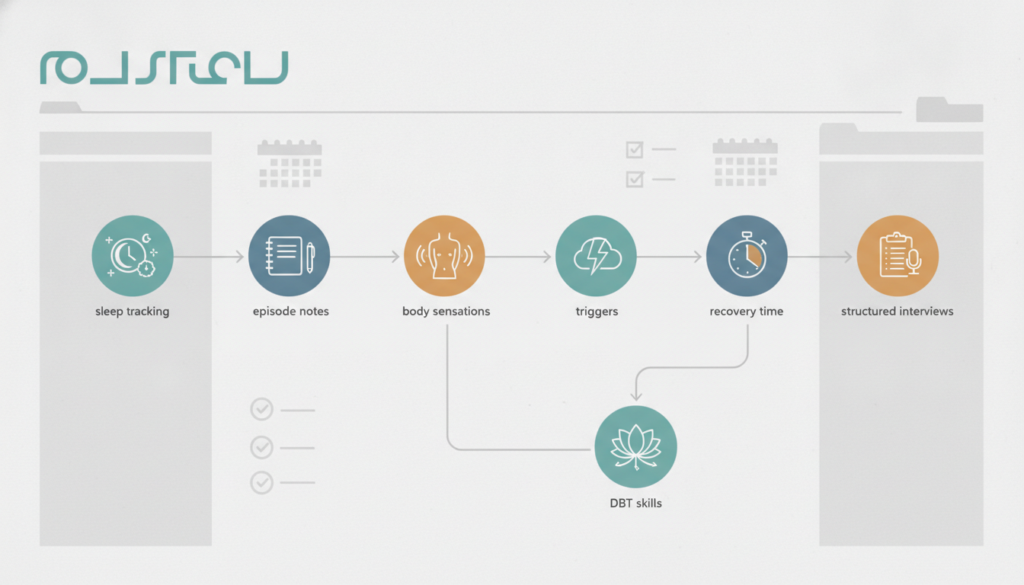
A good evaluation does not rely on one questionnaire or a single conversation. Clinicians often start with a self report tool known as the DERS scale, which uses 36 items to score how much trouble a person has with awareness, acceptance, impulse control, and access to strategies that actually help. A high score confirms real difficulty. It does not say whether the cause is ADHD, trauma, bipolar disorder, or something else entirely.
That is where structured interviews come in. For suspected ADHD, clinicians may use the DIVA-5 interview, which walks through 18 symptoms and childhood history in detail. For suspected trauma, the CAPS-5 interview is considered the strongest available tool, walking through each trauma symptom with standardized questions about frequency, intensity, and impairment. For suspected autism, observation tools like the ADOS-2 assessment can add useful information, though researchers caution it should never stand alone. One study found that relying only on ADOS-2 scores would have classified 36 percent of a sample as autistic, compared with 8 percent using full clinical judgment that included developmental history.
Clinicians also look at what a person’s life is like between episodes, since that single detail sorts through a lot of overlapping symptoms. Someone with bipolar disorder usually returns close to their usual self between mood episodes. Someone with ADHD usually keeps struggling with organization and getting things done even when mood is calm. Someone with borderline personality disorder often keeps feeling unstable in relationships even outside of an acute crisis.
The takeaway is simple. A score tells you the size of the problem. A full evaluation tells you what is actually going on.
Treatment Options That Actually Help
Emotional dysregulation treatment is not one size fits all, and the best plan usually depends on what is driving the pattern. If ADHD is central, treatment might include medication, coaching for planning and follow through, and skills for frustration tolerance. If trauma is central, trauma focused therapy and processing work often come first. If bipolar disorder is present, mood stabilization and sleep regulation matter as much as talk therapy. If borderline personality disorder or serious self harm risk is present, a full course of dialectical behavior therapy is often the strongest option available.
Because these conditions overlap so often, many people end up with more than one diagnosis explaining different parts of the picture. That is not a failure of assessment. It usually means the picture is genuinely layered, and treatment should reflect that rather than force everything into one label.
Across almost every cause, though, skills training helps. Learning how to notice an emotion building, tolerate distress without making things worse, and communicate needs without escalating a conflict gives people something concrete to do instead of just enduring the feeling. Medication, when it fits the underlying condition, and therapy, matched to what is actually happening, tend to work better together than either one alone.
DBT and Building Regulation Skills
Dialectical behavior therapy, or DBT, was originally built for people with chronic suicidal behavior and borderline personality disorder, and it remains the treatment with the strongest track record for that group. Full DBT is described as a structured behavioral system that combines individual therapy, skills training, coaching calls between sessions, and a therapist support team, all built around the idea that people need both acceptance and active change at the same time.
DBT teaches four groups of skills. Mindfulness helps you notice what you are feeling before you act on it. Distress tolerance helps you get through a crisis without making it worse. Emotion regulation itself focuses on reducing unnecessary suffering and building a more stable baseline over time. Interpersonal effectiveness helps you ask for what you need and set limits without damaging the relationship in the process.
DBT for emotional dysregulation reaches further than borderline personality disorder these days, though the evidence outside that group is mixed. A 2026 randomized trial of 98 adults with ADHD found that group DBT skills training improved core symptoms over six months, about as well as cognitive behavioral therapy did, though it was not shown to work better. A smaller clinical trial of 44 adults with high emotional dysregulation but no borderline diagnosis found DBT skills training outperformed a support group for reducing dysregulation and anxiety. A 2024 review of trauma focused DBT found moderate benefits for PTSD severity and depression, though mainly among people who also had borderline symptoms.
The honest summary is that DBT skills, things like noticing emotions without judgment, tolerating a crisis without making it worse, and asking for what you need without blowing up a relationship, help a lot of people regulate better. Whether you need the full four part program or just a skills group depends on how severe and how risky the pattern actually is.
Steps You Can Take Right Now
If you are wondering how to fix emotional dysregulation on your own while you look for care, a few habits make a real difference. Track your sleep for two weeks. Poor sleep lowers regulation capacity more than most people realize. Write down three recent episodes in detail, including what happened right before, what you felt in your body, and how long it took to recover. Bring that timeline with you to whoever evaluates you.
Pay attention to whether difficulty existed long before any major stress or trauma, since that detail helps separate a lifelong pattern like ADHD or autism from something that started after a specific event. And do not wait for a crisis to reach out. Regulation problems tend to respond better to care started early than care started after things fall apart.
Why Getting the Right Diagnosis Matters
A vague label can leave real problems untreated. Someone with undiagnosed ADHD might learn generic coping skills while the attention and impulse issues underneath stay exactly the same. Someone with PTSD might get told they have anger problems while the trauma driving the anger never gets addressed. Getting the actual pattern right, not just naming that big feelings exist, is what leads to a treatment plan that fits.
Emotional dysregulation is real, it is common, and it responds to treatment once the right pieces are in place.
If this sounds like what you or someone you love has been dealing with, our team offers care built around exactly this kind of pattern, from skills groups to full outpatient support. Reach out to our team at The Summit Wellness Group and learn about the treatment programs and find the level of care that actually fits your situation.

