
Can acceptance and commitment therapy (ACT) treat obsessive-compulsive disorder (OCD)? ACT can help people relate differently to intrusive thoughts, urges, and uncertainty. But for most adults with OCD, exposure and response prevention (ERP) remains the best-established psychological treatment. ACT is sometimes integrated into ERP to support willingness and values-based action, not to remove the exposure or response-prevention work. This guide explains how ACT therapy for OCD works, what studies have actually found, and how to choose a qualified clinician.
What Is ACT Therapy for OCD?
ACT aims to build psychological flexibility, the ability to make room for uncomfortable thoughts and feelings while choosing actions that reflect what matters to you. Its six core processes include acceptance, cognitive defusion, present-moment awareness, self-as-context, values, and committed action. See our ACT therapy explainer for an overview of these processes.
For someone with OCD, the goal is not to prove that every intrusive thought is false or to eliminate all anxiety. A therapist may instead help the person notice a distressing thought without treating it as an instruction to check, confess, mentally review, or seek reassurance. Crucially, acceptance does not mean accepting the content of an obsession as true.
ACT has been studied both on its own and in combination with ERP. These approaches must be distinguished: evidence for ACT alone does not automatically show that ACT improves the results of ERP.
Why ERP Remains the Starting Point for OCD
ERP is a specialized form of cognitive behavioral therapy (CBT). It involves collaboratively approaching obsessional triggers and learning to respond without performing compulsions. The International OCD Foundation’s ERP guide identifies ERP as a first-line psychological treatment. It can include exposure to external situations as well as feared thoughts, images, or uncertainty.
Response prevention includes more than refraining from visible rituals. Reassurance seeking, repeated checking in the mind, reviewing memories, comparing feelings, and mental neutralizing can all function as compulsions. A successful exposure needs a clear plan for which overt and covert responses the person will refrain from doing. Our CBT treatment overview describes the broader behavioral approach.
How ACT and ERP Work Together
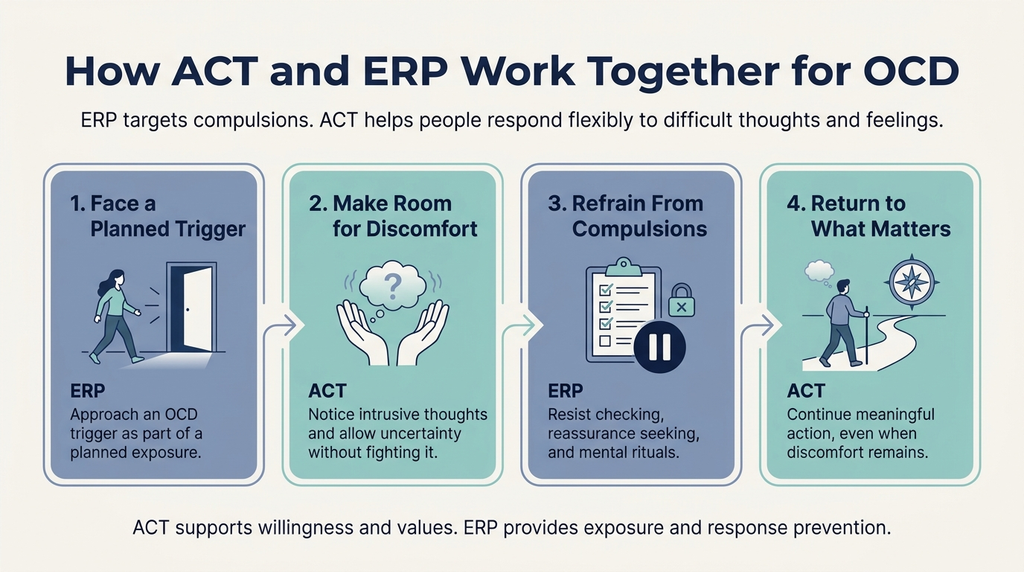
Standard ERP and ACT-informed ERP retain the same core task: contact a relevant trigger while not completing the ritual. Their explanations and therapeutic emphasis may differ. This table summarizes common emphases, not rigid rules.
| Focus | Standard ERP emphasis | ACT-informed ERP emphasis |
| Exposure | Learn that feared cues and uncertainty can be handled without rituals. | Practice willingness to experience discomfort in service of chosen values. |
| Intrusive thoughts | Evaluate obsessional interpretations where useful; learn through exposure. | Notice thoughts as mental events that need not direct behavior. |
| Anxiety | Distress may lessen through new learning, but calm is not required during every exercise. | Allow anxiety to be present without making its disappearance the goal. |
| Response prevention | Refrain from visible and mental compulsions to weaken the OCD cycle. | Refrain from the same compulsions while acting in line with values. |
Consider relationship OCD. A person repeatedly asks a partner whether the relationship is right. ERP might involve spending time together without checking feelings or asking for reassurance. ACT may help the person make room for doubt while choosing to act with care and honesty. The exposure and the response prevention remain essential; values are the motivation, not a source of certainty.
When ACT Skills Become Compulsions
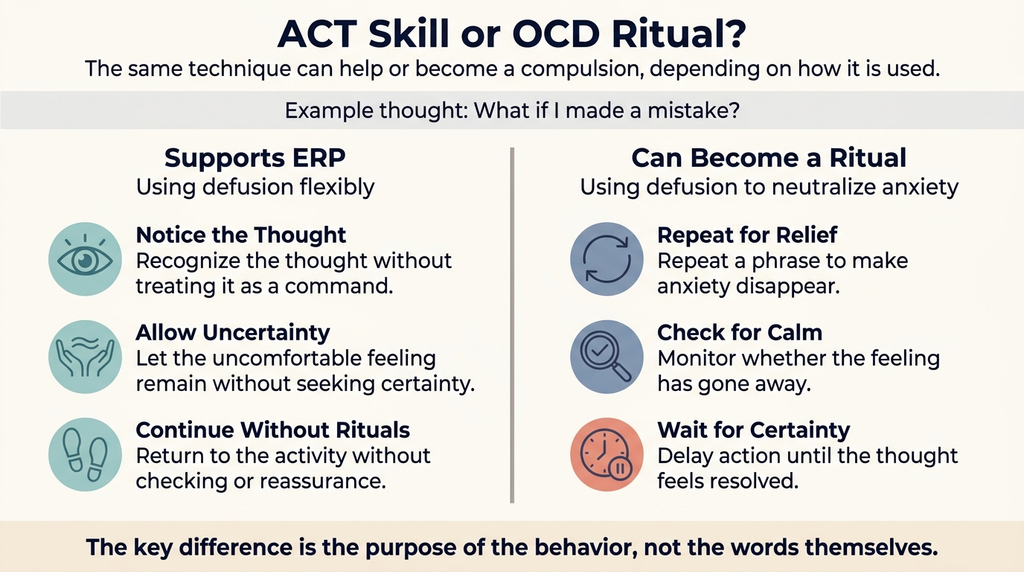
Cognitive defusion and mindfulness are not automatically helpful. If someone repeats “I am having the thought that…” until anxiety falls, the phrase may become another neutralizing ritual. Similarly, breathing exercises can turn into avoidance if they are required to feel safe before an exposure. The clinical question is whether the exercise supports contact with uncertainty and noncompulsive behavior, or whether it supplies reassurance.
ACT vs ERP for OCD: What Does the Evidence Show?
The 2018 Direct Comparison
In a 2018 randomized trial involving 58 adults with OCD, 30 received ACT-informed ERP and 28 received standard ERP. Both groups completed a planned course of 16 twice-weekly sessions. Both improved substantially, and researchers found no significant between-group differences in OCD symptom outcomes, exposure engagement, treatment acceptability, or dropout.
In a secondary analysis of the same trial, 70% of the ACT-informed ERP group and 68% of the standard ERP group met criteria for clinically significant and reliable improvement. The two numbers do not establish that ACT is superior. Equally, a nonsignificant difference does not prove the treatments are identical or equivalent for every individual.
The 2010 ACT-Only Trial
A separate 2010 trial of 79 adults compared eight weekly ACT sessions with progressive relaxation training. It found greater improvement in OCD symptoms with ACT. However, the ACT protocol had no formal in-session exposure exercises. That makes the study relevant to ACT as an intervention, but not evidence that adding ACT to ERP improves ERP results.
What the Broader Evidence Adds
A 2022 systematic review and meta-analysis described ACT as promising for OCD while calling for stronger, better-controlled trials. A 2025 trial comparing ACT plus ERP with a waitlist also reported improvement, but a waitlist comparison cannot answer whether adding ACT is better than delivering ERP well. The weight of guideline evidence still supports ERP as a first-line psychological treatment; ACT has a smaller, emerging evidence base.
In the 2025 OCD guideline update , CBT with ERP is classified as first-line psychotherapy and ACT as a second-line option. These categories describe the strength of available evidence, not whether any one patient can benefit.
Who Might Find ACT-Informed ERP Helpful?
ACT framing may be worth discussing when a person understands the logic of ERP but feels unable to proceed unless disgust, guilt, anxiety, or uncertainty goes away first. It may also help when shame about intrusive thoughts makes treatment hard to discuss, or when someone has lost sight of why they are doing difficult exposures. For a general explanation of acceptance-based strategies, see our ACT techniques for anxiety guide.
That is a reasoned clinical use, not proof of a special advantage. Trials have not established that ACT-informed ERP reliably prevents dropout or rescues people who previously refused ERP or did not respond to a properly delivered ERP course. If treatment feels stuck, first assess whether exposures were relevant and repeated, whether mental rituals were prevented, and whether between-session practice happened.
Sometimes the next step is a more experienced OCD clinician, a higher intensity of ERP, treatment of a co-occurring condition, or medication evaluation rather than a change in therapy branding.
What Treatment Might Look Like in Practice
Suppose someone fears that an intrusive image means they might cause harm. An ERP clinician would assess the obsession and its compulsions, then plan individualized, safe exposure and response-prevention work. ACT could contribute a brief practice of noticing the image as a mental event and allowing uncertainty while the person refrains from checking their intentions, seeking reassurance, or mentally replaying the thought.
With checking OCD, a plan might address leaving a routine task after checking once, rather than returning repeatedly or requesting confirmation. ACT may connect that practice to values such as independence and being present with family. These are illustrations of treatment principles, not do-it-yourself exposure instructions. Exposure plans should be individualized by a trained clinician and should not involve real danger.
How to Find a Clinician Trained in ACT and ERP
A therapist listing ACT or ERP on a website does not by itself demonstrate competence. Ask about supervised OCD cases, experience recognizing mental compulsions, how exposure hierarchies are built, and how progress is assessed. The University of Pennsylvania Ex/RP certification program illustrates a substantive training pathway that includes an intensive workshop, consultation on completed cases, and a consultant recommendation.
Useful questions to ask a prospective clinician include:
- How do you identify reassurance seeking, rumination, and other mental rituals?
- What response-prevention steps would accompany a typical exposure?
- How do ACT exercises support exposure without becoming rituals?
- How do you set between-session practice and adjust the plan if progress stalls?
- How do you decide when medication consultation or a higher level of care is appropriate?
Be cautious of promises that treatment will never be uncomfortable, that compulsions can continue indefinitely during exposure, or that ACT plus ERP has been proven superior to standard ERP.
Measuring Progress and Reassessing Treatment
A clinician may use the Yale-Brown Obsessive Compulsive Scale (Y-BOCS), a 0 to 40 measure of OCD symptom severity, alongside functional measures such as time spent ritualizing, avoidance, school or work participation, and relationship interference. Research on OCD outcomes suggests that a reduction of at least 35% in Y-BOCS scores is a useful component of defining treatment response, particularly alongside a clinician-rated improvement measure. Remission is a more demanding outcome and is not the same as improvement.
If progress stalls, a qualified provider should review exposure quality, homework, covert rituals, family accommodation, comorbid symptoms, and whether the treatment intensity is sufficient. Support may be delivered in different settings, including more structured services where appropriate; learn about our intensive outpatient treatment program without assuming that a particular level of care is necessary for everyone.
Frequently Asked Questions
Can ACT treat OCD without ERP?
ACT alone has shown benefit in a small randomized trial, but ERP has a much broader evidence base for OCD. A clinician should explain why an ACT-only approach is being considered and what established alternatives are available.
Is ACT better than ERP for OCD?
Not on the current direct comparative evidence. A key trial found meaningful improvements in both groups without a significant average advantage for ACT-informed ERP. This does not settle which approach will fit every person or prove that they are identical.
Can acceptance make OCD worse?
Acceptance is not the problem, but applying an exercise as a ritual can maintain the OCD cycle. Repeating phrases, checking whether you feel willing, or using mindfulness to obtain certainty may become compulsions. An OCD-trained clinician can help distinguish flexibility from neutralization.
Finding a Workable Next Step
ACT for OCD is most useful when acceptance, defusion, and values-based action help someone do the central work of ERP: face relevant uncertainty without completing rituals. If ERP has been difficult or unproductive, a careful review of treatment quality and barriers is more informative than assuming ACT is a proven replacement or guaranteed upgrade.
Explore Summit Mental Health’s OCD treatment overview and ACT therapy approach. If you are considering treatment, contact the team to ask about clinicians’ OCD and ERP training, available treatment options, and whether a more specialized referral would be appropriate. No single therapy format is right for everyone.

