
Many adults live for years with ADHD symptoms in adults that look like laziness, anxiety, or plain disorganization instead of a treatable neurodevelopmental condition. The clearest sign is a pattern of forgetfulness, procrastination, and trouble finishing tasks that started before age 12 and still shows up in at least two parts of life, like work and home. This article covers the quiet signs of ADHD in adults, why late diagnosis ADHD is common, and what a good evaluation should include.
ADHD Symptoms in Adults That Often Slip By
When people picture attention deficit hyperactivity disorder, they usually picture a bouncing kid who cannot sit still in class. Adult ADHD symptoms tend to look nothing like that. An adult might seem calm and put together on the outside while their mind drifts constantly, appointments slip by unnoticed, and a stack of paperwork grows on the counter for weeks at a time.
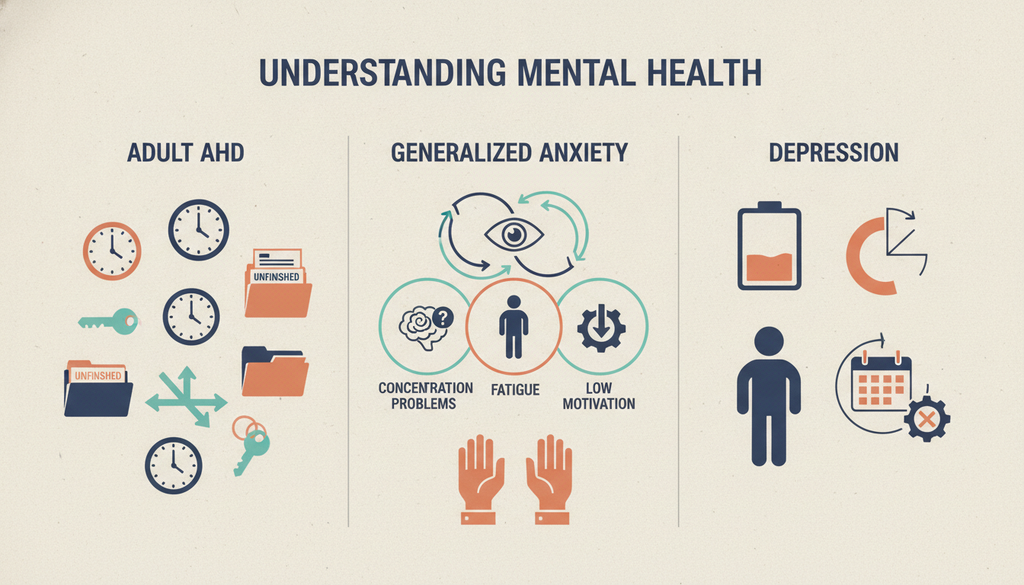
The condition is a developmental one, not simply a label for having a rough week or a hard time focusing. A useful piece of differential diagnosis guidance points out that attention problems on their own do not automatically mean ADHD, since anxiety, depression, poor sleep, grief, and plain overload can all cause someone to look distracted or disorganized. What sets ADHD apart is that the pattern starts early, sticks around through different seasons of life, and shows up in more than one setting rather than only during a stressful stretch.
For adults aged 17 and older, the diagnostic criteria call for at least five symptoms of inattention, or five symptoms of hyperactivity and impulsivity, with several of them present before age 12. That early evidence does not need to come from an old report card. It can come from a clear memory of daydreaming through class, forgetting homework, losing track of conversations, or being called “bright but scattered,” as long as a similar pattern still shows up today.
Why the Picture Looks Different in Adulthood
Kids with ADHD are often visibly restless. Adults tend to internalize that restlessness. It shows up as a racing mind, impatience in traffic or meetings, or a constant low level of tension even while sitting still. The outward behavior calms down with age far more often than the inner experience does.
Signs of ADHD in Adults Beyond Hyperactivity
Adult ADHD symptoms rarely look like the hyperactive stereotype from childhood. Hyperactivity in adults is less likely to look like running around a room and more likely to feel like an engine that will not turn off, paired with quieter habits that build up slowly over years. Signs of ADHD in adults tend to cluster around attention, time, and carrying tasks through, rather than obvious commotion.
Common patterns include:
- Losing track of time and consistently misjudging how long a task will take
- Starting several projects at once and finishing only a few of them
- Forgetting appointments, bills, or messages despite genuinely good intentions
- Feeling restless or on edge even during quiet, low pressure moments
- Needing a deadline, urgency, or strong interest just to get moving
- Misplacing keys, phones, or paperwork on a regular basis
None of these signs mean much on their own. Most people forget a bill or lose their keys now and then. The pattern becomes meaningful when it repeats across different years and different settings, and when it causes real trouble at work, at home, or in relationships rather than being an occasional slip.
Emotional and Executive Function Clues
Attention is only part of the picture. Many adults with ADHD describe quick bursts of frustration, a short fuse when interrupted, or a wave of overwhelm the moment several demands land at once. An emotional dysregulation study notes that these reactions are not part of the official symptom checklist, yet they show up often enough in adults with ADHD to matter for a full picture of the condition.
Executive function, the set of mental skills used to plan, prioritize, and carry tasks through, tends to break down in a specific way. A person might know exactly what needs doing, genuinely care about getting it done, and still sit frozen in front of the task for hours. Research on task initiation struggles describes this exact experience, caring but not starting, as one of the more telling clues seen in adults with ADHD. The task often has too many steps, too little built in reward, or too much ambiguity for the brain to find a clear entry point.
This stuck feeling differs from ordinary procrastination. It does not fade just because someone decides to try harder or feels guilty enough about it. It tends to lift only when urgency spikes at the last minute, when the task suddenly becomes genuinely interesting, or when outside structure kicks in, like a coworker checking in or a strict deadline.
The Caring But Not Starting Pattern
This particular combination, wanting to do something and still being unable to begin, is one of the more reliable clues that separates ADHD from simple avoidance. Someone without ADHD who avoids a task usually avoids it because they do not want to do it. Someone with ADHD may want to badly and still find the first step nearly impossible to locate.
How ADHD Symptoms in Adults Show Up at Work
ADHD symptoms in adults often stay hidden until the demands of adult life outgrow a person’s old coping tricks. School may have gone fine thanks to structure from parents and teachers. A first job might have worked because a manager handed out clear, short tasks with tight feedback loops. Once the job grows more complex, or once someone moves into their own place with nobody double checking their calendar, the same old pattern comes back in a bigger, messier form.
At work, this can look like missed deadlines, half finished reports, or a desk buried under sticky notes that never actually get read. At home, it can look like unpaid bills, laundry that never quite makes it into drawers, or a kitchen table permanently covered in mail. Fatigue is common too. Constantly redirecting attention and fighting off distraction takes real mental effort, and that effort adds up over a full day. Clinical writing on chronic fatigue patterns points out that this kind of tiredness shows up often in ADHD but is not unique to it, since poor sleep, anxiety, and depression can all wear a person down in similar ways.
What tends to separate this from ordinary stress is consistency. The same struggles with time, follow through, and organization show up across different jobs, different relationships, and different years, not just during one particularly hard season of life.
Why Late Diagnosis ADHD Happens So Often
Late diagnosis ADHD is common, and it is not because the condition is rare in grown adults. Plenty of people were never assessed as kids, especially those with the quieter, inattentive type rather than the disruptive, hyperactive type that teachers tend to notice first. Girls and women are frequently missed for exactly this reason, since daydreaming and mild disorganization draw far less attention in a classroom than climbing on furniture ever does.
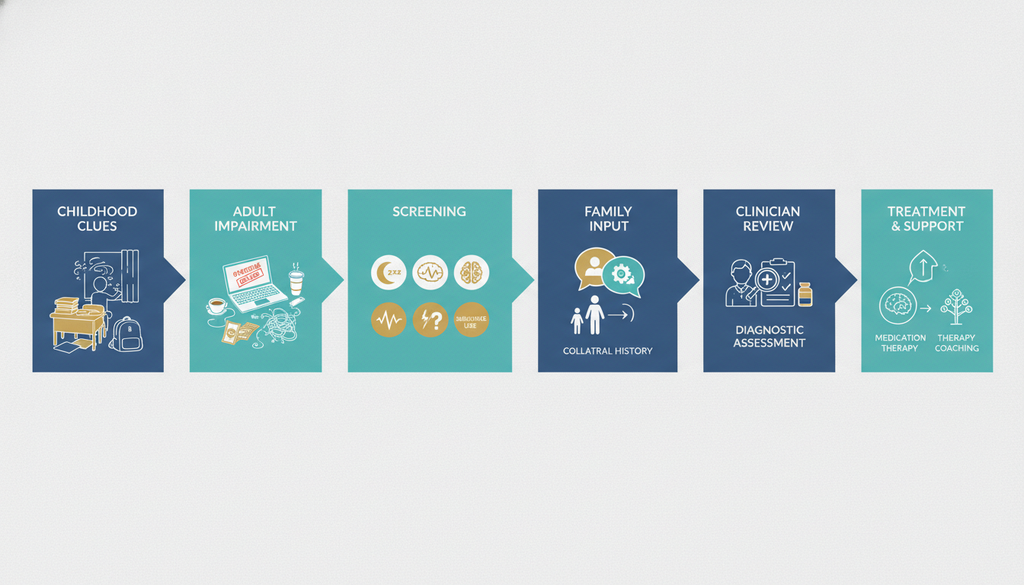
Memory also plays tricks on people. Research on childhood symptom recall found that adults often report fewer childhood symptoms than the people who actually watched them grow up, such as parents or older siblings. This does not mean a personal account is worthless. It means a good evaluation should look for outside confirmation whenever that is realistically possible, rather than leaning only on hazy memories of being eight years old.
There is also the problem of masking. Plenty of adults built elaborate systems long before anyone used the word ADHD to describe them: extra alarms, color coded calendars, working late into the night, or leaning heavily on a partner to keep the household running smoothly. These systems can hide real impairment for years, right up until a new job, a new baby, or simply a bigger workload finally breaks the routine wide open.
Getting a Proper Evaluation for ADHD in Adults
A quiz found online cannot diagnose ADHD in adults, no matter how detailed or scientific it looks. Popular self reported screeners can flag people who deserve a closer look, but their accuracy shifts quite a bit depending on who is taking them. One widely cited piece of screening tool research found strong results in a general population sample, yet accuracy dropped noticeably once the same tool was tested in a clinical group that included people already dealing with anxiety and depression.
That gap matters because anxiety and depression can produce many of the same surface symptoms as ADHD, including poor concentration, low motivation, and trouble finishing tasks. A comorbidity review notes that ADHD, anxiety, and depression often travel together and can even feed into each other over time, which makes a careful, structured evaluation far more useful than a short symptom list ever could be.
A solid evaluation usually includes a detailed conversation about childhood, current daily life, work history, sleep, substance use, and mood, along with input from someone who has known the person for years whenever that is possible. Standards described in an assessment quality standard recommend gathering information from at least one person who knew the individual as a child and one who knows their current adult life, since a single point of view rarely tells the whole story on its own. This kind of evaluation takes real time, but it is the difference between guessing and actually knowing what is going on.
Why It Matters
Missing adult ADHD symptoms for years carries a real cost. People blame themselves for being lazy or careless when the actual issue is a brain that needs a different kind of support. Chronic lateness, forgotten bills, and unfinished projects chip away at confidence, strain relationships, and can quietly feed the very anxiety or depression that grows out of years of feeling like a disappointment to others and to yourself.
Naming the pattern correctly changes the plan going forward. Someone whose anxiety improves with treatment but who still cannot start routine tasks or keep track of time deserves a closer look at ADHD, rather than an assumption that the anxiety diagnosis already explains everything happening. The goal is not a label for its own sake. It is a plan that actually fits the person’s real pattern of struggle, so the support offered matches the problem instead of only treating the parts that are easiest to see from the outside.
If any of this sounds familiar and you are not sure whether anxiety, depression, or ADHD is really behind the struggle, talking with someone trained to sort through that overlap can help. Reach out to explore an outpatient program built around your full mental health picture, not just the symptom that happens to be loudest right now.

