
Do your closest relationships leave you feeling anxious, shut down, or stuck in the same painful cycle? Adult attachment issues shape how you handle distress, ask for help, and read closeness, and therapy can help you build what researchers call earned security. A meta-analysis of 36 studies and 3,158 patients found that gains in attachment security during treatment lined up with better outcomes. This article explains anxious, avoidant, and disorganized patterns and what actually helps each one.
Understanding Adult Attachment Issues
Attachment is not a dating label. In therapy research, it works as a system for regulating distress and predicting whether other people will be there for you. Your early experiences with caregivers shape internal working models, meaning lasting expectations about whether your needs matter and whether others can be trusted.
These models influence how you handle conflict, ask for support, and interpret a delayed text or a canceled plan. What seems routine to one person can feel like abandonment, intrusion, or danger to another.
Most researchers now describe attachment along two dimensions rather than fixed types. One is attachment anxiety, which is fear of rejection and worry about a partner’s availability. The other is attachment avoidance, which is discomfort with closeness and a strong pull toward self-reliance. A prototypically secure pattern sits low on both, according to the adult attachment research from Professor R. Chris Fraley.
Insecurity is common and clinically relevant, but it is not a diagnosis. It also is not permanent.
Attachment Is a Pattern, Not a Life Sentence
Attachment shows real continuity over time, yet continuity is not destiny. Fraley’s meta-analytic work found a moderate correlation of about r = .39 in attachment security from infancy through early adulthood. Early patterns influence you, but later experiences can revise them.
This matters. If attachment were fixed, therapy could only teach coping around a permanent gap. Instead, the evidence supports something better. Repeated new experiences, reflection, and reliable support can shift how you relate.
Why Attachment Issues Affect Therapy Itself
Attachment shapes whether you start treatment, stay, and trust the person trying to help. A systematic review of 18 studies on treatment utilization found that attachment anxiety linked to more engagement and participation, while avoidance linked to less help-seeking and lower participation.
That does not mean anxious people are motivated and avoidant people are not. An avoidant person who skips a session after a hard disclosure may be protecting themselves, not giving up. An anxious person who asks for reassurance may be trying to restore a sense of safety.
The therapeutic alliance also matters. It includes agreement on goals, agreement on tasks, and an emotional bond, and it reliably predicts outcome at about r = .28. One review reported that attachment anxiety linked to slightly weaker alliance and that avoidance did too. These are small average effects, but they can loom large during conflict, disappointment, or termination.
Signs of Anxious, Avoidant, and Disorganized Patterns
Here is a quick way to compare the three broad presentations.
- Anxious or preoccupied: strong proximity-seeking, fear of rejection, emotional amplification, and trouble tolerating separation or ambiguity.
- Avoidant or dismissing: emotional distancing, discomfort with dependence, compulsive self-reliance, and limited access to vulnerable feelings.
- Disorganized, fearful, or unresolved: contradictory approach and avoidance, dysregulated emotion, trauma-linked fear, dissociation, and unstable trust.
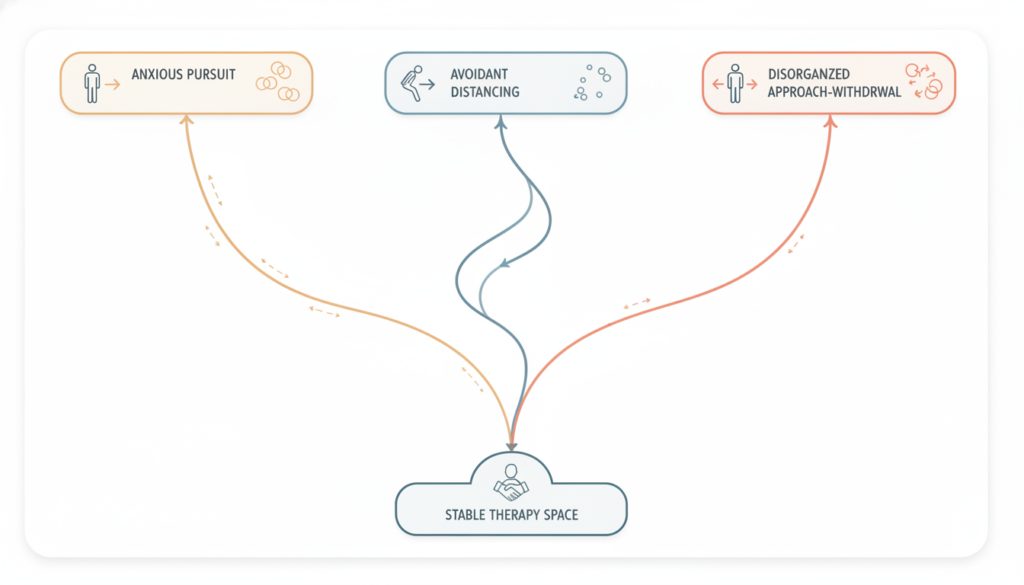
These are not rigid boxes. You might feel anxious with a partner, avoidant with a parent, and fairly secure with friends. Good therapy uses these patterns as hypotheses, not labels.
Anxious Attachment Therapy: Connection With Boundaries
Anxious attachment involves hyperactivation of the attachment system. You may scan for signs of distance, feel urgent panic when someone pulls back, and fear that disagreement will cost you the relationship.
In treatment, this can look like frequent reassurance-seeking, dread of breaks or endings, overdisclosure early on, or compliance that hides real feelings. These are attempts to feel safe, not proof of being too needy.
Effective anxious attachment therapy combines steady emotional availability with dependable limits. The corrective experience is not unlimited access. It is discovering that the relationship survives your anger, disagreement, and distance without falling apart.
How Different Approaches Help Anxious Attachment
Emotionally focused work helps you separate the visible protest, like anger or panic, from the primary fear underneath, such as “I will be left.” Instead of escalating, you learn to name the need directly.
Mentalization-based treatment restores curiosity when certainty takes over. Rather than concluding “my therapist is done with me,” you learn to ask what you imagined and whether more than one explanation could be true.
Schema therapy targets patterns like abandonment or defectiveness. You learn to recognize the cycle, soothe the vulnerable part, and build a healthy adult response that honors real needs without demanding constant proof.
Avoidant Attachment Therapy: Safety Before Vulnerability
Avoidant attachment involves deactivation. You may minimize distress, prize independence, and distrust dependence. These strategies often developed where asking for comfort was unsuccessful, criticized, or unsafe.
In therapy, this can look like presenting practical problems while dodging feelings, intellectualizing emotion, skipping sessions after closeness increases, or reporting that everything is “fine” with little engagement. This is easy to misread as low motivation, which is a serious error.
Avoidant attachment therapy needs gradual engagement, respect for autonomy, and carefully paced emotional depth. Engagement is a treatment target, not a hurdle. Follow-up after a missed session or a difficult conversation is itself an attachment intervention.
The point is not to make you emotionally expressive on someone else’s schedule. It is to expand your capacity to notice and share feelings without automatic shutdown. A therapist might say, “You handled it. I also notice the conversation gets very practical when we near what it cost you. Could we stay with that for thirty seconds?” That preserves your control while building tolerance for closeness.
Disorganized Attachment in Adults: Safety First
Disorganized attachment in adults involves a painful conflict where closeness feels like both comfort and threat. This pattern often links to trauma, abuse, frightening caregiving, or unresolved loss. You may seek intense closeness, then flee, dissociate, or abruptly cut contact.
The main treatment error is assuming more emotional intensity is always helpful. When closeness itself is a trigger, unstructured intensity can raise dissociation, self-harm risk, and dropout. So the sequence matters.
| Treatment phase | Priority for disorganized presentations |
| Engagement | Establish safety, crisis planning, and a predictable frame |
| Stabilization | Grounding, emotion regulation, and careful pacing |
| Core work | Build mentalization and integrate trauma gradually |
| Rupture repair | Slow down, ground, clarify safety, and repair unpredictability |
Mentalization-based treatment fits well here. When a session ends and you feel abandoned, the therapist does not just reassure or enforce the limit coldly. They help you slow down and explore whether the boundary and their care can both be true. The therapist’s steadiness is central, because unpredictable warmth or shifting boundaries can deepen expectations of relational danger.
The Relationship as the Main Tool for Change
The therapeutic relationship is not just a warm backdrop. It is an active intervention that repeatedly contradicts old predictions while keeping boundaries and reality intact.
Alliance ruptures are strains in that relationship. They can be confrontational, like anger or blame, or withdrawn, like silence or overcompliance. A meta-analysis found that clients whose ruptures were repaired had better outcomes than those with unresolved ones, and repaired ruptures even outperformed no reported ruptures at all.
That is powerful for insecure attachment. Repair offers direct evidence that conflict does not have to end in rejection, retaliation, or abandonment.
Can Attachment Security Really Be Earned?
Yes, and the research supports a clear but qualified answer. The strongest source, a meta-analysis of psychotherapy outcome, found that more secure attachment before treatment predicted better outcomes and that gains in security during therapy coincided with better outcomes.

A large controlled trial with 495 patients who had social anxiety showed that attachment characteristics can change during treatment, even in therapies not built as attachment interventions. In that study, attachment anxiety showed some reduction while avoidance stayed relatively stable, which suggests avoidance may take longer to shift.
A 2025 systematic review of 39 studies found that most reported shifts toward greater security after therapy, with the strongest effects in longer treatments. Because it is a dissertation, I would weight it below the peer-reviewed meta-analysis, but the direction is consistent.
Earned security is not perfect erasure of the past. It shows up as increased flexibility under stress, meaning you can:
- recognize when your attachment system fires up
- seek support selectively and effectively
- keep your autonomy while accepting closeness
- repair conflict instead of treating it as proof of doom
Why This Matters for Your Life
Attachment issues are not a fixed identity. Anxious, avoidant, and disorganized patterns differ less in how much you want closeness and more in what closeness, dependence, and separation have come to mean. That is why the same therapy dose does not fit everyone.
Anxious patterns respond to reliable connection with clear limits. Avoidant patterns respond to predictable, low-pressure collaboration that proves need does not equal humiliation. Disorganized patterns need safety and stabilization before deep attachment work. Across all three, a steady, reflective relationship becomes the place where you learn something new about being close.
If your relationships keep repeating painful patterns, you do not have to sort this out alone. Reach out to explore attachment work with a licensed team that can match care to your needs.

