
Internal Family Systems (IFS) meditation is a way to notice thoughts, emotions and protective reactions as different “parts” of your inner experience. Instead of trying to silence an anxious or critical part, you practice meeting it with curiosity. This guide explains how an IFS guided meditation works, offers a brief beginner exercise and shows when parts work is better done with a trained therapist.
What Is Internal Family Systems Meditation?
Internal Family Systems is a psychotherapy model developed by Richard Schwartz. It describes the mind as containing different parts—including protective and vulnerable responses—and a capacity for compassionate awareness called Self. In the model, these parts are not automatically symptoms or separate identities. They are a way to understand inner conflicts, such as wanting closeness while also fearing rejection. Read Summit Mental Health’s introduction to IFS therapy or the IFS Institute’s description of the model for more context.
An internal family systems meditation adapts some of that language for gentle self-reflection. You might notice a tight feeling in your chest before a difficult conversation, recognize “a worried part of me wants to avoid this,” and ask what it is trying to protect. You do not need to visualize characters, hear inner voices or uncover childhood memories to practice this skill.
In IFS terms, “blending” means becoming so caught up in a part’s viewpoint that it feels like the whole truth. “Unblending” means gaining enough perspective to notice, “Part of me is frightened,” without assuming that fear defines all of you. The aim is not to suppress the feeling or force the part away.
What Does Self Energy Feel Like During IFS Meditation?
The IFS model associates Self with qualities such as calm, curiosity, compassion, clarity and connectedness. In a short practice, Self energy might feel like a little less urgency to fight a feeling, more interest in why it appeared, or a kinder way of responding to yourself. It is not a measurable state you must achieve before the exercise “counts.” The IFS Institute describes these qualities as part of its therapeutic framework, not as a clinical test. See its overview of the Self and parts.
For example, you might begin with “I hate that I am so anxious” and shift to “I notice a worried part trying to keep me safe.” Anxiety may still be there. The change is that you can observe it with some choice. Feeling completely blank, unreal or disconnected from your body is different from this grounded distance; do not automatically label numbness or dissociation as Self energy.
A Brief IFS Guided Meditation: Meet One Part
This optional, beginner-level IFS parts meditation is intended for a manageable present-day feeling, not for retrieving memories or processing trauma. If inward attention tends to cause flashbacks, dissociation or overwhelming distress, skip solo practice and discuss safer options with a licensed clinician. Otherwise, try a short session in a familiar place, with your eyes open if that helps you stay grounded.
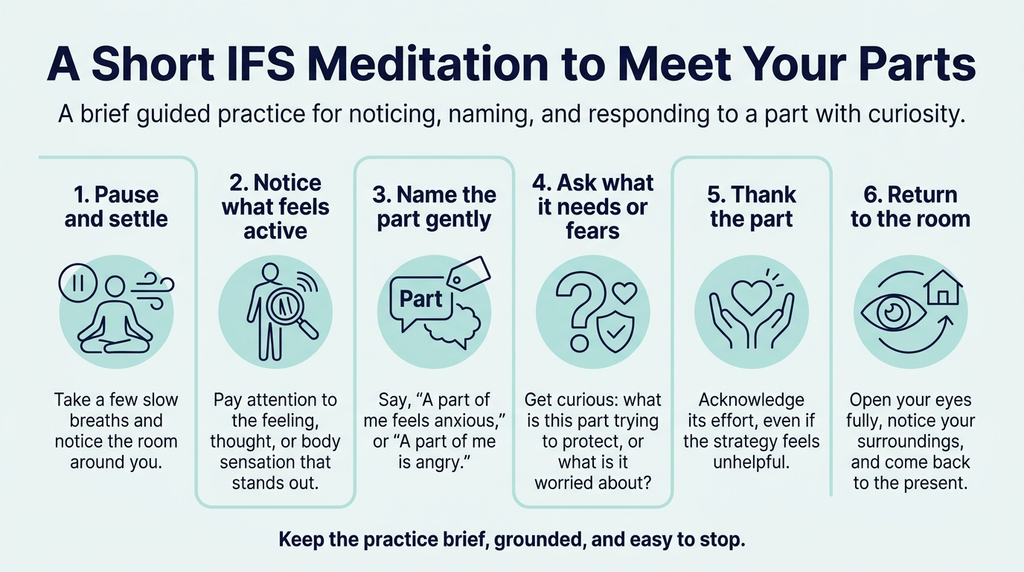
- Get oriented. Notice where you are sitting, place your feet on the floor and look around the room. You can stop at any point.
- Choose a mild feeling. Notice a manageable emotion, thought or body sensation—perhaps impatience before a meeting—not the most painful memory you can find.
- Name it as a part. Try: “A part of me feels anxious about tomorrow.” Notice whether this gives you a little space.
- Check for curiosity. Ask yourself how you feel toward that part. If you feel angry with it or pressured to fix it, notice that reaction too; do not demand calm.
- Ask one gentle question. If it feels comfortable, ask: “What are you worried might happen?” or “What are you trying to help me with?” You do not have to get an answer.
- Close deliberately. Acknowledge the feeling without promising to solve it. Look around, name a few objects, move your hands or feet and return to an ordinary activity.
There is no required duration. A few minutes may be sufficient; shorter and more externally grounded is preferable when you are unsure how you will respond. The ability to pause, remain oriented and get back to daily life matters more than having a dramatic insight.
Which Parts Might You Notice?
IFS commonly distinguishes three roles, described in Schwartz’s explanation of the model. These categories are a conceptual map, not a diagnosis or an invitation to go searching for hidden memories.
- Managers: parts that try to prevent distress by keeping control—for example, through perfectionism, planning or self-criticism.
- Firefighters: parts that react quickly when distress feels unbearable, sometimes through withdrawal, distraction or numbing.
- Exiles: vulnerable parts described in IFS as holding painful emotions or memories that protectors work to keep out of awareness.
A beginner’s practice should usually stay with a manageable, present-moment protector or emotion. Do not try to bypass protective responses to reach an “exile” or carry out self-directed trauma “unburdening.” Summit Mental Health explains these concepts further in its guide to parts work.
What If a Part Will Not Step Back?
A part that does not “unblend” is not proof you have failed. Within the IFS model, resistance may be understood as a protective response. Instead of pushing it aside, try acknowledging, “You do not have to change right now,” and end the exercise if it feels strained. You can return to a simple grounding activity without solving the issue.
The distinction is how the experience affects you. Feeling reluctant to continue is different from escalating panic, being unable to recognize your surroundings, losing time, or feeling compelled to keep meditating despite worsening symptoms. Those experiences call for stopping and seeking support, not pressing harder.
When to Pause: Warning Signs During IFS Meditation
Meditation is not automatically harmless simply because it is quiet or self-compassionate. Some people experience distressing or impairing effects during inwardly focused practices. However, studies on meditation-related adverse effects generally examined mindfulness programs or other meditation practices—not brief self-guided IFS exercises. Their statistics should not be presented as the risk rate of IFS meditation.
For example, a 2021 study of 96 mindfulness-program participants recorded meditation-related experiences, including some that were unpleasant or affected functioning. A 2024 study of 886 meditators also showed why intensity, duration and effects on everyday life matter when interpreting unusual experiences. Neither study establishes how frequently these problems occur during solo IFS parts meditation.
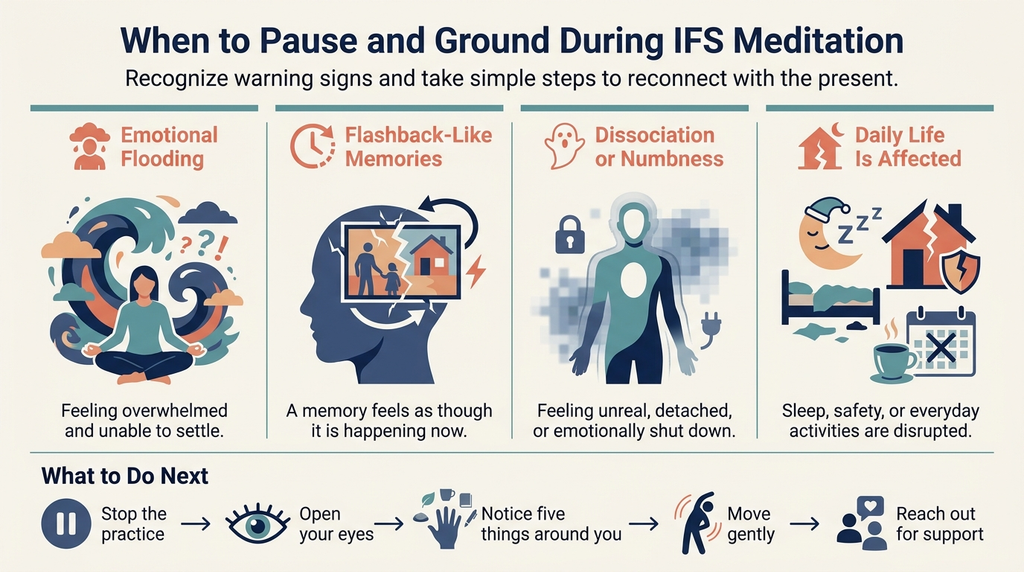
Stop the exercise and return to the present if:
- You feel emotionally flooded, panicked or unable to settle or orient to the room.
- A memory feels as though it is happening now, rather than being remembered.
- You feel unreal, detached from your body, unusually numb or confused, especially if this continues after stopping.
- Your sleep, concentration, relationships or ordinary functioning become worse after practicing.
- You experience urges to harm yourself, or feel unable to keep yourself safe.
If this happens, open your eyes, identify your surroundings, feel your feet on the floor, move gently and contact someone you trust if needed. Avoid driving or making major decisions while disoriented. If symptoms continue, recur or interfere with daily life, seek assessment from a qualified mental health professional. For immediate danger or an inability to stay safe, seek emergency help instead of trying another meditation.
When Is a Trained IFS Therapist the Better Choice?
Solo IFS meditation is not a substitute for treatment of trauma, PTSD, severe dissociation, suicidal thoughts, mania or psychosis-related symptoms. If the practice repeatedly brings up intrusive memories, overwhelming feelings, missing time, disturbed sleep or impaired functioning, a licensed, trauma-informed therapist can help assess what is happening and pace the work more safely. For significant changes in reality testing or confused thinking, seek timely clinical assessment; the National Institute of Mental Health identifies relevant warning signs.
Check licensure independently, along with experience in trauma and dissociation. The IFS Institute’s credential guidance distinguishes IFS Certified Therapists and Practitioners and cautions that it does not independently verify everyone’s professional license. The right question is not only “Do you use IFS?” but “Are you licensed to provide psychotherapy here, and how do you respond if a client becomes overwhelmed?”
IFS is an emerging psychotherapy approach with a developing research base. A 2026 randomized trial of a structured, therapist-supported IFS-based PTSD program reported improvement in both treatment groups without a statistically significant difference between them. That does not establish the effectiveness or safety of unsupervised parts meditation, which was not the intervention tested.
Can I Use IFS Meditation Every Day?
Some people find brief reflective practice useful, but there is no evidence-based daily dose for solo IFS meditation. It is reasonable to treat it as optional, start small and stop if symptoms worsen. The point is not to force access to an inner part, collect emotional breakthroughs or achieve constant calm. The point is to notice what is happening while keeping perspective, choice and a connection to daily life.
If you want more structured help, Summit Mental Health describes how IFS-informed trauma care may be paced in therapy. You can also review the center’s mental health treatment programs to explore whether professional support may fit your needs.
The Bottom Line on IFS Meditation
An IFS guided meditation offers a way to say, “A part of me feels this,” instead of letting one reaction define your entire experience. Begin with a mild, present-day feeling, approach it with curiosity and end by reconnecting with your surroundings. You do not need perfect Self energy, a vivid inner dialogue or a breakthrough for the practice to have meaning.
When IFS parts meditation causes recurring flooding, trauma reliving, dissociation or loss of everyday functioning, stop solo practice and seek licensed clinical support. The safest approach is one that leaves you with more choice and groundedness—not less. If you would like to discuss therapy options, explore Summit Mental Health’s Internal Family Systems treatment information.

