
Depression can make it hard to put feelings into words. Many people with depression struggle not only with low mood and hopelessness but also with verbalizing what they’re experiencing inside.
Art therapy offers a different route: using creative expression within a structured therapeutic relationship to externalize emotion, regulate feelings, and support recovery.
Recent research shows that art therapy can meaningfully reduce depressive symptoms, especially when delivered by trained therapists in formats that combine image-making with reflection and emotional processing.
What Art Therapy is and How It Differs From Creative Hobbies?
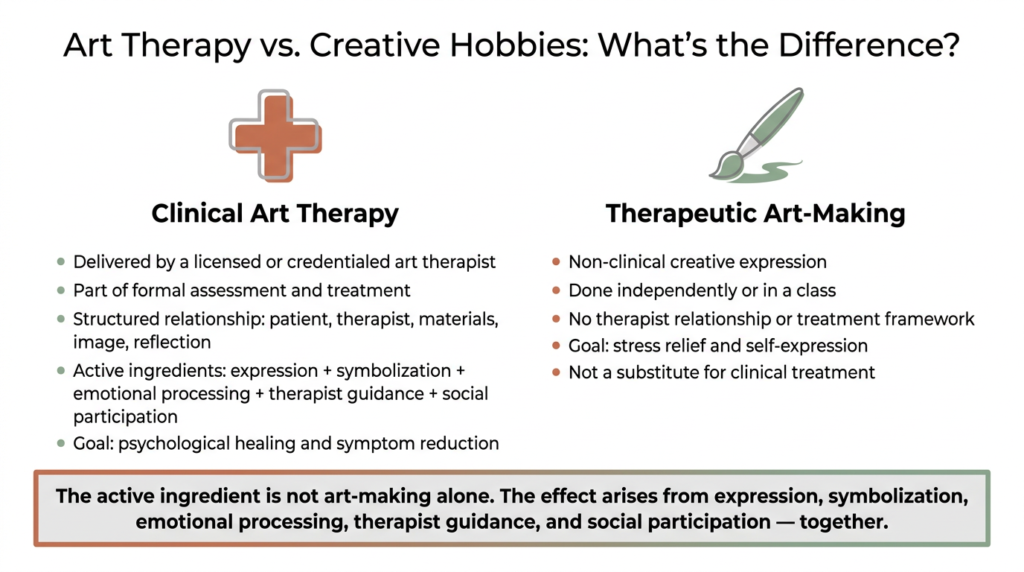
Art therapy is a form of psychotherapy that uses visual art-making and related creative processes as part of assessment and treatment. It is not simply producing artwork independently or taking an art class. The therapeutic element comes from the structured relationship among patient, therapist, materials, image-making, and reflection.
A useful contemporary distinction separates clinical art therapy, which is treatment delivered by a licensed or credentialed art therapist, from therapeutic art-making, which refers to non-clinical creative expression for stress relief and self-expression.
This distinction matters clinically because the active ingredient is unlikely to be art-making alone. Rather, the effect seems to arise from a combination of expression, symbolization, emotional processing, therapist guidance, and often social participation.
Why Creative Expression Helps Manage Depression?
Depression often narrows psychological functioning. Patients may experience low energy, emotional blunting or overwhelming affect, difficulty naming feelings, self-criticism, social withdrawal, hopelessness, and reduced sense of meaning.
Talk therapy can be highly effective, but not every patient can access or tolerate sustained verbal self-disclosure, especially when affect is diffuse or nonverbal.
Art therapy offers a nonverbal creative outlet for emotional expression and processing, especially useful for people who struggle with conventional talk-based therapies.
This claim aligns with broader findings from realist and neuroscience-oriented work showing that creative engagement activates neural systems implicated in adaptive emotion regulation.
Externalization of Internal Experience
One of the most consistent themes across research is that art therapy helps transform internal, often vague emotional states into something external, visible, and more manageable.
A realist review of art therapy for depression identified therapeutic factors such as self-exploration, self-expression, communication, acceptance of depression, readiness to express emotions, achievement, balance, insight, growth, and meaning.
Depression frequently traps people in an undifferentiated negative mood. Art-making can convert this diffuse state into color, line, shape, sequence, metaphor, or image. Once represented, an emotion can be observed, discussed, reframed, and integrated.
Agency, Mastery, and Achievement
Depression undermines the sense that one can initiate, influence, or complete meaningful action. Creative tasks may restore a limited but important sense of agency. Completing an artwork, making choices, experimenting, revising, and witnessing change can counter helplessness.
This aligns with behavioral activation logic: depression improves when people re-enter constructive activity and receive reinforcement from doing, making, and relating.
Social Connection and Reduced Isolation
Group delivery appears repeatedly as an important feature in depression research. Group art therapy may reduce loneliness, increase belonging, and make sharing less threatening than direct conversation.
In older adults, both a 2019 review and a 2026 meta-analysis highlight the recurrence and promise of group-based formats. This may be especially relevant because social withdrawal is both symptom and driver of depression.
The Evidence Base: What Research Shows About Art Therapy for Depression?
Strong Evidence in Children and Adolescents
The strongest direct evidence for art therapy in depression currently comes from children and adolescents.
A 2025 systematic review and meta-analysis restricted to peer-reviewed randomized controlled trials involving participants aged 18 years or younger found significant improvement in depressive symptoms versus control, with an effect size of -0.72 and a confidence interval of -1.28 to -0.16.
An effect size of this magnitude is clinically meaningful, suggesting moderate to large average benefit. However, heterogeneity was extremely high, meaning outcomes varied substantially.
The right interpretation is not that art therapy reliably produces a large effect in all youth, but rather that art therapy appears capable of producing clinically significant improvement in youth depression, though outcomes vary.
Promising Evidence in Older Adults
The strongest recent adult evidence comes from late-life depression. A 2026 PRISMA-based systematic review and meta-analysis of 23 randomized controlled trials involving 3,791 participants aged over 55 years examined group-based art interventions for depression.
The overall effect size was -0.93 with a confidence interval of -1.19 to -0.68, suggesting that group-based arts interventions can meaningfully reduce depressive symptoms in older adults.
Important nuances include that these were group-based interventions, and art interventions included music, dance, and visual arts. The review notes that current evidence does not justify routine replacement of standard treatments.
Art-based therapies should be considered complementary to pharmacotherapy and psychotherapy rather than substitutes.
Direct Adult Depression Evidence
A particularly important study is a randomized controlled trial that evaluated art therapy as an adjunctive treatment for elderly women with major depressive disorder who were stable on pharmacotherapy. The experimental group received 20 weekly sessions of 90 minutes each.
The study found significant improvement relative to control on depression and anxiety measures, with no significant cognitive differences.
This trial strengthens the argument that art therapy can have real antidepressant effects beyond generalized well-being. It also suggests that mood and anxiety may improve even when cognition does not.
Modality-Specific Findings
Not all art modalities appear equivalent. In subgroup analyses from the 2025 review, painting therapy showed a statistically significant effect on depressive symptoms with an effect size of -1.21, while music therapy was not significant in that analysis.
This strongly suggests that modality-specific mechanisms matter, and that visual modalities may currently have the best direct evidence for mood improvement.
Neurobiological Mechanisms: How Art Therapy May Work in the Brain?
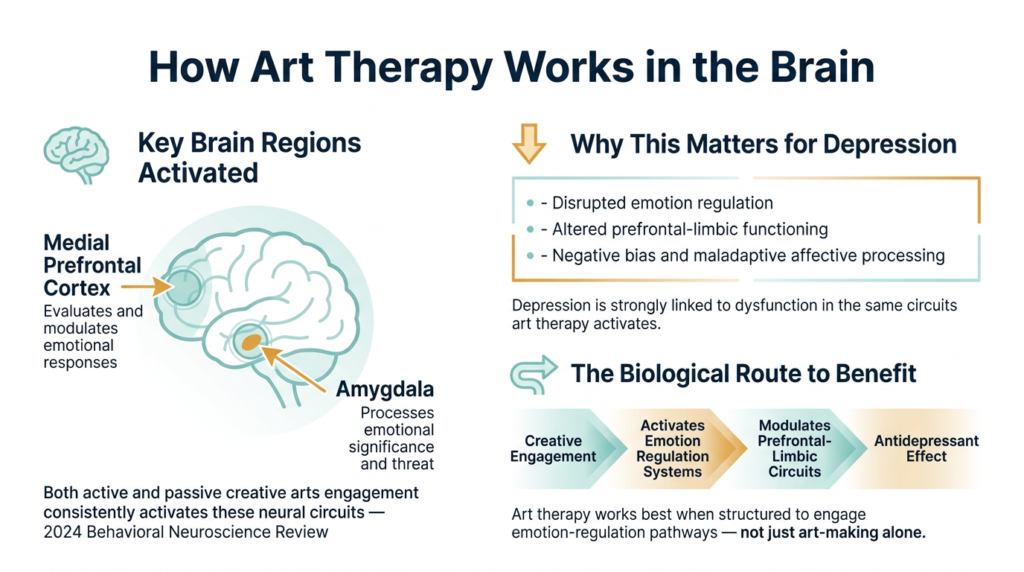
A 2024 systematic review in behavioral neuroscience found preliminary evidence that both active and passive engagement in creative arts consistently activates neural circuits involved in adaptive emotion regulation, especially the medial prefrontal cortex and amygdala.
This matters because depression is strongly associated with disrupted emotion regulation, altered prefrontal-limbic functioning, negative bias, and maladaptive affective processing.
If creative engagement recruits systems involved in evaluating, modulating, and integrating emotion, then art therapy has a plausible biological route to antidepressant benefit.
The review suggests that identifying shared neural mechanisms between creative expression and emotion regulation could help build more targeted therapeutic interventions, implying that art therapy may work best when structured to engage emotion-regulation pathways rather than relying on art-making alone.
Practical Art Therapy Activities for Depression
Visual Journaling as a Core Low-Cost Practice
Visual journaling is among the most accessible art-based practices. It is described as an important and accessible expressive arts therapy approach that may work particularly well as between-session homework because it is easy to begin and does not require advanced art skills.
Psychology Today describes visual journaling as a self-care and wellness practice comparable in spirit to exercise and nutrition, supporting stress reduction and creative engagement.
Depression often narrows verbal output and produces cognitive overprocessing. Visual journaling offers a middle ground: not silent avoidance, but not fully verbal demand either. It can hold colors for mood states, shapes for body sensations, images for memory fragments, collage for identity and hope, and short captions for emerging meaning.
Sample Visual Journaling Prompts
- Color your mood: Divide a page into sections and assign colors to today’s emotional states for low-energy mood check-in
- Image of the day: Draw one image that captures how depression felt today for reflection after difficult day
- Before and after page: Left side shows how you arrived; right side shows how you feel now after rest, walk, music, or support
- Small acts of survival collage: Use scraps, images, or words representing things you did despite depression to counter hopelessness
- Window and room drawing: Draw an inner room and what is outside the window for narrative exploration
Emotion-to-Color Journaling
Emotion-to-color journaling uses colors and shapes rather than long writing to track mood over time. This fits well with evidence on nonverbal processing and visual journaling.
It reduces the burden of language, can be done in three to five minutes, reveals patterns over time, and supports therapist discussion if brought to sessions.
A simple procedure involves drawing five to ten small boxes or circles, assigning each a feeling state from the day, filling with color, line, pressure, or pattern, and adding one sentence only if desired.
This is especially useful for people whose depression includes difficulty identifying feelings or flat responses.
Clay-Based Exercises
An adult randomized controlled trial makes clay especially important for practical recommendations. Because clay art therapy outperformed a visual-art recreational control in adults with major depressive disorder, clay deserves more attention.
Clay is tactile and grounding, encourages sensorimotor engagement, externalizes emotion physically, supports reshaping and symbolizing, and may help people who are tired of purely verbal reflection.
Evidence-aligned clay exercises include shaping the weight of depression as a physical form, creating two forms representing what depression says versus what you need, and forming a container or vessel to hold specific emotions.
Because clay work can bring up unexpectedly strong material, more emotionally intense versions should be reserved for therapist-led settings.
Painting and Drawing Interventions
Given the meta-analytic signal favoring painting therapy, painting and drawing exercises deserve a central place in practice recommendations.
Practical ideas include safe place drawing to counter emotional narrowing and build internal refuge imagery, color breathing pages that pair slow breathing with simple color movement across the page, depression landscape mapping that adds one path or source of warmth, and weather report self-portraits using weather or climate symbols.
Collage for Depression
Collage is especially suitable for people with low energy, perfectionism, or fear of not being artistic. It also works well when depression makes image generation difficult because it allows selection rather than creation from scratch. Collage supports nonverbal processing, self-expression, and cognitive reorganization.
Practical collage exercises include feelings collage for externalizing overwhelming feelings, self-compassion collage particularly relevant for harsh self-talk, and identity beyond depression board with three zones showing what depression has taken, what remains, and what you still value.
Integrating Art Therapy With CBT and Mindfulness
A 2025 grounded review explicitly suggests that art therapy may be especially useful when integrated with CBT and mindfulness-based approaches.
This is a major practical implication because depression treatment often requires multiple capacities: noticing thoughts, identifying emotion, tolerating distress, shifting behavior, restoring pleasure and meaning, and weakening self-criticism.
Art activities can support these targets rather than compete with them. Possible links with CBT include drawing automatic thoughts as characters or speech bubbles, painting mood shifts before and after behavioral activation, and creating collages contrasting depression story versus evidence story.
Links with mindfulness include color breathing pages, texture-focused drawing, repetitive patterning for grounding, and nonjudgmental mark-making without product goals.
Trauma-Informed Considerations in Depression-Focused Art Work
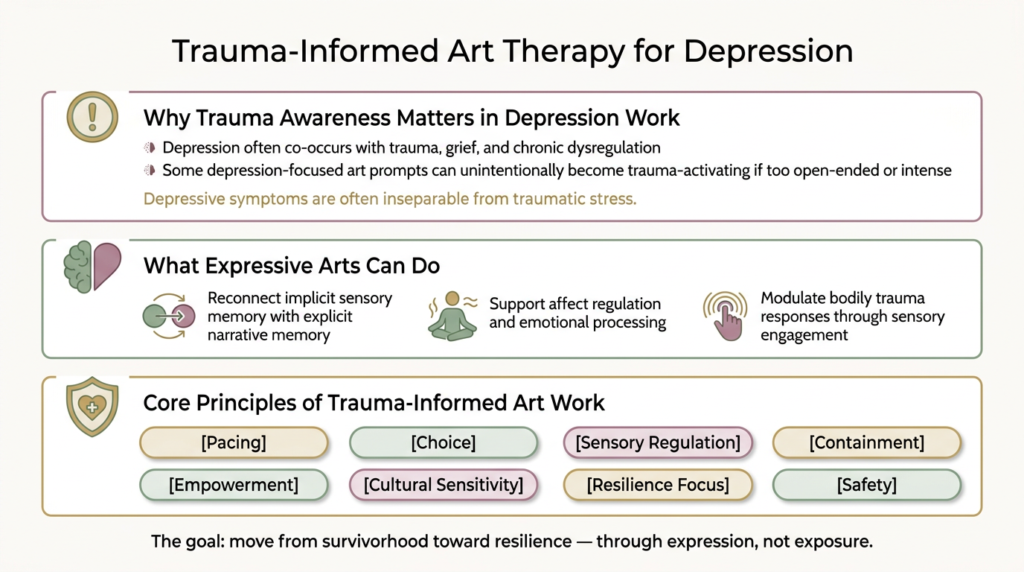
Depression often co-occurs with trauma. For some people, depressive symptoms are inseparable from traumatic stress, grief, or chronic dysregulation. Trauma-informed expressive arts therapy uses the sensory qualities of art, music, movement, and related forms to help people communicate traumatic memories, repair, and recover.
This framework emphasizes that expressive arts can help reconnect implicit sensory memory and explicit narrative memory, support affect regulation, and modulate bodily trauma responses. Some depression-oriented art prompts can unintentionally become trauma-activating if they are too open-ended or emotionally intense.
Trauma-informed art work should emphasize pacing, choice, sensory regulation, containment, empowerment, cultural sensitivity, and movement from survivorhood toward resilience.
Digital and Telehealth Delivery of Art Therapy
Remote mental health care is no longer a niche issue. An AHRQ evidence brief specifically emphasized studies comparing telehealth-delivered mental health care directly with in-person delivery of the same intervention.
A rapid umbrella review found telemental health to be potentially effective, feasible, and acceptable across mental health conditions, with symptom improvement and satisfaction broadly comparable to face-to-face care when interventions are well-designed.
The 2025 grounded review explicitly highlights digital art therapy as a way to improve access in university settings. Practical forms of remote art therapy for depression include synchronous video-based sessions where client and therapist meet by video with the client using home materials, hybrid models with some sessions remote and some in person, and digitally supplemented care with in-person therapy plus photos of artwork or app-based prompts.
Remote art therapy for depression is a valid and often valuable access strategy, but it should be treated as clinically equivalent only when the intervention is intentionally designed, privacy-protected, and professionally delivered.
When At-Home Creative Practice is Appropriate and When It Is Not?
A counseling source on at-home art therapy rightly emphasizes that home-based art activities can complement counseling and help hold feelings between sessions, but are not a replacement for therapy.
Clear warning signs for seeking professional help include panic, flashbacks, or dissociation during art-making, thoughts of self-harm or suicide, declining daily functioning, expanding substance use, and overwhelming trauma memories.
At-home creative practices are appropriate when used for mild symptom support, stress reduction, between-session homework, mood tracking, self-awareness, relapse prevention, and low-cost daily regulation.
They are not sufficient as sole care when depression is moderate to severe, suicidal ideation is present, trauma material becomes destabilizing, functioning is deteriorating, psychosis or severe dissociation is present, or substance use is escalating.
A Tiered Approach to Matching Activities to Need Level
For wellness and prevention with stress, low mood, or mild sadness, visual journaling, color breathing, collage, and mood-color tracking are suitable with self-guided or group-based support.
For mild depression with low motivation, rumination, or reduced pleasure, structured journaling, safe-place drawing, self-compassion collage, and behavioral activation art homework work well with self-guided practice plus therapist check-in if possible.
For moderate depression with persistent low mood, functional decline, or hopelessness, therapist-guided art therapy integrated with CBT or mindfulness is recommended with a licensed clinician or credentialed art therapist.
For depression with trauma involving numbness, shame, intrusive material, or body dysregulation, trauma-informed expressive arts, containment work, and paced visual processing require a trauma-informed clinician or art therapist.
For severe or high-risk depression with suicidality, marked impairment, or self-neglect, art therapy should only be used as adjunct within comprehensive treatment with a mental health team and crisis planning.
Why It Matters: Real Outcomes From Art-Based Depression Care
The evidence supports neither dismissing art therapy as soft or non-serious nor romanticizing it as a stand-alone cure. The truth is more precise. Art therapy is most credible when understood as a structured psychotherapeutic process rather than simply as doing art.
The adult clay trial is especially revealing because it compares guided clay art therapy against active creative leisure, and the therapy condition performed better. The active ingredient is likely not creativity alone; it is creativity embedded in therapeutic structure, reflection, and relationship.
At the same time, the evidence also supports a more modest but meaningful role for self-directed creative practices.
Visual journaling, color-based mood tracking, collage, and simple drawing exercises are inexpensive, accessible, low-barrier supports that can reduce stress, improve self-observation, and serve as between-session tools. But they should be framed honestly as supportive creative tools, not as equivalent to clinical treatment for depression.
If you’re experiencing depression and think art therapy might help, consider starting with simple visual journaling or color-based mood tracking as a self-care practice.
For moderate to severe symptoms, trauma-related depression, or when creative work brings up overwhelming feelings, reach out to The Summit Wellness Group’s trained professionals who can guide the process safely. Contact our team to learn how our structured art therapy can be integrated into your personalized depression treatment plan.

