
Anxiety can feel like a storm inside your head, with racing thoughts and tension that words alone can’t always reach.
Many people struggling with anxiety find that traditional talk therapy, while helpful, doesn’t fully address the physical and emotional overwhelm they experience. Art therapy offers a different path by engaging the body, senses, and emotions through creative expression rather than relying solely on verbal processing.
Research shows that art therapy can meaningfully reduce anxiety symptoms across different age groups and settings.
A 2025 systematic review of 14 randomized controlled trials involving 1,686 adults found that all included studies reported significantly greater anxiety reduction in visual art therapy groups than in control groups.
This article explains how art therapy works for anxiety, which techniques show the most promise, and how you can safely incorporate art-based practices into your own recovery.
How Art Therapy Helps Anxiety?
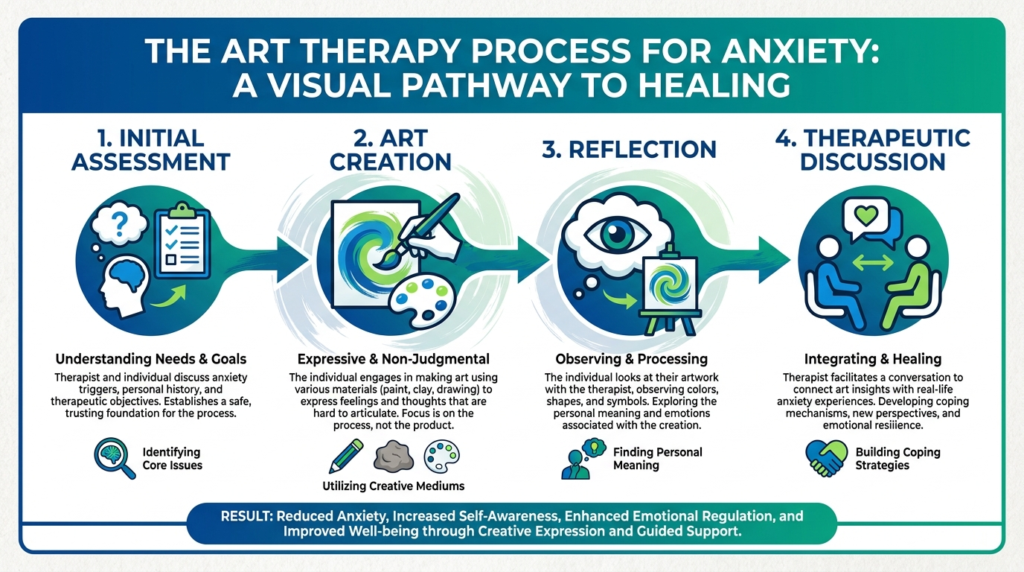
Art therapy is not simply coloring or crafting. In clinical settings, it refers to the therapeutic use of visual media such as painting, drawing, sculpting, and collage to help people express emotions, process experiences, and develop coping strategies within a psychotherapeutic relationship.
The process matters as much as the finished product, and reflection on the artwork often becomes a crucial part of healing.
Why Anxiety Responds to Visual Expression?
Anxiety often involves hyperarousal, rumination, muscle tension, and difficulty putting internal states into words.
Art therapy addresses these challenges through several interconnected mechanisms. Creating visual images can externalize difficult internal states, making overwhelming feelings more concrete and observable. When you draw your anxiety as a creature or map tension in your body, you transform something diffuse and frightening into something you can see and discuss.
The act of making art also shifts emotional processing out of purely verbal channels and into sensory, symbolic, and embodied forms. A 2021 mechanism-focused study found that image-making supports emotional elicitation and processing while improving emotion regulation. This matters because anxiety can be difficult to verbalize, especially when it involves trauma, panic, or pre-verbal bodily sensations.
Art-making redirects attention away from repetitive worry and toward a concrete task. Repetitive motions like shading, patterning, or molding clay can interrupt rumination and provide sensory grounding. The artwork itself becomes a tangible object that supports self-reflection, self-awareness, and therapeutic understanding, not merely residue from the activity.
Evidence Across Age Groups
The evidence for art therapy’s anxiolytic effects is strongest in children and adolescents. A 2024 meta-analysis of six studies involving 422 young people found a significant overall reduction in anxiety symptoms, with particularly strong effects for state anxiety rather than trait anxiety.
This suggests art therapy may be especially useful for situational stress such as school-related anxiety, medical procedures, or acute emotional arousal.
In pediatric oncology settings, where anxiety is common and linked to pain, hospitalization, and uncertainty, a 2025 systematic review of eight studies involving 452 participants found significant reductions in anxiety and depression with moderate evidence quality.
This is clinically persuasive because it shows art therapy can produce real benefits under medically intense conditions, not just in convenience samples.
For adults, the evidence is promising but less standardized. A systematic review found only three eligible randomized controlled trials totaling 162 participants, all with high risk of bias and drawn from narrow populations rather than core anxiety disorder samples.
However, a more recent randomized trial in adult women found that 10 to 12 sessions of art therapy reduced anxiety, improved quality of life, and enhanced emotion regulation, with benefits maintained at three-month follow-up.
Art Therapy Techniques for Anxiety
Not all art activities are equally effective for anxiety. The research suggests that structured, intentionally framed interventions tend to produce clearer outcomes than generic creative activity.
A randomized pilot study of adolescents with PTSD symptoms found that trauma-focused expressive art therapy outperformed treatment-as-usual arts-and-crafts activities, implying that therapeutic structure matters more than simply doing something creative.
Grounding and Immediate Regulation Techniques
These techniques are the safest starting points for anxiety because they focus on settling the nervous system rather than deep interpretation.
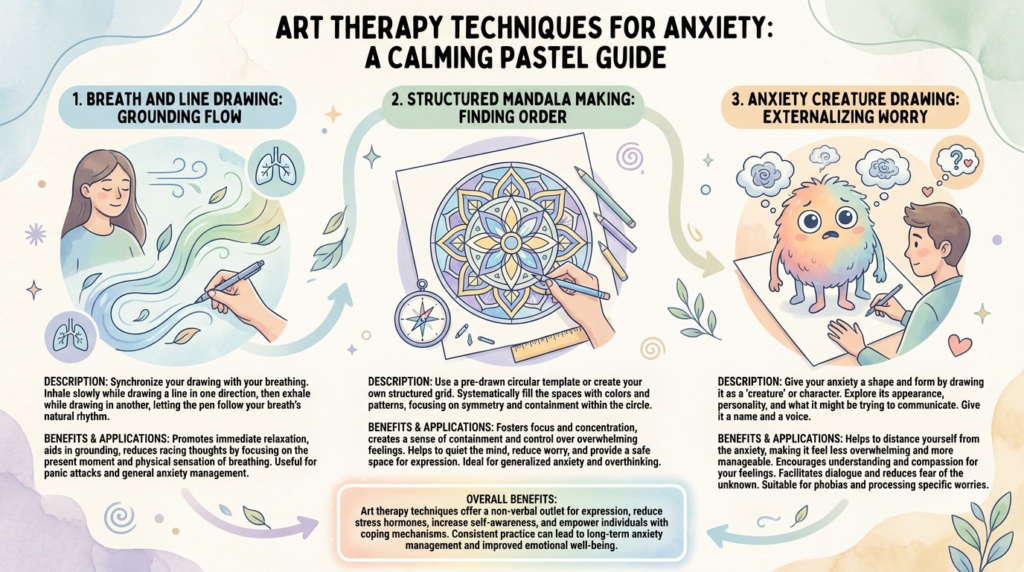
Breath and line drawing pairs breath with movement by drawing a slow upward line on inhale and downward line on exhale, repeating across the page. This integrates visual tracking, motor pacing, and breath regulation, making it especially useful for acute anxiety or pre-panic escalation.
Structured mandala making involves filling a circular space with repeating shapes, colors, or symmetrical patterns. Circular containment and repetition can be soothing, and structured instructions reduce overwhelm. Directive mandala work has been specifically described as beneficial for anxious clients in need of control and relaxation.
Tactile grounding objects such as beaded bracelets or dot-painted stones provide sensory focus during creation and can be carried later for portable regulation. This is particularly helpful for school anxiety, social anxiety, and fidget-based regulation in teens.
Repetitive patterning and shading such as filling a page with repeated dots, lines, waves, or spirals supports mindfulness and grounding by shifting focus from problem-solving to sensory rhythm. This works well for low to moderate anxiety and bedtime decompression.
Externalizing Anxiety Techniques
These interventions help when anxiety feels vague, intrusive, or hard to describe.
Anxiety cartoon or creature involves personifying anxiety as a being with appearance, habits, strengths, weaknesses, and typical dialogue. Externalization reduces fusion with anxiety and makes it easier to discuss triggers and coping. You might draw what anxiety looks like, how it acts, what feeds it, what weakens it, and when it shows up.
Body mapping uses a body outline to mark where anxiety appears physically using color, symbols, words, or texture. This links bodily sensations and emotional awareness, which is especially useful when anxiety is experienced somatically, such as in panic or health anxiety.
Anxiety map or trigger map creates a visual map of stress triggers using colors, arrows, places, people, body sensations, and coping exits. This transforms diffuse anxiety into patterns that can be discussed and planned for.
Sequential drawing makes three to four panels showing a stressful event, peak anxiety, coping action, and resolution. This supports narrative coherence and coping rehearsal, making it particularly useful for children, teens, and CBT-oriented treatment.
Safety and Containment Techniques
These are especially useful when anxiety is linked to insecurity, hypervigilance, or distress intolerance.
Safe-place collage creates a collage using magazine images, colors, words, and textures that represent safety, calm, and refuge. Positive imagery can become a visual anchor in distress. Keeping one copy near the bed and one in a desk or bag extends its usefulness.
Worry container or decorated box involves decorating a box, jar, or envelope that symbolically holds worries or intrusive thoughts. This creates distance and containment, making it especially helpful for children, adolescents, and bedtime worries.
Safe-space diorama builds a small three-dimensional comforting space using paper, cardboard, found objects, or clay. Three-dimensional construction strengthens sensory involvement and imagined refuge, often feeling more immersive than drawing.
Cognitive and Meaning-Focused Techniques
These activities bridge expressive work with insight and cognitive processing.
Circle of control art draws concentric circles labeled “in my control,” “influence,” and “outside my control,” then places worries, images, or symbols in each. This reduces global worry by sorting concerns and is particularly useful for generalized anxiety and academic stress.
Before-and-after self image creates two images titled “me in anxiety” and “me with support or regulation.” This makes change visible and supports self-compassion and hope, which is especially valuable for persistent anxiety and recovery tracking.
Heart inventory or inner landscape fills a heart shape or symbolic container with colors and images representing fear, pressure, hope, support, needs, and strengths. This organizes internal complexity while keeping the task bounded.
Directive Versus Non-Directive Approaches
Art therapy historically developed through multiple psychotherapy traditions. Directive approaches involve therapist-guided prompts, clear instructions, structured materials, and defined goals. Non-directive approaches allow freer exploration of materials and imagery with less predetermined content.
For anxiety, directive methods are often more effective, especially during acute or early phases. Anxiety typically benefits from predictability, bounded time, clear task instructions, reduced performance ambiguity, and therapeutic scaffolding. Directive work is especially useful when clients are overwhelmed, indecisive, or not sure how to begin.
Non-directive work can support self-discovery, symbolic emergence, and personal meaning, but it may be more appropriate later in therapy when acute anxiety is lower and the person can tolerate ambiguity.
The most defensible application for anxiety is usually a hybrid progression: start with directive grounding and containment, move into semi-structured externalization, add reflective discussion, and transition toward more open exploration as regulation improves.
Benefits Beyond Symptom Reduction
Art therapy’s value extends beyond anxiety scale scores. The adult women trial found improved access to emotion regulation strategies, with specific gains in emotional acceptance and goal-oriented action associated with anxiety reduction. The study estimated that these aspects of emotion regulation accounted for 46 percent of the improvement in anxiety symptom severity.
Quality of life improvements were also large in the same trial. Other studies have reported benefits in self-awareness, distress tolerance, communication, confidence, and self-expression alongside anxiety reduction. In pediatric cancer, art therapy improved broader psychological outcomes including depression and narrative improvements in stress and anger.
These broader benefits likely matter because anxiety reduction may occur partly through improvements in emotion regulation, self-expression, and psychological flexibility. In other words, these are not peripheral extras but part of the therapeutic pathway.
Safety and Trauma-Informed Practice
Safety is central to art therapy for anxiety, not an optional add-on. Art-making can sometimes activate rather than calm, especially when anxiety is trauma-related. Recognizing signs of overload is crucial. If you notice racing heart, holding breath, nausea, or feeling frozen during art-making, pause the activity immediately.
Recommended steps include placing both feet on the floor, looking around the room, naming visible objects, and reorienting to the present. This parallels the broader 5-4-3-2-1 grounding technique: name five things you see, four things you can touch, three things you hear, two things you smell, and one thing you taste.
Creating a safe container for art at home involves using brief sessions of about 10 to 20 minutes, setting a clear start and end time, keeping water nearby, ending with a short reflection, and putting intense artwork away in a folder or envelope until therapy. These details matter because anxiety often worsens when activities feel endless, unbounded, or emotionally exposing.
Trauma-informed art therapy guidance emphasizes safety, stabilization before exploration, grounding, collaborative pacing, and empowerment. Trauma-related anxiety should not be approached as unrestricted emotional excavation. Stabilization and titration are core therapeutic safeguards, not conservative extras.
At-Home Practice and When to Seek Professional Help?
Self-guided art therapy can be useful, accessible, and low cost, but it is not equivalent to formal therapy. Home-based art interventions are best suited for mild to moderate anxiety, stress management, emotional regulation support, between-session practice, and building a coping routine.
A practical self-guided protocol might include setting a timer for 10 to 20 minutes, choosing one simple goal such as calm, express, sort, or contain, using one medium only to reduce overwhelm, starting with grounding breath, doing one structured activity, ending with one to two reflection questions, stopping on time, and storing the piece intentionally.
Good home-friendly activities include breath-line drawing, simple mandalas, safe-place collage, worry container, repetitive patterning, color-based mood tracking, anxiety creature drawing, and circle of control art.
However, professional help is necessary when anxiety interferes significantly with daily functioning, panic attacks are frequent or hard to control, art-making triggers flashbacks or dissociation, trauma memories feel overwhelming, there are thoughts of self-harm or suicide, or substance use is increasing to cope.
Formal art therapy may be especially appropriate for people who struggle to verbalize emotions, have trauma or PTSD, respond well to visual or sensory expression, or feel overwhelmed by direct verbal processing.
Integrating Art Therapy With Other Treatments
Art therapy is increasingly framed as integrative rather than single-modality. It is often most useful before, during, or alongside verbal therapy rather than instead of it. This is particularly true for clients who become flooded when talking directly, lack words for bodily states, need symbolic distance from trauma, or can reflect better after regulation.
Many anxiety-oriented art activities are naturally compatible with cognitive behavioral therapy. Circle of control, anxiety personification, trigger mapping, coping sequence drawings, and anchoring statements paired with imagery all support cognitive approaches in a more accessible form for some clients.
Art therapy is not best understood as an alternative to cognitive approaches but as a visual and sensory route for delivering many of the same therapeutic functions.
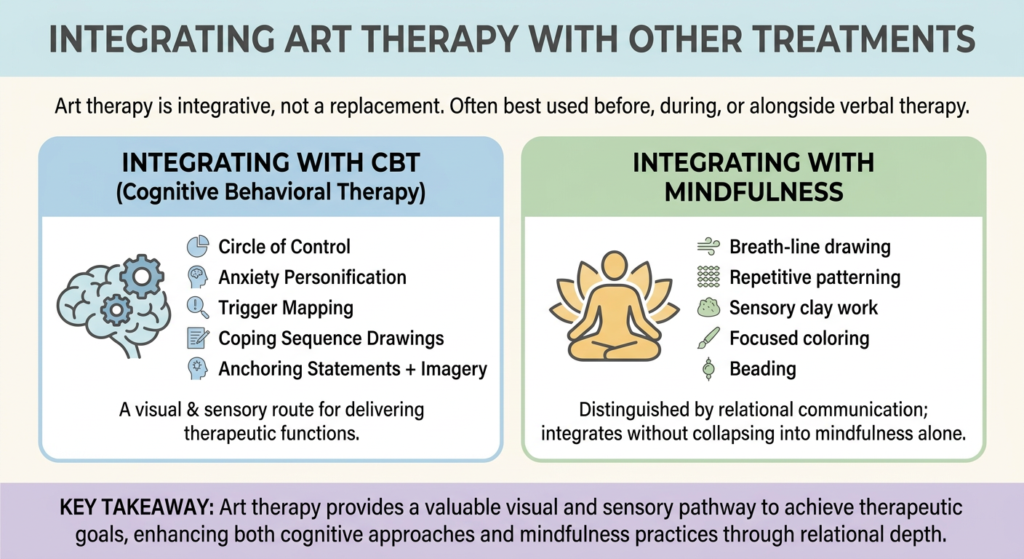
Art therapy can also integrate mindfulness through breath-line drawing, repetitive patterning, sensory clay work, focused coloring, and beading. The presence of relational communication in therapy distinguishes creative art therapy from mindfulness alone, meaning art therapy can integrate mindfulness without collapsing into mindfulness alone.
Conclusion
Art therapy helps anxiety through emotional externalization, embodied expression, reflective meaning-making, and improved emotion regulation.
The strongest evidence supports these effects in children, adolescents, and pediatric cancer populations, where recent meta-analyses show significant anxiety reduction. In adults, the evidence is more limited and less generalizable, but positive signals exist, especially in structured, multi-session formats.
The most defensible position is that art therapy is a credible complementary intervention for anxiety, and its benefits are most convincing when interventions are structured, titrated, and integrated with reflection or psychotherapy. Generic creative activity may help, but it is not equivalent to art therapy, and trauma-related anxiety should not be approached as unguided self-expression alone.
The best practical activities are those that either regulate first or externalize second, such as breath-line drawing, structured mandalas, safe-place collage, anxiety cartoons, body maps, and trigger maps. Trauma-sensitive anxiety work should be paced and grounded, not pushed toward unrestricted catharsis. At-home art practices are worthwhile when framed as supportive self-regulation rather than full therapy.
If you’re struggling with anxiety and think art therapy might help, consider reaching out to our professional who can guide you through structured, evidence-based techniques personalized to your needs. Contact our team to learn how integrative treatment approaches, including art therapy, can support your recovery.

