
Depression often feels like carrying a weight you can’t name. Many people describe heaviness in the chest, chronic fatigue, or a sense of being disconnected from their own bodies.
A growing body of research shows that depression isn’t just a disorder of thoughts and emotions, it’s also deeply physical. Somatic therapy for depression addresses this mind-body connection by working directly with bodily sensations, movement, and nervous system regulation.
Studies indicate that people with major depressive disorder often experience impaired interoceptive accuracy, meaning they struggle to accurately sense and interpret internal bodily signals.
This article explains how body-based approaches can support recovery when depression shows up in both mind and body.
What is Somatic Therapy for Depression?
Somatic therapy is a body-centered approach to psychotherapy that treats emotional distress by working directly with physical sensations, posture, breath, and movement.
Rather than focusing solely on thoughts and feelings, somatic therapists help clients notice how emotions appear in the body, tension in the shoulders, tightness in the throat, heaviness in the limbs, or a sense of collapse in the chest.
The premise is straightforward: unresolved stress and trauma can become expressed through the body, and healing can proceed through awareness of bodily experience rather than verbal reflection alone.
Harvard Health Publishing describes somatic therapy as focusing on how emotions show up physically, operating on the idea that difficult experiences may become “trapped” and expressed through bodily symptoms.
For depression, this matters because many depressive symptoms are intensely physical. Fatigue, psychomotor slowing, chronic pain, sleep disruption, and a sense of numbness or shutdown are not secondary details, they’re often central to the disorder itself.
Core Principles of Somatic Therapy
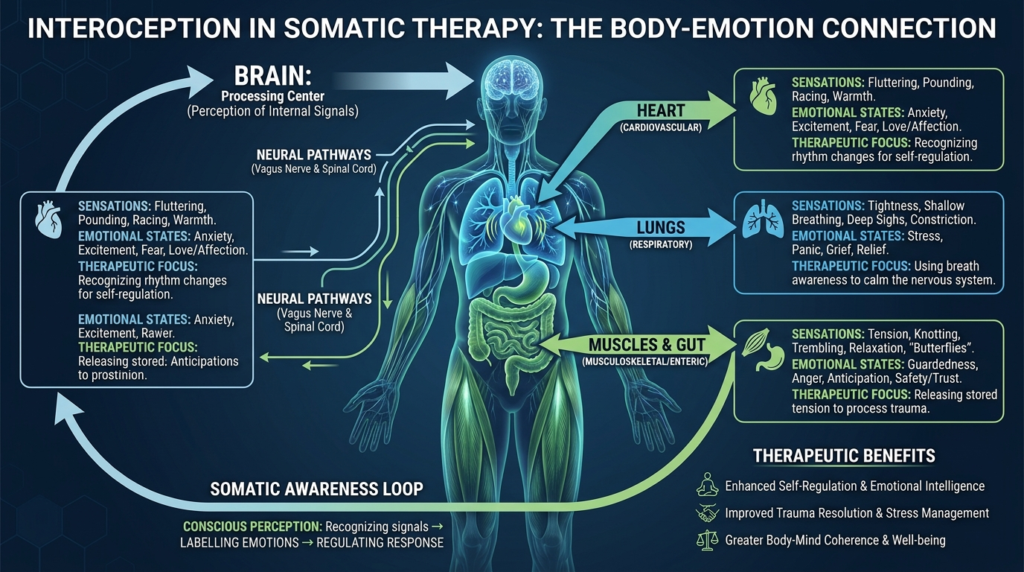
Somatic therapy operates through several key mechanisms. It emphasizes interoception, the ability to sense internal bodily states such as heartbeat, breath, tension, and warmth. Research shows that mindfulness meditation training can improve self-reported interoception, suggesting that body-awareness practices may influence clinically relevant mechanisms in depression.
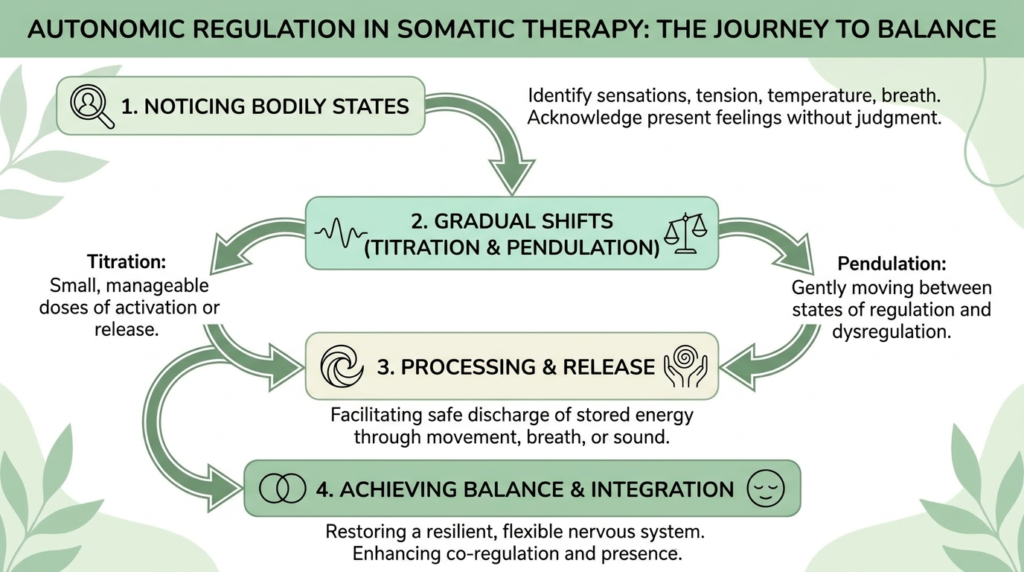
Another core principle is autonomic regulation. Depression often involves dysregulated stress responses, including chronic activation or shutdown of the nervous system. Somatic approaches aim to help clients notice these states and gradually shift toward greater flexibility and balance.
The therapy also works with movement and posture. When depression causes collapse, immobility, or withdrawal, gentle movement can interrupt these patterns and create achievable experiences of mastery and engagement.
How Depression Shows Up in the Body?
Depression is commonly described in psychological terms—sadness, hopelessness, loss of interest, negative thinking. Yet the lived experience is often intensely bodily. People with depression frequently report heaviness, muscle tension, slowed movement, exhaustion, numbness, agitation, pain, and a diffuse sense of disconnection from their own bodies.
Recent research supports the view that these experiences are not merely secondary. A 2023 study found that in hospitalized patients with major depressive disorder, dysfunctional self-reported interoception predicted greater residual fatigue burden, suggesting that disturbed body awareness may help explain persistent somatic symptoms even when standard depression treatment is delivered.
A 2026 review highlighted neural differences during interoceptive tasks in people with depression, especially abnormal insula activity and connectivity. The insula is a brain region widely implicated in integrating bodily state information with emotional awareness.
If depressive disorders involve disrupted body-signal processing, then interventions that change how patients attend to and interpret internal sensations may reasonably affect symptom experience.
The Stress System and Depression
A 2025 review on trauma and lifelong vulnerability to depression argues that early-life trauma and chronic stress produce depression risk through interacting structural, synaptic, epigenetic, hormonal, immune, and molecular pathways, not through a single root cause.
This review is important because it shows that chronic stress during early development can cause long-lasting disruption in systems that regulate emotion, cognition, and stress, including HPA-axis dysregulation, neuroinflammation, and structural brain changes.
If depression emerges partly through chronic dysregulation of threat, arousal, inflammation, and neuroendocrine responses, then therapies targeting body-based regulation have a stronger rationale than if depression were only a disorder of conscious beliefs.
Evidence for Somatic Therapy in Depression
The evidence base for somatic therapy is mixed by modality, population, and outcome. Some body-based approaches have stronger research support than others, and it’s important to distinguish between different branches of the field.
Body Psychotherapy Research
A systematic review and meta-analysis of body psychotherapy included 18 randomized controlled trials and found medium effects on primary outcomes such as psychopathology and psychological distress.
The authors concluded that body psychotherapy appears beneficial for a broad spectrum of psychological suffering, but emphasized the need for high-quality studies with larger samples.
An earlier review identified 19 effectiveness studies and 38 reviews and concluded that body-oriented psychotherapy interventions show effectiveness across different populations and settings, but the evidence base remains insufficient to satisfy American Psychiatric Association standards for established treatments.
This is one of the clearest high-level judgments in the literature: the evidence rejects the idea that somatic psychotherapy has no support, but it equally rejects the idea that the evidence is already strong enough to declare the field fully established.
Somatic Experiencing for Trauma-Related Depression
Somatic Experiencing is among the most visible somatic modalities. A 2017 randomized controlled trial of Somatic Experiencing for PTSD with 63 participants was the first known RCT evaluating this approach.
A 2021 scoping review concluded that there is preliminary evidence that Somatic Experiencing may reduce PTSD and comorbid symptoms, but stressed that the evidence base is still early-stage and methodologically limited.
The direct evidence for Somatic Experiencing is stronger in PTSD than in depression. However, many depressed patients, especially those with trauma histories, have overlapping symptoms such as hyperarousal, shutdown, dissociation, pain, chronic stress, and somatic distress.
Therefore, Somatic Experiencing may reasonably be considered a promising adjunctive or subgroup-specific intervention rather than a universally validated antidepressant treatment.
Movement-Based Interventions
One of the most important findings across the research is that movement-based interventions have stronger evidence for depression than narrow somatic psychotherapy categories.
A large systematic review and network meta-analysis summarized in The CHI included 218 randomized controlled trials with 14,170 patients with major depressive disorder and found that multiple movement-based interventions improved depression, including walking, jogging, yoga, strength training, dance, tai chi, and qigong.
Among exercise modalities, dance, walking, jogging, and exercise combined with SSRIs were among the most effective options, and higher-intensity exercise tended to produce larger antidepressant benefits, although lower-intensity activities such as walking and hatha yoga still showed benefit.
If the question is how body-based healing addresses depression, exercise and movement therapies cannot be treated as secondary footnotes. They are currently among the most evidence-supported body-based approaches for depressive symptom reduction.
Somatic Therapy Techniques for Depression
Somatic therapy uses a variety of techniques to help people reconnect with their bodies and regulate their nervous systems. These methods are often used in combination and tailored to the individual’s needs and symptom profile.
Breath Work and Grounding
Diaphragmatic breathing is one of the most accessible somatic techniques. The American Psychiatric Association describes diaphragmatic breathing as slow, deep breathing that fills the lungs and lets the lower belly rise, and recommends belly breathing, 4-7-8, and box breathing as accessible home practices.
Grounding techniques help interrupt collapse, freeze, dissociation, or mental fog by shifting attention from rumination to external reality. Simple practices include pressing feet into the floor, looking around and naming visible objects, or noticing chair support against the body.
Body Scan and Interoceptive Awareness
Body scan involves systematically noticing sensations throughout the body without judgment. This practice can counter numbness and disconnection, build awareness of tension and fatigue, and create nonjudgmental contact with bodily state.
Research suggests that therapeutic changes may involve reduced distraction from bodily discomfort and greater body trust. In people with depression and chronic pain, improvement in depression severity after mindfulness-based cognitive therapy was mediated by the interoception dimension “Not Distracting,” according to findings cited in a 2025 meta-analysis.
Progressive Muscle Relaxation
Progressive muscle relaxation involves gently tensing and releasing muscle groups to reduce accumulated tension and improve sleep readiness.
A 2023 guideline from the World Federation of Societies for Biological Psychiatry and Australasian Society of Lifestyle Medicine notes that breathing exercises and progressive muscle relaxation are among the studied relaxation techniques that may form beneficial components of treatment and ongoing management in depression care.
Titration and Pendulation
Somatic approaches often rely on gradual exposure-like principles. Titration means approaching difficult sensations or traumatic material in very small increments to prevent overwhelm. Pendulation involves moving attention back and forth between distress and safety or resource to build flexibility.
These methods align with stabilization-first approaches in complex trauma treatment. A 2015 theoretical paper presents Somatic Experiencing as a therapy that guides attention toward interoceptive, kinesthetic, and proprioceptive experience in order to resolve symptoms resulting from chronic and traumatic stress.
Who Benefits Most From Somatic Therapy?
Somatic therapy is not equally useful for all presentations of depression. The evidence suggests it is most justified in specific clinical contexts.
Depression With Trauma History
When depressive symptoms occur alongside childhood abuse, chronic stress, or PTSD symptoms, body-based regulation work has a stronger rationale because stress-system dysregulation is part of the condition. The 2025 review on trauma pathways to depression supports this view.
Depression With Dissociation or Shutdown
If the patient experiences numbness, disconnection, freeze, or fluctuating dissociative states, body-based stabilization and state tracking may be more useful than purely verbal exploration alone.
A 2023 protocol argues that dissociation should increasingly be studied as a dynamic, time-varying process rather than a static trait, implying that clinicians may need to track when autonomic shutdown or disconnection emerges.
Depression With Chronic Pain or Somatic Symptoms
Although psychotherapy may not eliminate pain or disease processes, body-aware treatment may improve mood, function, and quality of life while helping patients relate differently to bodily distress.
A meta-analysis of 75 randomized controlled trials involving 8,209 participants found that psychotherapy showed a moderate post-treatment benefit for depressive symptoms in adults with both depression and a medical or somatic illness.
Depression With Low Vitality and Psychomotor Slowing
Movement-based interventions such as walking, dance, strength training, yoga, tai chi, or qigong have substantial antidepressant relevance. These approaches may directly oppose psychomotor slowing, anhedonia, low energy, and social withdrawal while also improving sleep, circadian rhythm, and self-efficacy.
Integrating Somatic Therapy With Other Treatments
A key conclusion across the research is that somatic work is usually most effective when integrated, not isolated. Several sources explicitly describe somatic methods as combinable with cognitive behavioral therapy and other modalities rather than replacing them.
The 2023 guideline explicitly recommends lifestyle-based interventions as a foundational component of care for adults with major depressive disorder, either alone in some cases or in combination with other evidence-based treatments.
Relevant domains include physical activity and exercise, mindfulness and stress management, sleep, diet, loneliness and social support, and green space interaction.
With Cognitive Behavioral Therapy
Somatic techniques can complement CBT by helping clients notice body cues linked to negative thought cycles, use breathing or grounding before cognitive restructuring, and identify posture or action changes associated with withdrawal.
With Medication Treatment
Body-based routines can support sleep, self-regulation, and adherence to medication treatment. They may also address side-effect-related tension or fatigue when appropriate.
With Behavioral Activation
Gentle movement can interrupt immobility, increase environmental engagement, and create achievable mastery experiences. For depressed individuals who feel overwhelmed by standard exercise prescriptions, somatic movement may be a more acceptable entry point into activation.
Safety Considerations and Limitations
Somatic exercises are often described as safe or low risk, and in many cases they are. But low risk does not mean risk-free.
Window of Tolerance
Trauma-informed somatic guidance emphasizes introducing interventions slowly and gently, keeping the client within their window of tolerance, and explicitly reminding them they may pause or stop at any time. This principle is highly relevant to depression because many depressed patients also have trauma histories, dissociation, chronic pain, or shutdown states.
When Self-Guided Mindfulness May Not Be Appropriate
The 2023 guideline warns that mindfulness learning may not be appropriate during acute or severe major depressive episodes or psychosis, where engagement may be difficult and symptoms may worsen without close supervision.
For severe depression, simpler, externally anchored practices may be safer than silent meditation, and professional support may be needed.
Suicide Risk
A review of somatic psychiatric treatments and suicide outcomes found that only lithium and clozapine had randomized controlled trial evidence showing reduced suicide risk. This directly implies that body-based exercises should never be represented as proven suicide-prevention treatments.
If a patient has active suicidal intent, escalating self-harm risk, inability to maintain safety, severe psychotic depression, or severe functional collapse, then somatic exercises may be supportive but must not be treated as adequate treatment.
Practical Starting Points
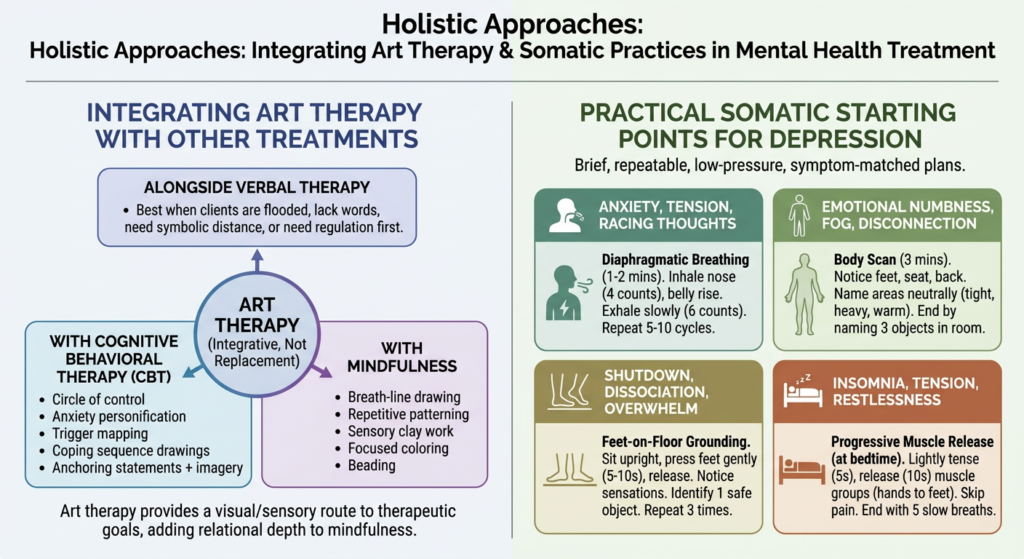
The best somatic plan for depression is usually brief, repeatable, low-pressure, symptom-matched, and integrated with overall treatment.
For depression with anxiety, tension, racing thoughts, or insomnia, start with one to two minutes of diaphragmatic breathing, inhale gently through the nose for four counts, let the belly rise, and exhale slowly for six counts. Repeat five to ten cycles.
For emotional numbness, fog, disconnection, or chronic rumination, try a three-minute body scan. Keep eyes open or soft if needed. Notice feet contacting the floor, seat and back support, then scan upward naming each area with a neutral word: tight, heavy, numb, warm, restless, neutral. End by looking around the room and naming three objects.
For depression with shutdown, dissociation, or overwhelm, use feet-on-floor grounding. Sit upright, press both feet gently into the floor for five to ten seconds, release, notice the contact, weight, and pressure, look around the room and identify one safe or neutral object, and repeat three times.
For depression with insomnia, tension, headaches, or restlessness, try progressive muscle release at bedtime. Start with hands: lightly tense for five seconds, release for ten. Move to shoulders, jaw, abdomen, legs, feet. Keep intensity low and skip painful areas. Finish with five slow breaths.
Why Does It Matter?
Depression is not just a disorder of thoughts and emotions. It is also a disorder of the body, of energy, movement, sensation, regulation, and embodied presence. The strongest current evidence supports somatic exercises as clinically meaningful adjuncts for depression, especially low-burden practices such as diaphragmatic breathing, body scan, grounding, progressive muscle relaxation, and gentle mindful movement.
Somatic therapy is best understood not as a proven singular cure for the root cause of depression, but as a biologically plausible, clinically useful, and increasingly research-supported pathway for treating depressive disorders when depression is embodied, stress-linked, trauma-linked, dissociative, or medically comorbid.
It is most justified as an adjunct to established psychotherapy or medication, a frontline component in stabilization and regulation work for complex trauma-related depression, and a useful route for patients whose depression is strongly expressed through the body.
If you’re struggling with depression that feels stuck in your body, chronic tension, fatigue, numbness, or disconnection, The Summit Wellness Group offers body-based approaches, so reach out today to explore how our somatic therapy can support your recovery.

