
Anxiety often feels like a racing heart, tight chest, or shallow breathing that won’t stop even when you know you’re safe. Somatic therapy addresses anxiety by working directly with these physical sensations rather than focusing only on thoughts.
Research shows that 15 weekly sessions of Somatic Experiencing produced large reductions in PTSD severity and depression in a randomized controlled trial, suggesting real benefit for trauma-linked anxiety.
This article explains how somatic therapy works, which techniques help calm the nervous system, and when body-based approaches make the most sense for anxiety treatment.
What Somatic Therapy is?
Somatic therapy is a family of body-centered approaches that treat emotional distress by working with physical sensations, posture, breath, movement, and nervous system activation.
The core idea is that anxiety and trauma are not only mental experiences but also physiological patterns that can become stuck in the body. Harvard Health describes somatic therapy as focusing on the body and how emotions appear within it, based on the idea that traumatic or unresolved emotional experiences can persist through bodily expression.
Rather than starting with thoughts and beliefs like cognitive behavioral therapy, somatic therapy begins with present-moment bodily experience.
A somatic therapist might ask where you feel anxiety in your body, what happens to your breathing when you talk about stress, or what signals safety for you physically. This bottom-up approach targets the physiological patterns through which anxiety is maintained.
Common somatic modalities include Somatic Experiencing, Sensorimotor Psychotherapy, and polyvagal-informed therapies. Each uses slightly different techniques, but all share the premise that healing can occur through increased body awareness, regulation of autonomic arousal, and completion of interrupted stress responses.
How Somatic Therapy Works for Anxiety?
Somatic therapy operates on the understanding that anxiety is not just cognitive worry but also a nervous system problem. When stress or trauma overwhelms the body’s capacity to process it, the autonomic nervous system can become dysregulated. This shows up as hyperarousal, which includes restlessness, racing heart, muscle tension, and hypervigilance, or hypoarousal, which includes numbness, disconnection, shutdown, and collapse.
The therapy aims to restore nervous system flexibility by helping you notice bodily sensations without immediately reacting to them. This process is called interoceptive awareness. Somatic Experiencing treats post-traumatic symptoms by changing the interoceptive and proprioceptive sensations associated with traumatic experience, helping clients track sensations and move between activation and calm.
One central concept is that anxiety can result from incomplete stress responses. When the body cannot complete a natural defensive action like fight or flight, activation may remain trapped in the nervous system. Somatic therapy helps the body complete these responses through gentle movement, grounding, and attention to bodily shifts, allowing the nervous system to settle.
Another key mechanism is the restoration of felt safety. Many anxious people understand intellectually that they are safe but still feel as though their body is running survival protocols. Somatic work tries to help the body not only know but actually feel that danger is over.
Core Somatic Therapy Techniques for Anxiety
Grounding
Grounding redirects attention from anxious thoughts to present-moment sensory or bodily experience. Hinge Health defines grounding as a way to feel calmer and more in control by anchoring attention in the here and now.
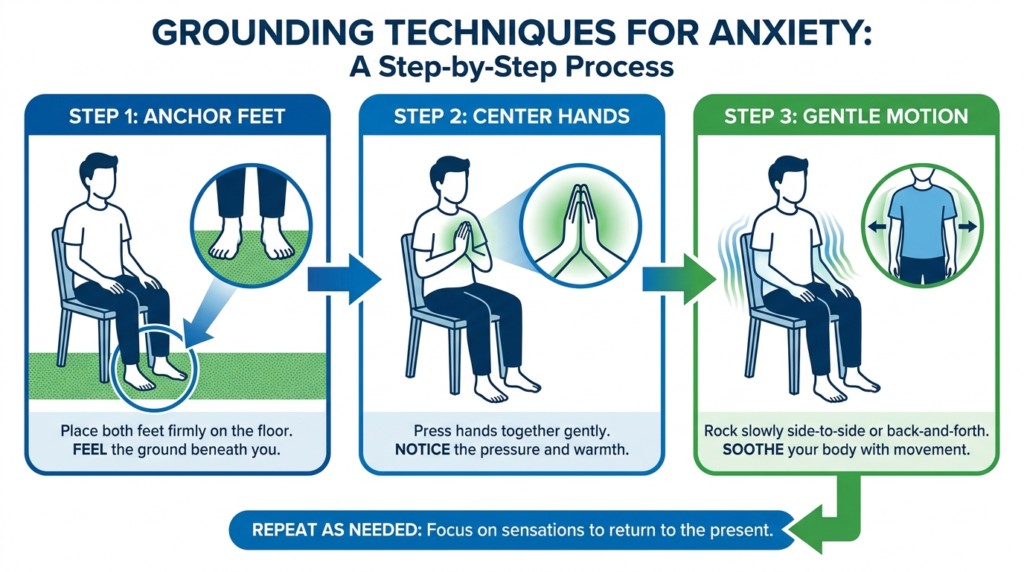
Physical grounding techniques include feeling your feet on the floor, pressing your hands together, or noticing the support of your chair.
A simple grounding exercise involves placing both feet flat on the floor, pressing gently downward, noticing the support from the ground, and gently rocking for 60 to 90 seconds.
This helps reduce floating sensations during anxiety by increasing contact with support and present orientation.
Breath Regulation
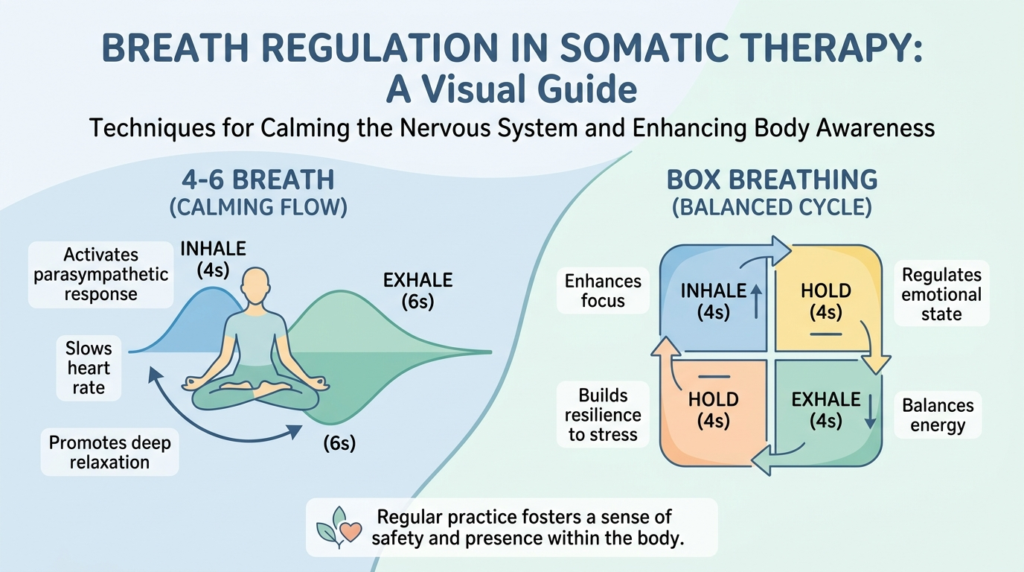
Breathwork is one of the most accessible somatic tools for anxiety. The key principle is that longer exhales tend to support calming.
A common format is the 4-6 breath: inhale gently for 4 counts, exhale slowly for 6 counts, and repeat for 1 to 3 minutes without forcing depth. This extended exhale breathing helps shift the nervous system from sympathetic activation toward parasympathetic regulation.
Other breath techniques include box breathing, where you inhale, hold, exhale, and hold again in equal counts, and deep belly or diaphragmatic breathing.
These methods are useful for hyperarousal, panic onset, or stress spikes, though some trauma survivors may find interoceptive focus on breath distressing and should pair it with external orienting or grounding.
Body Scanning and Interoceptive Awareness
Body scanning involves slowly attending to each body part and noticing sensations without judgment.
You might sit or lie down comfortably and notice your feet, legs, pelvis, abdomen, chest, shoulders, and jaw, naming sensations simply as warm, tight, buzzy, heavy, empty, or neutral. This builds body literacy and helps you detect early signs of anxiety before panic escalates.
For anxiety, early detection of chest tightness, held breath, or jaw tension allows earlier intervention. Body scanning also helps differentiate distress from danger, teaching the nervous system that noticing activation does not require immediate alarm.
Orienting
Orienting means using the senses to look around and recognize present-moment safety cues.
This technique is central in polyvagal-informed therapy and involves looking around the room, naming neutral or pleasant objects, noticing one sound, one texture, one color, and one sign of safety, and letting your eyes move naturally instead of staring fixedly.
Orienting is especially useful when anxiety narrows attention and makes the environment feel globally unsafe. It interrupts spiraling attention loops and restores sensory contact with the present environment.
Progressive Muscle Relaxation
Progressive muscle relaxation targets the diffuse muscle bracing that often accompanies anxiety, especially in the jaw, shoulders, chest, and abdomen.
A simple 5-minute routine involves clenching your fists for 5 seconds and releasing, shrugging your shoulders for 5 seconds and releasing, tightening your legs for 5 seconds and releasing, and noticing the contrast between tension and relaxation.
This technique is useful when anxiety feels muscular rather than purely mental and helps release pent-up tension that accumulates during chronic stress.
Pendulation
Pendulation is a signature somatic technique that involves moving attention between areas of discomfort and areas of safety or resource in the body.
For example, if you notice chest tightness, you might focus on it for a few seconds, then shift attention to the steadiness of your feet, return briefly to the chest, and return again to feet or hands, repeating gently.
The aim is not to force exposure but to teach the nervous system that distress can coexist with safety. This builds tolerance for bodily sensations without flooding.
Titration
Titration means approaching distress in small, manageable doses. Instead of fully immersing in the worst fear or bodily intensity, you notice a small amount and then return to regulation.
This prevents overwhelm and retraumatization, making it one of the strongest practical advantages of somatic work for anxiety.
Resourcing
Resourcing involves identifying internal or external cues associated with calm, support, competence, or safety. Resources can include a supportive person, a favorite place, a pet, a memory of steadiness, the feeling of a chair holding your body, or the stability of your feet on the floor. In anxiety treatment, resourcing is crucial because it counterbalances the tendency to focus only on threat.
Gentle Movement
Gentle movement helps complete stress responses and shift physiology. Simple gestures, stretching, gentle yoga, Tai Chi, rolling shoulders slowly, standing and swaying side to side, shaking hands gently for 10 seconds, or walking slowly while feeling foot contact can all help regulate the nervous system and release pent-up tension. This may be more effective than stillness for anxious people whose physiology is mobilized.
Evidence for Somatic Therapy and Anxiety
The strongest direct evidence for somatic therapy comes from trauma and PTSD research rather than generalized anxiety disorder specifically.
The Brom et al. randomized controlled trial included 63 participants meeting full PTSD criteria and found large reductions in PTSD severity and depression following 15 weekly sessions of Somatic Experiencing compared with waitlist control. This matters for anxiety because PTSD and anxiety overlap strongly in hyperarousal, panic, startle, body tension, and autonomic dysregulation.
A scoping review of Somatic Experiencing concluded that existing studies report promising effects for PTSD symptoms and suggest usefulness beyond trauma therapy, while also highlighting the preliminary nature of the evidence and the need for more rigorous research.
The review identified key therapeutic factors including increasing body awareness, working at the client’s pace, building empowerment and distress tolerance, activating resources, and ensuring fit between client and practitioner.
A systematic review of somatic interventions in PTSD found that complementary approaches based on Somatic Experiencing, meditation, and brainspotting demonstrated preliminary efficacy, with especially positive clinical impact noted for Somatic Experiencing.
However, the review emphasized that scientific production is still limited, studies often have small sample sizes, and more controlled trials are needed.
A 2023 meta-analysis of 29 body and movement-oriented intervention studies for PTSD reported moderate improvements in PTSD symptoms plus benefits for depressive symptoms and sleep quality, while stressing variable study quality and the need for stronger trial designs and longer follow-up.
The anxiety-specific evidence is more diffuse and generally weaker than the PTSD evidence. The most defensible interpretation is that anxiety relief from somatic methods is clinically plausible and broadly supported by converging lower to mid-level evidence, but the most rigorous direct evidence still centers on trauma and PTSD populations rather than pure anxiety samples.
Comparing Somatic Therapy With CBT for Anxiety
Harvard Health offers balanced caution: somatic therapy appears beneficial anecdotally and may be useful for trauma-related distress, but it lacks the same research backing as cognitive behavioral therapy and some other treatments.
Amanda Baker recommends CBT as at least a starting point, especially given insurance coverage realities and the stronger evidence base.
CBT for generalized anxiety disorder has moderate-certainty evidence for acute symptom reduction from dozens of randomized controlled trials, and traditional CBT remains significantly superior to treatment as usual at longer-term follow-up.
By contrast, somatic therapy has promising but limited evidence, with methodological concerns including small samples, mixed diagnoses, variable definitions, inconsistent control groups, and limited follow-up data.
However, multiple clinical sources argue that somatic work is particularly helpful when insight is present but physical anxiety persists, trauma was pre-verbal or non-verbal, body numbness or disconnection is prominent, or hypervigilance, startle, or shutdown remain despite talk therapy.
The better sources favor integration rather than replacement: somatic approaches can complement CBT, DBT, EMDR, or ACT, and somatic work may help clients regulate enough to benefit more from structured trauma processing.
Who Benefits Most From Somatic Therapy for Anxiety?
Somatic methods appear particularly relevant for people who experience strong physical anxiety symptoms, have panic attacks, feel chronically hypervigilant or on alert, alternate between anxiety and shutdown, have trauma histories, feel disconnected from their bodies, or have not found full relief from talk therapy alone.
Panic With Strong Body Symptoms
People who understand panic cognitively but still react physically may benefit from body-based skills added to CBT or EMDR. Somatic techniques like grounding, extended exhale breathing, and orienting can interrupt panic onset and help restore a sense of control.
Trauma-Linked Anxiety
Those with PTSD, developmental trauma, chronic startle, or freeze responses fit especially well with the current evidence base. The strongest somatic therapy trials target trauma-related dysregulation, making this population the best-supported use case.
Dissociation or Body Numbness
When anxiety coexists with numbness, disconnection, or collapse, purely cognitive work may miss the main dysregulation pathway. Somatic therapy can help restore embodiment and increase awareness of internal states.
Chronic Stress Bracing
People who habitually clench, hold their breath, or collapse posture under stress may respond well to body awareness and regulation training. Progressive muscle relaxation, body scanning, and gentle movement can release accumulated tension.
Safety Considerations and When to Modify Somatic Work?
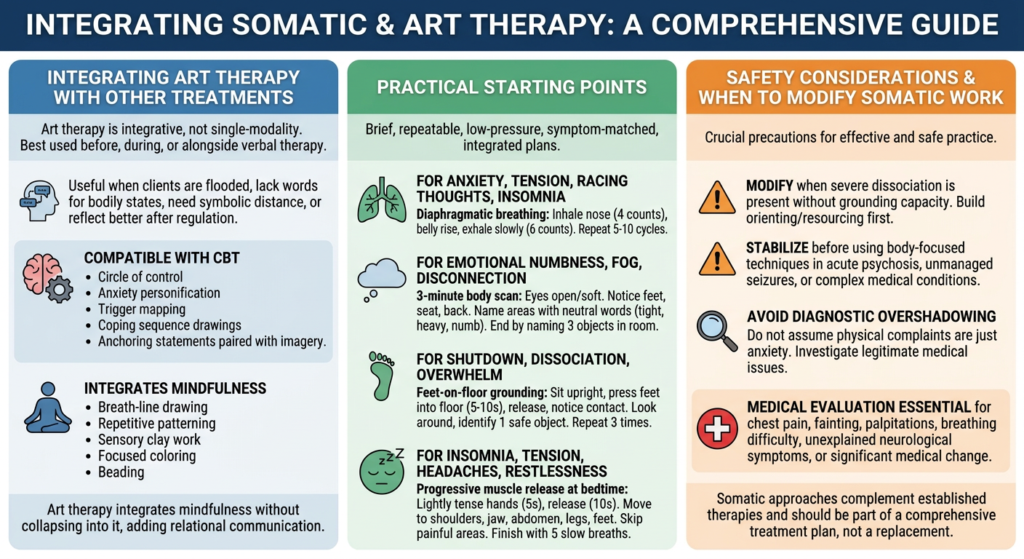
Somatic approaches should be modified when severe dissociation is present without adequate grounding capacity. In such cases, clinicians should build orienting and resourcing first before deep body exploration.
Acute psychosis, unmanaged seizures, and complex medical conditions require stabilization and adaptation before body-focused techniques are used.
One of the most important contemporary insights is the warning against diagnostic overshadowing. Clinicians must not assume that persistent physical complaints are just anxiety and should investigate legitimate medical issues while also addressing anxiety processes.
If you have chest pain, fainting, palpitations, breathing difficulty, unexplained neurological symptoms, or significant medical change, medical evaluation is essential rather than simply prescribing grounding techniques.
Somatic therapy’s focus on bodily symptoms can be helpful, but if misused, it could accidentally reinforce dismissal of real illness. The better sources repeatedly favor integration rather than replacement: somatic approaches can complement established evidence-based therapies and should be part of a comprehensive treatment plan.
Practical Somatic Routines for Different Anxiety Presentations
Acute Anxiety Spike or Panic Onset
Place both feet on the ground, look around and name 5 objects, exhale longer than inhale for 1 to 2 minutes, press hands together or cross arms in a self-hold, and if energy is high, add brief swaying or hand shaking. This routine combines grounding, orienting, breath regulation, and containment.
Chronic Hypervigilance at Work
Every 2 to 3 hours, pause for a 30-second body scan, unclench jaw and shoulders, take 3 slow long-exhale breaths, feel both feet in shoes or on floor, and look up and orient to three neutral cues. This interrupts accumulation of muscular and autonomic tension.
Anxiety With Numbness or Freeze
Begin with orienting rather than deep inward focus, notice contact points with chair or floor, add gentle movement like finger pressing, shoulder rolls, or swaying, use a small activating cue such as humming or standing, and track whether energy increases into manageable presence. Hypoarousal often needs gentle mobilization, not only relaxation.
Bedtime Somatic Downshift
Practice progressive muscle relaxation from feet to shoulders, do 4-in 6-out breathing for 2 minutes, place hand on chest or abdomen, name three things that are safe or settled right now, and soften gaze or close eyes if comfortable. This targets bracing, breath, and mental threat scanning.
Limits of the Evidence and Areas of Uncertainty
A credible assessment must state clearly what is not yet known. Anxiety-specific large trials are limited, with the best direct evidence concerning PTSD rather than generalized anxiety disorder or panic disorder specifically. Study quality varies, with multiple reviews noting problems such as small sample sizes, inadequate controls, heterogeneous measures, and limited follow-up.
Not all somatic claims are equal. The field includes rigorous clinical models, broad wellness practices, and marketing-heavy content that should not be treated as interchangeable. Mechanisms such as completing defensive responses, discharge, or vagal tone enhancement are clinically influential but not all are equally well validated in controlled anxiety trials.
Self-help can be insufficient for severe trauma, dissociation, panic, or complex medical presentations. Self-guided somatic exercises may be inadequate or destabilizing without professional support in these cases.
Why Somatic Therapy Matters for Anxiety?
The most valid conclusion from the evidence is that somatic therapy techniques are among the most practical and clinically meaningful tools available for anxiety that is heavily expressed in the body, especially panic, hypervigilance, freeze and shutdown states, trauma-linked anxiety, and chronic stress bracing.
However, the formal evidence base remains emerging rather than definitive, and these methods are usually best used as part of an integrated treatment model rather than as a wholesale substitute for established psychotherapy or medical evaluation.
For anxious patients whose bodies stay alarmed even when their minds understand they are safe, treatment should include structured body-based regulation skills, especially grounding, orienting, slow exhale breathing, muscle release, sensation tracking, and resourcing. This is precisely where somatic methods appear to offer the greatest added value.
These methods should be delivered with caution, pacing, and medical discernment, especially where dissociation, complex trauma, or possible medical illness are present. The strongest somatic therapy evidence comes from trauma populations, not stand-alone anxiety disorders, but the practical techniques are broadly applicable and low-cost tools that can improve emotional regulation and body awareness.
If you’re struggling with anxiety that feels stuck in your body despite understanding it mentally, reach out to our team at The Summit Wellness Group for our somatic therapy that can help you find relief through body-based healing.

