
Do you look calm and capable while your mind never stops running possible disasters? Chronic worry can hide behind good grades, promotions, and caregiving, yet a 2023 network meta-analysis of 66 trials with 5,597 adults found CBT was the only therapy that stayed effective at 3 to 12 month follow-up. This article explains how ACT, IFS, and somatic methods target different parts of worry, and where high-functioning anxiety therapy fits.
What High-Functioning Anxiety Therapy Treats
“High-functioning anxiety” is not a formal diagnosis. It describes people who keep up at work, school, or home while carrying constant worry, tension, poor sleep, perfectionism, and private exhaustion. The pattern often overlaps with generalized anxiety disorder, or GAD, marked by excessive worry that is hard to control for at least six months.
The tricky part is that looking capable can delay care. People assume that success proves nothing is wrong. Research on treatment seeking found that people with anxiety disorders are less likely to seek help and more likely to face delays than those with depression or substance problems, often because of gaps in mental health literacy, as described in a large survey by treatment-seeking research.
Here is the key point about diagnosis. GAD requires clinically significant distress or impairment. The word “or” matters. You can meet the distress threshold even if your job and grades stay intact. Visible functioning and severity are not the same thing.
Why competence hides real suffering
You might keep performing by working longer hours, checking your work over and over, avoiding delegation, sleeping less, and refusing rest. That is compensation, not health. Greater anxiety severity has been linked to lower work performance and more presenteeism in a workplace review by mental health literature.
So impairment can be hidden. You may protect your output by sacrificing sleep, leisure, health, and relationships. That is why a clinician should ask not only “Can you do it?” but “What does it cost you?”
ACT for Anxiety and Experiential Avoidance
Acceptance and commitment therapy, or ACT, does not mainly ask whether a worry is true. It asks what the struggle to control anxiety is costing you and what you would do if the fear was allowed to be present.
The core mechanism is psychological flexibility. ACT targets experiential avoidance, which is the effort to escape unwanted thoughts, feelings, and body sensations. In high-functioning anxiety, avoidance often wears the mask of competence. You overwork to dodge shame. You worry to avoid grief or helplessness. You plan compulsively to avoid uncertainty.
ACT uses acceptance, mindfulness, cognitive defusion, and values-guided action, as summarized in a trial by ACT researchers. Defusion means noticing a worry as a thought rather than a command. You might say, “I am having the thought that I will fail,” and still choose your next step.
How strong is the evidence? A randomized trial of 143 adults with mixed anxiety disorders found ACT and traditional CBT produced large, similar improvements with no meaningful difference on major outcomes, reported by the same ACT researchers. That makes ACT a credible alternative or add-on, especially when values and avoidance are the main targets. It does not show ACT beats CBT for long-term GAD outcomes.
ACT may suit you if you have spent years trying to suppress anxiety, feel fused with worry, or wait to “feel ready” before living. These are clinical hunches, not proven matching rules.
IFS Therapy for Anxiety and Protective Parts
Internal family systems, or IFS, sees the mind as containing “parts” and a core Self marked by calm and compassion. In this model, chronic worry often works like a protective “manager” part that believes constant vigilance prevents failure, shame, or rejection.
That reframing can help. Instead of “my anxiety is irrational and must stop,” you might say, “a worried part believes vigilance keeps me safe.” That shift can lower shame and internal conflict. Many high-functioning clients describe a tug of war: one part wants rest, another calls rest irresponsible.
IFS overlaps with familiar ideas. A protective manager resembles a safety behavior. Unblending resembles defusion. Self-led relating resembles self-compassion and decentering.
Now the honest part about evidence. Direct research on IFS for chronic worry or GAD is sparse and much weaker than for CBT or ACT. Some promotional pages call IFS “promising” for anxiety, which itself signals low certainty. The fair conclusion: IFS is a plausible, useful framework for shame, overcontrol, and trauma-linked vigilance, but it is best used as an adjunct or emerging model, not a proven first-line treatment on its own.
IFS makes sense as a supplement to CBT or ACT, or as trauma-informed preparation when direct exposure would be premature. It is less defensible as the only treatment for severe, persistent GAD.
Somatic Therapy for Anxiety and Body Regulation
“Somatic therapy” is not one method. It covers biofeedback, breathing work, progressive muscle relaxation, mindfulness programs, yoga, movement, and body-oriented trauma methods. These differ sharply in training, dose, and evidence, so no single claim covers them all.
The shared rationale is that worry and body arousal feed each other. Muscle tension, shallow breathing, and broken sleep can become both a result of worry and a cue for more worry. Body-focused work aims to break that loop by building tolerance for sensations and improving regulation.
Some pieces have real support. Mindfulness suits chronic worriers because worry is future-focused while mindfulness pulls attention back to the present, a point raised in a review by GAD treatment authors. A 2026 randomized trial of an eight-week mindfulness program for 106 adults with GAD used an active control and measured anxiety, sleep, and functioning, as reported by a mindfulness trial. Biofeedback shows promise as an adjunct, with good patient satisfaction noted in a review by biofeedback researchers.
Relaxation is trickier. When high-bias studies were removed, relaxation was no longer clearly better than usual care in a network meta-analysis by Papola and colleagues. So body methods can help with real components of anxiety, but claims about “resetting the nervous system” run ahead of the evidence.
Therapy for Overthinking and Stress: Comparing Paths
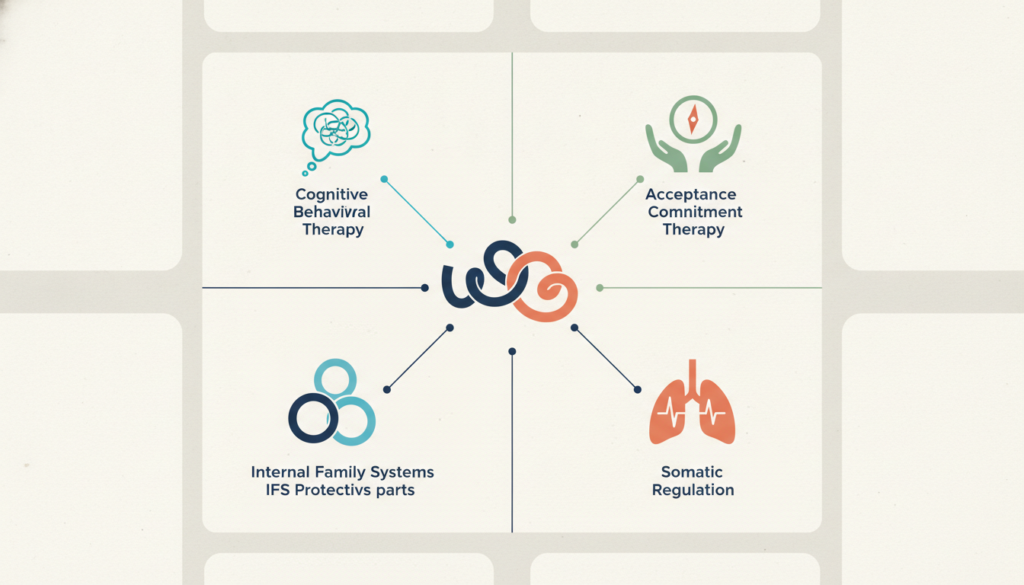
Each approach enters the same worry cycle at a different point. Here is a simple summary.
- CBT targets threat predictions, safety behaviors, and intolerance of uncertainty, and has the strongest short- and long-term evidence for GAD.
- ACT targets experiential avoidance and values, and offers meaningful short-term benefit as an alternative or adjunct.
- IFS targets protective internal parts and shame, and is clinically plausible but lacks strong direct GAD evidence.
- Somatic methods target arousal and interoception, and work best as specified, adjunctive tools.
All four, at their best, reduce avoidance. A CBT therapist calls it dropping a safety behavior. An ACT therapist calls it willingness. An IFS therapist calls it getting permission from a protective part. A somatic therapist calls it staying with activation while regulating. These may describe overlapping processes with different language.
Long-term change usually needs corrective learning. You send the email after one review and nothing terrible happens. You attend the meeting without exhaustive prep and still perform. You feel tension without escalating into panic. Insight alone rarely does it.
What the research allows us to say
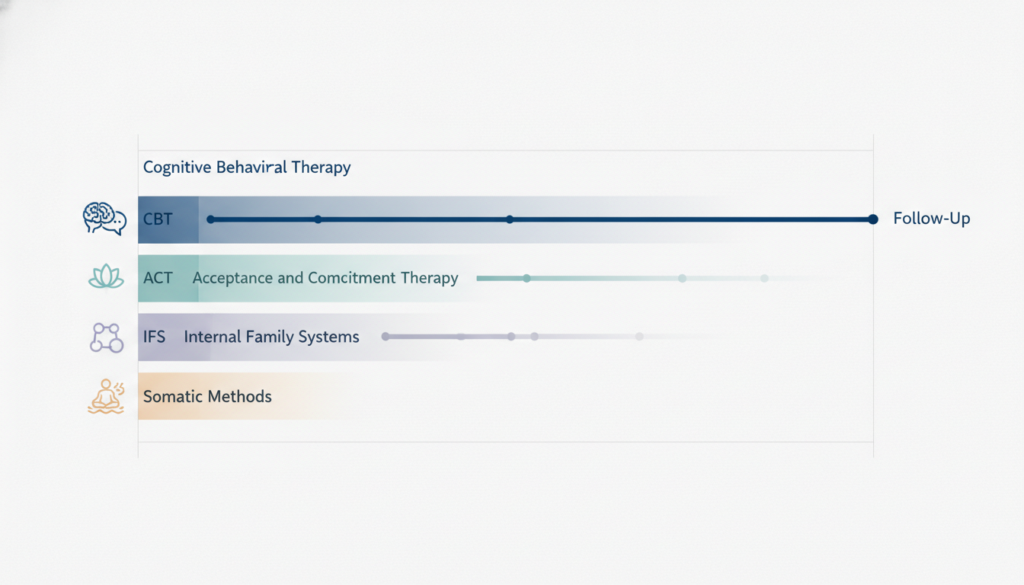
The clearest finding is durability. CBT worked in the acute phase and was the only therapy that stayed better than usual care at follow-up in the review by Papola and colleagues. Media summaries reported a standardized mean difference of about −0.68 for CBT versus usual care in acute treatment, described by a clinical news summary.
CBT specifically targeting intolerance of uncertainty matters here too. Reductions in that trait can mediate reductions in worry, according to a mediation study by uncertainty researchers. The treatment goal is not to guarantee certainty but to practice acting without it.
One more caution about matching people to methods. A review of treatment moderators found few reliable baseline predictors of who should get which therapy, reported by moderator researchers. So mechanism matching helps you build a formulation, but it is not a validated algorithm.
The Belief That “Anxiety Makes Me Succeed”
Many high-functioning worriers hold a hidden belief: worry keeps them sharp, responsible, and safe from failure. It feels reasonable. You worry, you prepare more, you avoid a mistake, and you conclude that fear protected you.
But that reads correlation as causation. Success may come from your skills, effort, prior knowledge, and support, not from the alarm. Worry can also add sleep loss, dread, and inefficiency. Prospective research on 190 students found that both worry and beliefs about worry independently predicted later anxiety, according to a metacognition study. Beliefs like “worry keeps me motivated” or “if I relax I will fail” keep the cycle running.
Trait anxiety does not reliably produce productive action either. A study of 3,370 college students found trait anxiety was linked to more procrastination, with self-efficacy partly explaining the pattern, as reported by a procrastination study. Anxiety can drive frantic overwork in one moment and avoidance in another.
Think of anxiety as an alarm, not an engine. An alarm can prompt action, but leaving it on constantly drains attention, wrecks sleep, and makes ordinary uncertainty feel like emergency. Good treatment aims to separate competence from chronic fear, so you can work from skill and values rather than dread.
Why It Matters
If you keep succeeding while quietly suffering, you may wait for a crisis before getting help. That waiting has costs. Longer untreated GAD appears linked to a more complicated course, and physical symptoms often get tested repeatedly before anxiety is recognized, as noted in a duration study. You do not need to lose your job or fail a class before distress counts.
A sensible plan usually keeps CBT as the backbone, then adds mechanism-relevant tools. Bring in ACT when avoidance and values dominate. Use IFS-informed work when self-criticism and protective parts run the show. Add somatic and mindfulness tools when tension, sleep, and body arousal drive the fear. CBT stays a strong choice across anxiety disorders, including GAD, panic, and social anxiety, per a review by CBT evidence authors.
The goal is not lower standards. It is functioning that is flexible, sustainable, and freely chosen. You can keep your ambition and lose the constant alarm.
If your anxiety looks invisible to others but feels heavy to you, reach out to explore trauma-informed care and find a plan that fits your life.

