
Have you tried therapy before and left feeling rushed, unheard, or pushed to share more than you were ready to share? Trauma-informed therapy differs from regular talk therapy mainly in how care is structured around safety, consent, and choice, not just which topics you discuss. For example, SAMHSA built its framework on four ideas: realize, recognize, respond, and resist retraumatization. This article explains what that looks like in real sessions and how to pick the right therapist next time.
What Is Trauma-Informed Therapy, Explained Simply
Trauma-informed therapy is less about whether your therapist talks about hard experiences and more about how the whole relationship is set up. The Substance Abuse and Mental Health Services Administration describes a trauma-informed approach through four assumptions and six principles. The four assumptions are realize, recognize, respond, and resist retraumatization. The six principles are safety, trustworthiness and transparency, peer support, collaboration and mutuality, empowerment and choice, and attention to cultural, historical, and gender issues.
In plain terms, a trauma-informed therapist explains the plan before starting, asks permission instead of assuming consent, and paces the work to your capacity. They check how activated you feel, set goals with you, and treat hesitation as useful information rather than as you being difficult.
There is an important difference between two ideas that sound alike. Trauma-informed care is a universal stance that can be used in any setting, from a school to a hospital to a therapy office. Trauma-focused treatment is a set of specific clinical methods where processing trauma memories is the main mechanism. A therapist can be trauma-informed without using a trauma-focused method, and a good trauma-focused method should still be delivered in a trauma-informed way.
Trauma Therapy vs Talk Therapy: The Real Difference
There is no single form of ordinary talk therapy. When I use the phrase here, I mean therapy that may focus on current problems, insight, coping, or relationships without organizing its structure around trauma awareness, informed choice, or a specific trauma protocol.
The main difference is structural, not just emotional tone. A warm, kind therapist may still fall short if they:
- pressure you to disclose before you are ready
- give little reason for why an exercise is used
- treat distress as proof therapy is working without checking if you feel unstable
- set goals without you
- skip clear talk about confidentiality, fees, or crisis plans
- read all avoidance as a problem rather than a protective habit
Trauma-informed care is not simply being nice. It shifts power. It changes who controls disclosure, how decisions get explained, and whether you have real say over pace and goals.
Trauma-Informed Care Is Not the Same as Trauma Treatment
The phrase trauma-informed therapy gets used loosely. It can mean a therapist who understands trauma, a clinic that avoids retraumatization, or a clinician who uses a manualized trauma protocol. These are not equal. The VA and DoD guideline defines trauma-focused therapy as treatment where processing a traumatic event is a central component, which is narrower than the broad trauma-informed stance.
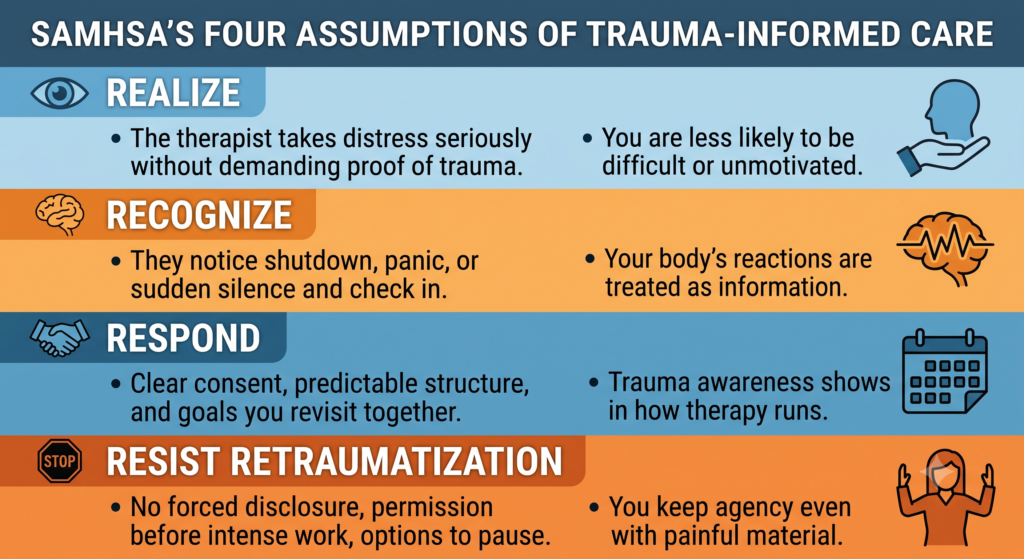
SAMHSA’s Four Assumptions in Real Sessions
SAMHSA’s four assumptions often sound abstract. Their value shows up in what you can actually see in the room.
| SAMHSA assumption | What it looks like in session | What it means for you |
| Realize | The therapist takes distress seriously without demanding proof of trauma. | You are less likely to be called difficult or unmotivated. |
| Recognize | They notice shutdown, panic, or sudden silence and check in. | Your body’s reactions are treated as information. |
| Respond | Clear consent, predictable structure, and goals you revisit together. | Trauma awareness shows in how therapy runs. |
| Resist retraumatization | No forced disclosure, permission before intense work, options to pause. | You keep agency even with painful material. |
To realize trauma’s impact does not mean assuming every problem is trauma. It means the therapist knows trauma can shape your sense of safety, sleep, focus, and trust. A good clinician holds trauma as a possibility and invites your own meaning, rather than diagnosing it from a short intake.
Recognition matters because you can be flooded or shut down without saying so. The American Psychological Association notes that trauma-related dissociation is common yet often missed, which can prolong suffering and derail treatment planning. A therapist does not need to label every reaction, but they should notice a change and ask about it.
Resisting retraumatization means avoiding conditions that recreate helplessness. SAMHSA identifies seclusion and restraint as potentially traumatizing and stresses reducing their use. Most outpatient therapy does not involve restraint, but the same principle applies: minimize coercion, keep choice. You should never have to guess whether saying no will damage the therapist’s regard for you.
Trauma-Sensitive Counseling and the Six Principles
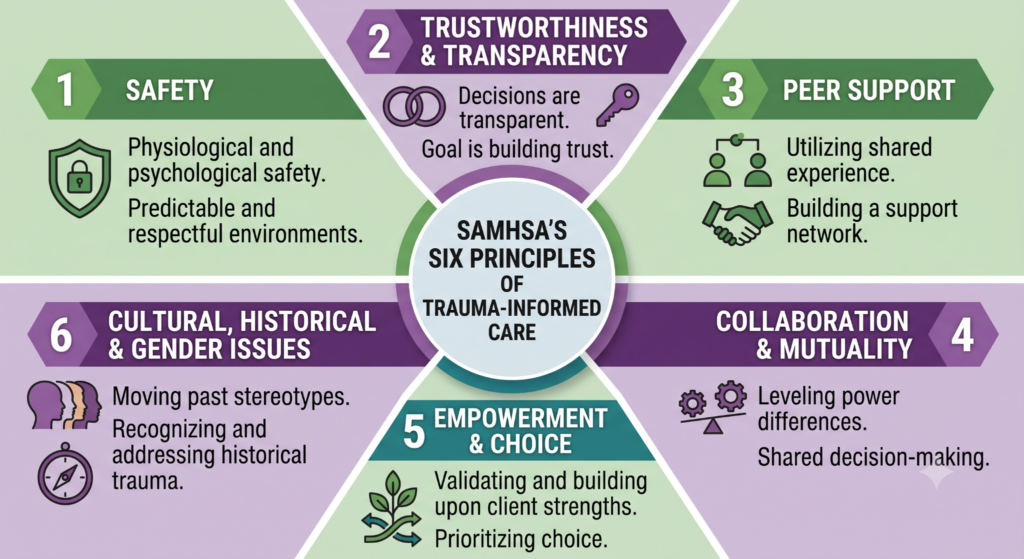
Safety is not just the therapist saying you are safe. It is built through predictable, respectful, noncoercive practice. It includes both psychological safety, like being able to disagree without punishment, and physiological safety, like checking arousal and helping you transition out of hard material. A clinician might ask how activated you feel from zero to ten, or whether you want to pause, get water, or keep the door open.
Trust grows from transparency, not from being asked to trust. The therapist should explain the treatment model, the session direction, confidentiality limits, and how progress gets measured. Trauma often involves betrayal by people or systems, so a therapist who gets defensive about reasonable questions is a concern.
Collaboration means the therapist has expertise but does not use it as unilateral control. Shared decisions matter for outcomes too. A meta-analysis found a moderately strong link between weaker therapeutic alliance and dropout. When someone leaves therapy after feeling pushed, the problem may be a broken alliance, not a lack of motivation.
Empowerment means consent is ongoing, not a one-time form. You can often start effective therapy without recounting every detail of trauma. Finally, cultural, historical, and gender factors shape what safety means. NICE directs clinicians to watch for cultural contexts that make trauma effects hard to recognize or discuss.
Pacing: The Most Visible Difference
Many people who had bad therapy describe feeling rushed. Rushed to explain their history, to forgive, to confront family, or to jump into exposure. Trauma-informed pacing tells the difference between useful challenge and destabilizing overload.
NICE’s trauma-focused CBT guidance shows that quality treatment is not just immediate retelling. It includes psychoeducation, managing arousal and flashbacks, safety planning, memory processing, and help with avoidance. Preparation and coping are part of the work.
A common fear is that trauma therapy will make things worse. That deserves neither dismissal nor exaggeration. In research on CPT and PE, a minority of people had temporary symptom increases, about 29 percent in CPT and 20 percent in PE, but these increases were not linked to dropout, and those people still improved by the end. A useful question to ask a therapist is how you will both tell the difference between expected short-term discomfort and signs the approach needs to change.
Benefits of Trauma-Informed Therapy and Evidence-Based Methods
The benefits of trauma-informed therapy are practical. You keep more agency, you understand what is happening, and you are less likely to be mislabeled when trust or attendance is hard. It also lowers the risk that treatment repeats earlier harm.
For clear PTSD symptoms, major guidance points to three trauma-focused therapies with the strongest evidence: Cognitive Processing Therapy, Prolonged Exposure, and EMDR. The VA’s provider primer reports that among 100 people who receive one of these treatments, about 53 no longer have PTSD symptoms after roughly three months, and others still improve. You can see the figures in the VA’s trauma-focused primer, which also notes these therapies appear similarly effective, so your goals and preferences should guide the choice.
Not every method requires you to retell your story in detail. Research comparing phase-based and immediate trauma-focused treatment for childhood-abuse PTSD found no significant difference in outcomes, and about 69 percent no longer met PTSD criteria, as shown in this randomized clinical trial. The point is not that stabilization is useless. It is that a long, fixed preparation phase should be based on real need, not applied to everyone.
Why This Matters When You Try Therapy Again
If therapy hurt or fell flat before, the advice to just try again is not enough. What should be different matters more. The strongest practical recommendation is to find a therapist who shows both a trauma-informed stance and a credible plan, not just someone who uses trauma language and not just someone offering a protocol without collaboration.
Before you commit, you can reasonably ask a few questions:
- What training do you have with trauma and PTSD?
- Are you trauma-informed, trauma-focused, or both?
- What happens if I become overwhelmed or want to slow down?
- How do we measure whether therapy is helping?
A therapist who answers with clarity and humility offers a very different experience from one who asks for trust while withholding information. You do not have to choose between gentle support and intense processing as if they were opposites. Good care blends structure with choice.
If you are ready to talk with someone who works this way, reach out for trauma-informed care and ask the questions above before you begin.

