
Wondering if DBT for self-harm actually works, or if it’s mostly a buzzword? Dialectical behavior therapy pairs weekly individual therapy with group skills training, phone coaching, and a therapist consultation team, and a year of this full program outperformed expert psychotherapy for women with recent self-harm and borderline personality disorder in a well known trial. This article breaks down what the skills actually do, what a full program includes, and what sessions tend to look like.
What Is DBT for Self-Harm?
Dialectical behavior therapy, or DBT, was built by psychologist Marsha Linehan for people who hurt themselves to cope with pain they cannot otherwise manage. It is not a single technique you pick up in one session. A full program links four pieces together: weekly individual therapy, a weekly skills group, coaching calls between sessions, and a team of therapists who meet to keep each other sharp, a structure laid out by the DBT treatment model at the University of Washington.
When researchers tested this full package against care from psychotherapy experts in a 2006 DBT trial involving 101 women with borderline personality disorder and recent self-harm, the group that got DBT showed better results on suicidal behavior and crisis service use over two years. That comparison carried weight because the other group received expert, credible psychotherapy, not a weak placeholder.
Self-harm, suicide attempts, and nonsuicidal self-injury are related but not identical. Self-harm can include self-poisoning or self-injury with or without any wish to die. A suicide attempt involves at least some intent to die. These can overlap in the same person and even change over time, which is one reason treatment needs to track behavior closely rather than guess at intent from the outside.
The Four Parts of a Full DBT Program
Each piece of the model does something different, and leaving one out changes what the program can actually deliver.
| Component | What it does | How often |
| Individual therapy | Targets self-harm, treatment dropout, and personal goals one on one | Usually weekly |
| Skills group | Teaches mindfulness, distress tolerance, emotion regulation, and interpersonal skills | Usually weekly |
| Phone coaching | Helps you use a skill in a live crisis, not just in the therapy room | Between sessions |
| Consultation team | Keeps therapists consistent and supported with hard cases | Usually weekly |
This four part setup is not decoration. Real-world studies show how often parts get dropped. A 2017 national evaluation of DBT programs in the Veterans Health Administration found that fewer than half of sites offered all four, and even among teams fresh from DBT’s standard intensive training, a 2019 follow-up study found about a quarter had not put all four in place. That gap helps explain why two services can both call themselves DBT while offering very different care.
The DBT Skills Set: Distress Tolerance and More
The skills group teaches four sets of tools, and distress tolerance is usually the one people have heard of first.
DBT distress tolerance skills are built for the handful of minutes when an urge to self-harm feels unbearable. The goal is not to fix the underlying pain right away. It is to get through the next ten minutes without making things worse, using grounding, temperature shifts, or intense sensation to ride out the wave of urge.
Emotion regulation skills work on a longer timeline. They help you notice what you feel, understand what is feeding it, and respond in a way that fits the situation instead of reacting on autopilot. Mindfulness sits underneath both, since you cannot use a skill you do not notice you need. Interpersonal effectiveness rounds things out by teaching you to ask for help, set a limit, or repair a relationship without it falling apart.
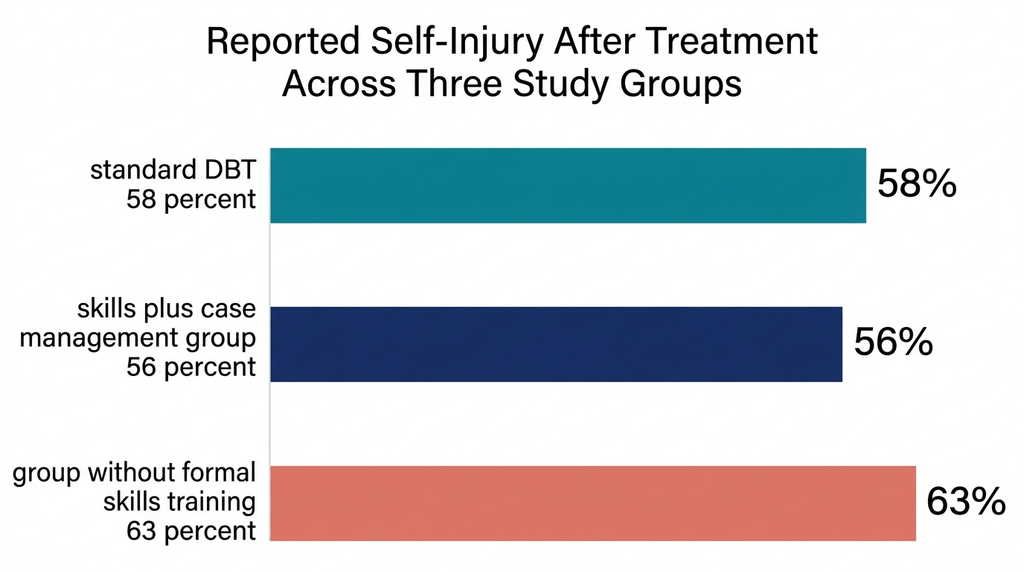
The clearest adult evidence on DBT skills for self-harm comes from a 2015 component study that compared standard DBT against two stripped down versions. One kept the skills group but swapped in case management for individual therapy. The other kept individual therapy but replaced formal skills training with an activities group. All three groups improved by similar amounts on suicidal behavior, but the two groups that kept formal skills training showed bigger drops in self-injury, depression, and anxiety than the group without it. Reported rates of self-injury after treatment were about 58 percent in standard DBT, 56 percent in the skills plus case management group, and 63 percent in the group without formal skills training, according to a related skills training analysis.
What the Research Says About DBT for Self-Harm
So does DBT for self-harm actually stop people from hurting themselves again? The honest answer sits between a clear yes and a clear no.
A 2021 Cochrane review pooled six trials and 502 adults and found that 66 percent of people who got DBT repeated self-harm by the end of treatment, compared with 68 percent who got usual care or another comparison treatment. The odds ratio was 0.71 with a confidence interval running from 0.32 to 1.55, and the certainty of that evidence was rated very low. In plain terms, that gap is too small and too shaky to call DBT a guaranteed fix for whether someone repeats self-harm at all.
The same review drew a more hopeful conclusion about frequency. Standard DBT may lower how often self-harm happens among people who stay at risk, even if it does not reliably stop every single episode. Picture two groups of 100 people where about two thirds in each group have at least one repeat episode. If the DBT group has fewer total episodes, shorter crises, or less dangerous injuries, that improvement would not show up in a simple yes or no count, which is exactly the pattern the Cochrane outcome summary pointed to.
That same review also found that skills group alone or individual therapy alone, stripped of the rest of the model, probably did little to change whether someone repeated self-harm at all. That is a useful warning against treating a short coping skills class as a stand in for a full program.
Does Age Change the Picture?
Most of the adult evidence above involves women with recurring self-harm and borderline personality disorder. Adolescent evidence tells a somewhat different story. A U.S. trial comparing six months of DBT against an intensive supportive therapy in 173 high risk teens, known as the McCauley adolescent trial, found that teens in DBT were more likely to reach self-harm remission during follow up, though many still self-harmed again within a year. Guidance from the United Kingdom’s NICE guidance says clinicians should consider an adolescent version of DBT for teens with frequent self-harm and major trouble managing emotion, not that every teen needs it automatically.
What to Expect in DBT Sessions
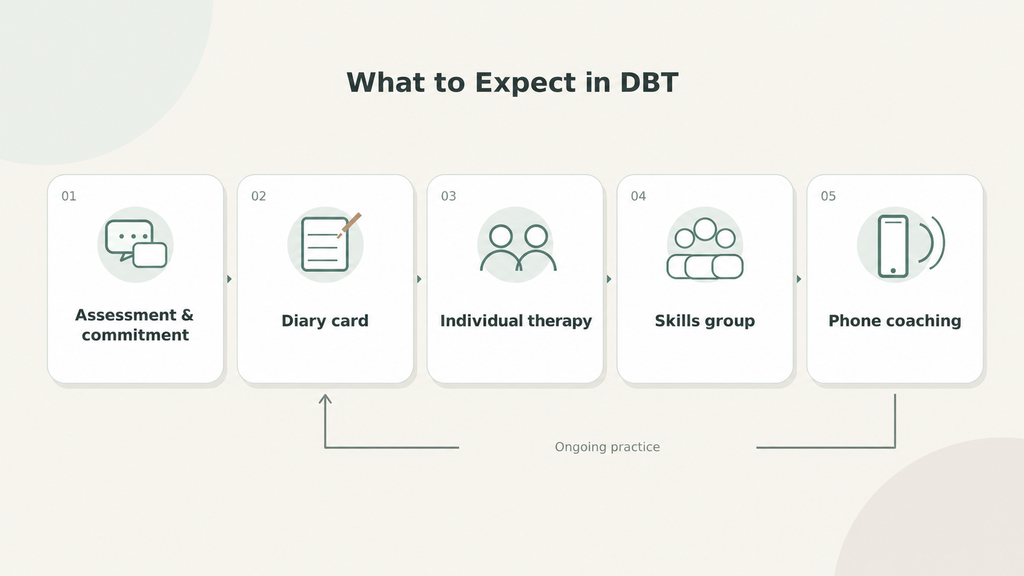
Most people start with an assessment and a commitment conversation before any skills work begins. Expect to fill out a diary card that tracks urges, self-harm, and skill use between sessions. That card becomes the roadmap for individual therapy, where you and your therapist look closely at what happened before, during, and after a hard moment, a process called a behavior chain analysis.
Group sessions usually run once a week and move through the four skill sets on a rotation, often repeating the full cycle every few months so you encounter each skill more than once. Phone coaching is not open ended counseling. It is meant to be a short call that helps you use a skill right now, not a session about your whole week.
A full course of standard DBT commonly runs about a year for adults dealing with recurring self-harm, though some programs use shorter formats. People also tend to stay in standard DBT longer than in stripped down versions, a pattern noted in treatment retention research, and staying in treatment matters a great deal when the goal is lasting change rather than a quick fix.
How to Tell Real DBT From Skills Handouts
Not every service that uses the word DBT offers the full model, and that distinction matters if you are choosing care. A handout of coping skills, a single workshop, or a therapist who mentions DBT now and then is not the same as the coordinated system the trials actually tested.
Ask a potential provider a few direct questions:
- Do they offer weekly individual therapy run specifically as DBT?
- Is there a weekly skills group covering all four skill sets?
- Can you reach a coach between sessions during a crisis?
- Does the therapist meet with a consultation team every week?
If the answers stay vague, you may be looking at dialectical behavior therapy self-harm support that borrows the name without the structure behind it.
Why DBT for Self-Harm Matters
None of this means skills groups or shorter programs are worthless. They can still help someone build real coping tools, and for some people that is exactly the right amount of care. But if you are dealing with frequent, high risk self-harm, the strongest case for DBT for self-harm points toward the full model, not a piece of it.
The goal is not just fewer trips to the emergency room, though that matters too. It is a life that feels more workable day to day, with support solid enough to catch you between sessions and skills solid enough to use when it actually counts.
If self-harm is part of your story right now, you do not have to sort this out alone. Reach out to our team at The Summit Wellness Group to learn more about treatments and find care that actually fits what you are going through.

