
Choosing between Internal Family Systems (IFS) and cognitive behavioral therapy (CBT) is not simply a choice between a gentle approach and a structured one. Both can explore distress and change behavior, but they use different frameworks and have very different amounts of research behind them. This guide explains the difference between IFS and CBT in real sessions, what evidence exists for trauma, anxiety and depression, and what to ask before choosing a therapist.
IFS vs CBT: The Main Difference
CBT is a broad family of treatments that examines how thoughts, emotions, physical reactions and behaviors influence one another. A therapist may help you test an upsetting prediction, change avoidance patterns or practice a specific skill between visits. Depending on the condition, CBT may use behavioral activation, cognitive restructuring, behavioral experiments or exposure. Learn more about CBT at Summit Mental Health.
IFS, developed by Richard Schwartz, describes inner experiences as “parts” with protective or vulnerable roles. It commonly distinguishes managers, firefighters and exiles, while describing Self as a capacity for curiosity, calm and compassion. In an IFS session, a therapist may invite you to notice a critical or fearful part, understand what it is trying to prevent, and respond without forcing it away. The IFS Institute’s model outline explains these terms; Summit Mental Health also offers an introduction to IFS therapy.
The contrast is mainly in the starting question. CBT may ask, “What keeps this thought-and-behavior cycle going, and what can we test or change?” IFS may ask, “Which part is reacting, what is it protecting, and how can you relate to it differently?” Neither therapy is only about thinking or talking: skill practice, behavioral change and the therapeutic relationship also matter.
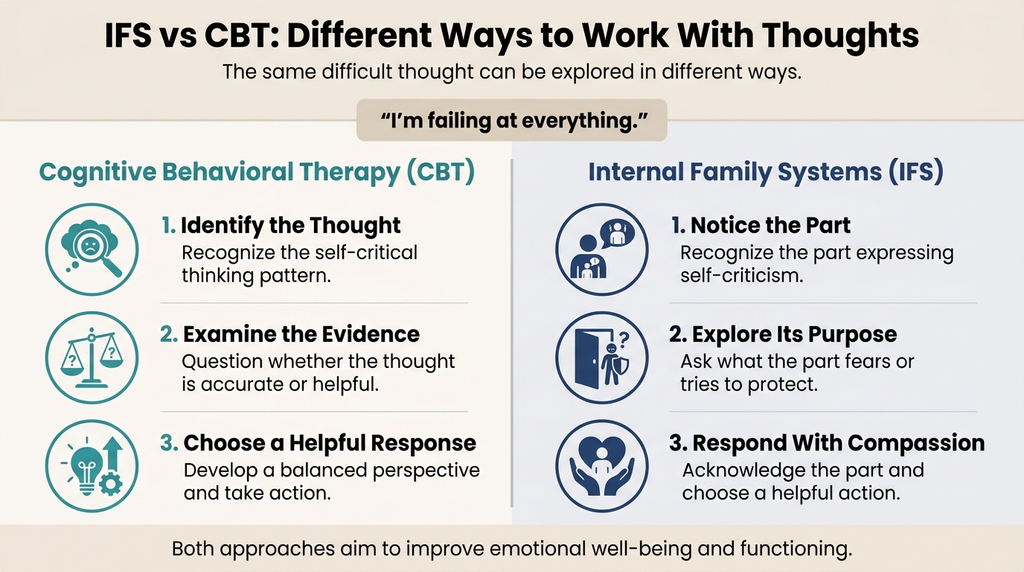
Internal Family Systems vs CBT at a Glance
These are typical emphases, not fixed rules. CBT does not exclude compassion or emotion work, and IFS therapists may incorporate behavioral strategies. Most importantly, the quality of a particular treatment depends on the therapist’s training and the clinical problem, not the label alone.
| Focus | CBT | IFS |
| How distress is understood | Patterns of thoughts, behaviors, emotions and avoidance | Protective and vulnerable parts with competing needs |
| Common session work | Testing predictions, practicing exposure or activation | Noticing parts, exploring protective roles, building Self-led responses |
| Between-session work | Often planned exercises and tracking | Reflection or parts-awareness practices, depending on clinician |
| Evidence for PTSD | Strong for specified trauma-focused protocols | Preliminary; far fewer controlled studies |
| Evidence for anxiety/depression | Large, condition-specific research base | Small depression pilot; limited anxiety-specific evidence |
What Would IFS or CBT Look Like in a Session?
Imagine someone who freezes during a work presentation because they expect colleagues to judge them. A CBT therapist might help identify that prediction, build an achievable practice plan, reduce avoidance and compare the feared outcome with what actually happens. Progress might be measured through presentation attempts, anxiety ratings and day-to-day participation.
An IFS therapist might invite the same person to notice an inner critic that warns against mistakes. Instead of immediately debating the warning, they may ask what the critic fears would happen if it relaxed. The client might begin to recognize the criticism as an attempt at protection rather than the whole truth about themselves. See Summit Mental Health’s explanation of parts work for more examples.
Both approaches may be meaningful. But a compelling session illustration cannot establish that two therapies work equally well for a particular diagnosis. That requires condition-specific clinical studies.
IFS vs CBT for PTSD: Where the Research Differs Most
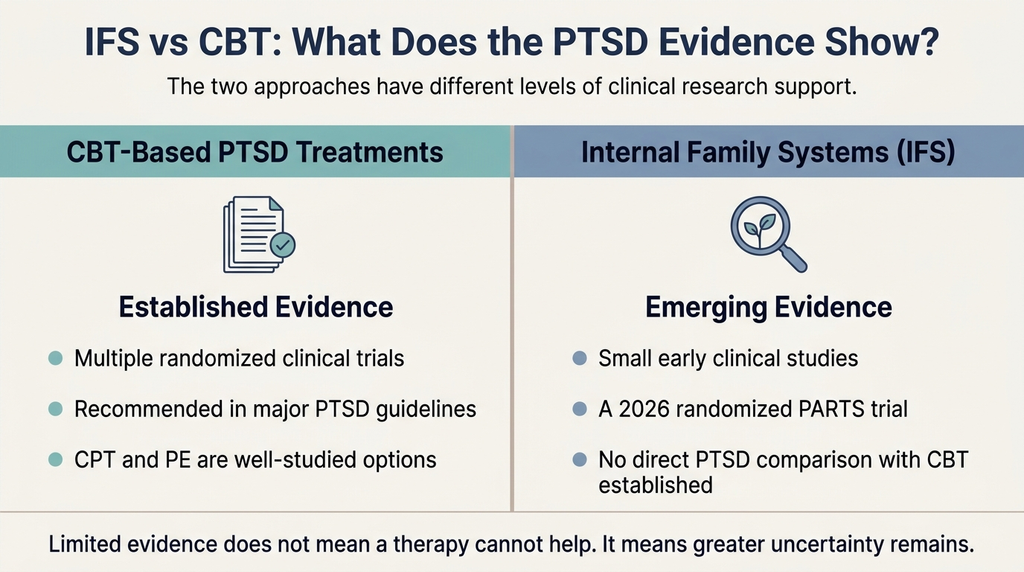
For diagnosed post-traumatic stress disorder (PTSD), evidence-based guidance gives the clearest starting point. The American Psychological Association’s 2025 treatment guidance recommends CBT, Cognitive Processing Therapy (CPT) and Prolonged Exposure (PE). CPT and PE are specialized CBT-derived trauma treatments. The 2023 VA/DoD recommendations summarized by the National Center for PTSD favor CPT, PE and eye movement desensitization and reprocessing (EMDR). EMDR is another trauma-focused therapy, not a subtype of CBT.
These recommendations reflect multiple trials and systematic reviews, not a claim that every patient must follow one identical plan. The NICE PTSD guideline also recommends specified trauma-focused CBT approaches and, for relevant adult presentations, EMDR. IFS is not among the named first-line PTSD treatments in these guidelines.
The distinction is about evidence depth. Trauma-focused treatments such as CPT and PE have been studied extensively across different populations. IFS has a much smaller PTSD research base, including early pilot work and a more recent study of an IFS-derived program. That makes IFS an emerging choice, but not a proven replacement for guideline-supported PTSD therapy.
What Did the 2026 IFS PTSD Trial Actually Find?
In a 2026 randomized trial published in Psychological Trauma, 60 adults with PTSD were assigned to a 16-week group-based IFS-derived program called PARTS or to an active nature-based stress-reduction program. Each arm included group sessions and individual counseling. Both groups experienced significant reductions in clinician-rated PTSD symptoms. The study did not find a statistically significant difference between groups; PARTS participants attended more group sessions and reported greater satisfaction.
The trial is encouraging for feasibility and acceptability. But it did not compare IFS with CBT, CPT, PE or EMDR. Nor was it designed to prove equivalence or noninferiority. “Both groups improved” cannot be turned into “IFS works just as well as CBT.” That would be a stronger claim than the evidence permits.
What About IFS for Depression and Anxiety?
CBT has a long record of clinical studies for major depression and several anxiety disorders. Depending on the diagnosis, treatment may include activation for depression, exposure for panic or phobias, and structured work with worry or avoidance. If you are exploring care for these symptoms, Summit Mental Health explains its depression treatment options and anxiety treatment options.
IFS research for these diagnoses is much less developed. One pilot study by Haddock and colleagues enrolled 37 female college students and compared IFS with treatment as usual, which could involve CBT or interpersonal psychotherapy. Depressive symptoms fell in both groups without a statistically significant difference in the rate or amount of improvement. The article was first available online in 2016 and published in a 2017 journal issue.
That small study does not show that IFS is ineffective; it also cannot demonstrate that IFS and CBT are equally effective. The reviewed material does not establish a similarly extensive IFS trial base for specific anxiety disorders. People can still prefer IFS’s language and method, but preference should be distinguished from evidence of efficacy.
Is IFS Better Than CBT for Trauma?
There is no sound basis for claiming that IFS is generally better than CBT for trauma. For PTSD, condition-specific guidance favors first exploring treatments such as CPT, PE or EMDR with qualified clinicians. Some people may find the parts framework easier to engage with or may not wish to begin a particular trauma-focused method. Those are legitimate preferences that deserve a careful discussion of risks, benefits and alternatives.
It is also inaccurate to assume that exposure-based trauma treatment necessarily retraumatizes people, or that IFS is inherently safer for complex trauma or dissociation. Those are clinical claims requiring evidence. Significant dissociation, repeated self-harm, suicidal thoughts, substance-related instability or severe symptoms call for individualized assessment, safety planning and appropriate professional support regardless of the approach chosen.
Which Should You Try First: IFS or CBT?
A useful decision begins with the concern you want treated, the strength of evidence for that concern, and the clinician’s actual skills. Consider the following starting points:
- Diagnosed PTSD: Ask first about CPT, PE and EMDR, including what treatment would involve and whether the clinician has formal training in the specific method.
- Anxiety or depression: Structured, diagnosis-appropriate CBT generally offers the larger research base. IFS may be discussed as an emerging or complementary approach when it fits your priorities.
- Strong self-criticism or inner conflict: IFS language about protective parts may resonate with you, but a therapist should still explain how improvement will be assessed.
- Previous treatment did not help: Review diagnosis, treatment delivery, therapeutic fit and barriers before dismissing an entire approach.
It is reasonable to consider a combination or a change in approach after discussing what has or has not worked. The key is not to continue indefinitely without improvement, or to assume that an appealing therapy description is itself evidence that it will help.
Questions to Ask Before Choosing a Therapist
Whether you choose IFS or CBT, ask for a concrete treatment plan rather than a broad promise of healing:
- What are we treating? What diagnosis or problem is the therapy targeting, and how was it assessed?
- What will sessions involve? Will there be exposure, behavioral practice, parts work or homework, and why?
- What training do you have? Is the clinician licensed for psychotherapy and trained in the proposed protocol, including trauma and dissociation where relevant?
- How will we measure change? What symptoms, daily activities and personal goals will be reviewed?
- What happens if I am not improving? When will we revisit the plan, consider consultation or explore a different treatment?
For someone with PTSD, ask particularly whether a provider can deliver evidence-based trauma-focused care, how they respond to distress in session, and whether they can coordinate with other clinicians when necessary. Therapist competence and ongoing outcome monitoring are more informative than a therapy label on its own.
The Bottom Line on IFS vs CBT
The difference between IFS and CBT is real: CBT typically focuses on changeable thought-behavior patterns, while IFS works with protective and vulnerable inner parts. Their evidence bases are not equally developed. CBT has substantial research support for depression, anxiety and specific trauma-focused protocols. IFS is promising and may fit some people’s preferences, but current research does not establish it as equivalent or superior to CBT for these conditions.
If you are weighing therapy options, start with an accurate assessment and ask what a specific treatment plan would look like. Explore Summit Mental Health’s PTSD treatment services or mental health programs to discuss appropriate clinical options, provider qualifications and a plan for monitoring progress.

