
Experiential avoidance is the habit of trying to escape unwanted thoughts, emotions, memories, or body sensations, even when doing so begins to limit your life. It might mean skipping every meeting that triggers anxiety, seeking constant reassurance, or using alcohol to numb grief. Some avoidance is sensible and protective. The concern is a rigid pattern that offers brief relief while interfering with what matters to you. This guide explains everyday experiential avoidance examples, how to distinguish avoidance coping from healthy self-care, and how Acceptance and Commitment Therapy (ACT) can help.
What Is Experiential Avoidance?
In ACT, experiential avoidance describes an unwillingness to stay in contact with difficult inner experiences, combined with attempts to suppress, change, or escape them. The original ACT formulation of experiential avoidance treats it as a behavioral process, not a psychiatric diagnosis. The focus is not simply what you do, but why you do it and what it costs over time.
For example, two people might leave the same gathering early. One is exhausted and needs rest. The other leaves because their heart is racing and they believe they must never feel anxious in public. The action looks similar, but the function is different. Experiential avoidance becomes problematic when fear of an internal experience increasingly dictates choices.
Why Avoidance Is Not Always a Problem
Avoidance can be useful. Taking a break after an overwhelming day, leaving an unsafe situation, postponing a difficult discussion until you can think clearly, or using brief distraction to get through an emergency may all be effective responses. ACT does not ask people to tolerate danger, ignore medical needs, or force themselves through every uncomfortable experience.
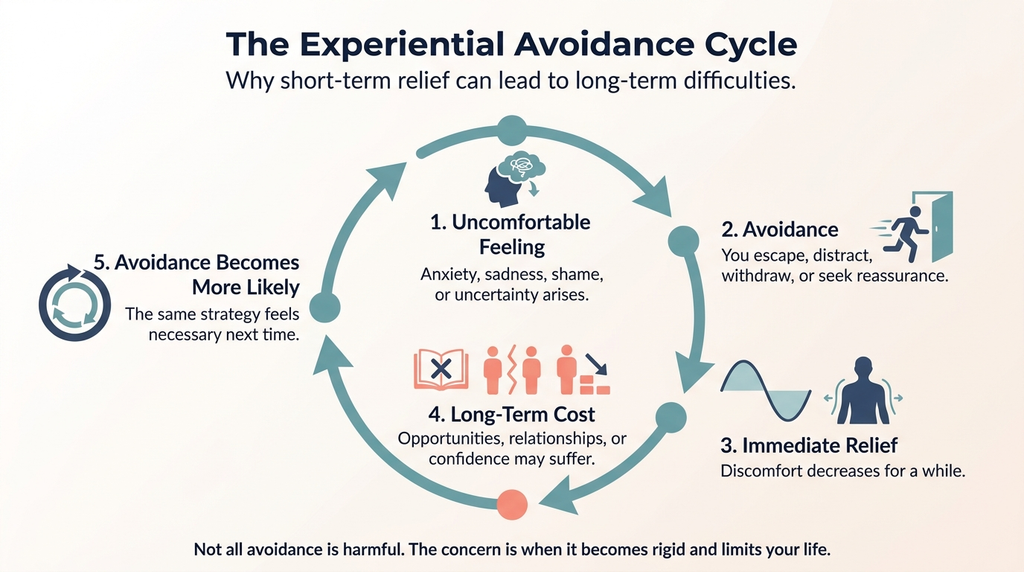
The difficulty arises when short-term relief becomes the main measure of success. Research describes a process called negative reinforcement: leaving a feared situation reduces distress immediately, so the same escape response becomes more likely next time. A review of experiential avoidance research emphasizes that the behavior must be understood in context and that the construct is not a complete explanation for every mental health condition.
Experiential Avoidance Examples You Might Recognize
Experiential avoidance can involve visible actions or quiet mental strategies. Examples include:
- Repeatedly canceling social plans because you do not want to feel anxious or embarrassed.
- Avoiding a medical appointment because you fear receiving difficult news.
- Checking messages or asking for reassurance over and over to quiet uncertainty.
- Working constantly to prevent yourself from noticing sadness, grief, or loneliness.
- Using alcohol or other substances primarily to numb painful feelings.
- Suppressing a distressing memory or arguing with a thought for hours to make it disappear.
- Remaining isolated because anticipated shame or rejection feels intolerable.
None of these actions alone proves a person is engaging in maladaptive avoidance. Sometimes a cancelled event, distraction, or rest day is a deliberate, healthy choice. What matters is the purpose, flexibility, repetition, and long-term impact of the pattern.
How the Short-Term Relief Cycle Works
Experiential avoidance can become self-reinforcing even when a person understands that it is limiting them:
- A thought, emotion, or physical sensation feels unpleasant. For example, anxiety rises before a work meeting.
- The person predicts the feeling will be unbearable or dangerous. They think, “I cannot handle this.”
- They escape or suppress the experience. They skip the meeting.
- Distress drops temporarily. The immediate relief makes avoidance more likely the next time.
- Long-term costs grow. They lose opportunities to contribute, test their fears, and build confidence.
Avoidance can therefore work in the moment while becoming less workable over time. This is a useful way to understand why the pattern persists without treating the person as weak or making a claim that avoidance alone causes anxiety or depression.
Healthy Coping vs. Unhelpful Avoidance Coping
ACT uses the idea of workability: does a response help you live in line with your goals and values over time? The following comparison is a practical guide, not a diagnostic test.
| Potentially helpful coping | Potentially costly avoidance |
| Chosen flexibly based on the situation | Feels automatic or like the only tolerable response |
| Protects safety or allows recovery | Mainly aims to escape an unwanted feeling |
| Makes it possible to re-engage later | Repeatedly delays or blocks re-engagement |
| Supports relationships, health, or valued action | Increasingly narrows opportunities and daily life |
Ask yourself: “Is this one coping option among several?” “Is it helping me return to what matters?” “What happens after the relief wears off?” “If I kept responding this way for six months, would my world expand or shrink?” Answers that point toward rigidity and growing costs may indicate a pattern worth discussing with a clinician.
How ACT Helps With Experiential Avoidance
ACT focuses on psychological flexibility: learning to notice internal experiences and select actions that fit your values and circumstances. It does not require fear, sadness, or intrusive thoughts to disappear before you can move forward. For more on the approach, see what ACT therapy is and how it works and the center’s ACT therapy service overview.
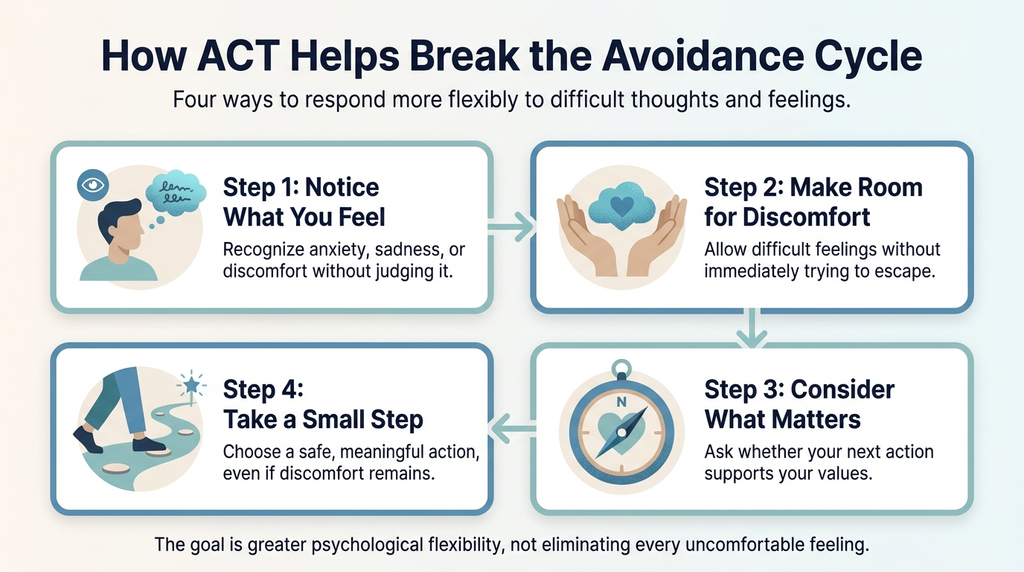
ACT draws on six interconnected processes: acceptance, cognitive defusion, attention to the present moment, self-as-context, values, and committed action. In practical terms, a therapist might help someone:
- Notice an anxious thought without treating it as a command.
- Allow manageable discomfort without trying to eliminate it immediately.
- Return attention to what is happening in the present, rather than a feared future.
- Identify a personally meaningful direction, such as connection, learning, or health.
- Take a small, realistic step toward that direction while making room for discomfort.
If thoughts are especially sticky, cognitive defusion techniques may help create enough distance to respond differently. Acceptance does not mean approving of abuse, giving up on change, or abandoning appropriate treatment. The aim is flexible action, not passive endurance.
An Everyday ACT Example: Avoiding a Meeting
Suppose you want to speak up during a meeting, but the thought “I will embarrass myself” arrives with a racing heart. Avoidance offers one immediate route to relief: say nothing or call in sick. An ACT-informed response might start by noticing, “I am having the thought that I will embarrass myself.” You then allow the anxious sensation to be present, remember that contribution matters to you, and ask one prepared question.
This is not a demand to push through panic at any cost. A therapist would consider the context, pace, severity, and safety. Over time, repeated workable actions may reduce the control that anxiety has over your choices. For more examples, the related guide on ACT techniques for anxiety covers willingness, present-moment awareness, and values-based behavior.
What Does the Research Say About ACT and Avoidance?
ACT is supported by treatment studies, but it is important to separate results for an entire therapy program from evidence for any single exercise. In a randomized study of 128 adults with mixed anxiety disorders, ACT and CBT both led to substantial improvement. Another trial of 101 outpatients with anxiety or depression compared ACT with cognitive therapy and reported improvements in both groups. Neither study proves that one technique alone cures experiential avoidance.
Longitudinal studies also suggest a nuanced relationship with symptoms. In a four-year cohort involving adults with anxiety disorders, experiential avoidance overlapped with worry, rumination, and other risk processes while contributing to some predictions of disorder maintenance. For depressive disorders, a separate cohort analysis found that the apparent predictive effect of avoidance was no longer independent after adjusting for rumination, worry, and neuroticism. This is evidence against treating avoidance as the single cause of depression.
For obsessive-compulsive disorder (OCD), an ACT trial against relaxation training reported improvement, but that does not establish ACT as superior to exposure and response prevention (ERP). The International OCD Foundation identifies ERP as the first-line psychological treatment. ACT skills may complement ERP when they support willingness and reduce rituals, rather than become new reassurance routines.
When Avoidance Signals You May Need Support
Consider a professional assessment if avoiding difficult experiences has begun to interfere with daily life, particularly when:
- You repeatedly miss work, school, medical appointments, or important responsibilities.
- Anxiety, low mood, or social withdrawal persists and daily activities keep shrinking.
- Alcohol, drugs, compulsive checking, or other behaviors have become your main way of managing emotions.
- You feel unable to change a pattern even when you want to reconnect with people or activities.
- You are experiencing self-harm urges, suicidal thoughts, or difficulty staying safe.
If you may act on suicidal thoughts, have a plan, or cannot keep yourself safe, seek urgent help through local emergency services or an emergency department. A self-report questionnaire or online article is not a substitute for direct assessment.
A clinician can help determine whether avoidance is linked to anxiety symptoms, depression, OCD, trauma, substance use, or another concern. The right treatment may include ACT, CBT with exposure or behavioral activation, medication, or coordinated care, depending on your needs.
Frequently Asked Questions
Is experiential avoidance the same as ordinary avoidance?
No. Everyday avoidance can be adaptive, especially when it protects safety or allows recovery. Experiential avoidance refers to efforts to control unwanted inner experiences, and it becomes concerning when the pattern is rigid and interferes with meaningful living.
Can experiential avoidance make anxiety worse?
It can help maintain anxiety when repeated escape prevents new learning and leaves feared situations untested. However, anxiety has many causes, and avoidance is not the sole explanation for every person.
Does ACT teach you to stop avoiding everything?
No. ACT supports flexible choices. It aims to reduce costly efforts to escape thoughts and emotions, while still respecting real danger, health needs, boundaries, and the pace of treatment.
Building a More Flexible Way Forward
Noticing experiential avoidance is a starting point, not a reason for self-criticism. The useful question is whether a strategy that once helped now costs more than it gives back. An ACT-informed treatment plan can help you recognize that pattern, make room for manageable feelings, and reconnect with the people and activities that matter.
If avoidance has started limiting your life, explore Summit Mental Health’s treatment programs and discuss an individualized plan with a qualified mental health professional.

