
Depression can make ordinary tasks feel impossible, especially when previous therapy or medication has not brought enough relief. Acceptance and commitment therapy for depression (ACT) offers another approach: instead of waiting for painful thoughts and feelings to disappear, it helps people respond to them more flexibly and reconnect with activities that matter. Research suggests ACT can reduce depressive symptoms, but it is not automatically better than CBT or a proven solution for treatment-resistant depression. This guide explains how it works, what studies show, and when to consider it.
How Acceptance and Commitment Therapy for Depression Works
ACT is a behavioral psychotherapy aimed at building psychological flexibility. That means noticing difficult thoughts, feelings, and sensations without allowing them to dictate every choice. As the Association for Contextual Behavioral Science explains, acceptance is combined with values and concrete behavior change. Accepting an emotion is not giving up, agreeing with hopeless thoughts, or remaining in an unsafe situation.
The six interconnected ACT processes include acceptance, cognitive defusion, awareness of the present moment, self-as-context, values clarification, and committed action. Therapists choose exercises based on the person rather than teaching the processes as a rigid checklist. Our overview of what ACT therapy is explains the full model.
In depression, the aim is to reduce the control that hopelessness, shame, withdrawal, and self-criticism exert over daily behavior. A person may still feel low while finding ways to restore connection, self-care, work, or enjoyable activities. Small actions are not a demand to simply think positively or ignore fatigue.
An Everyday Example of ACT for Depression
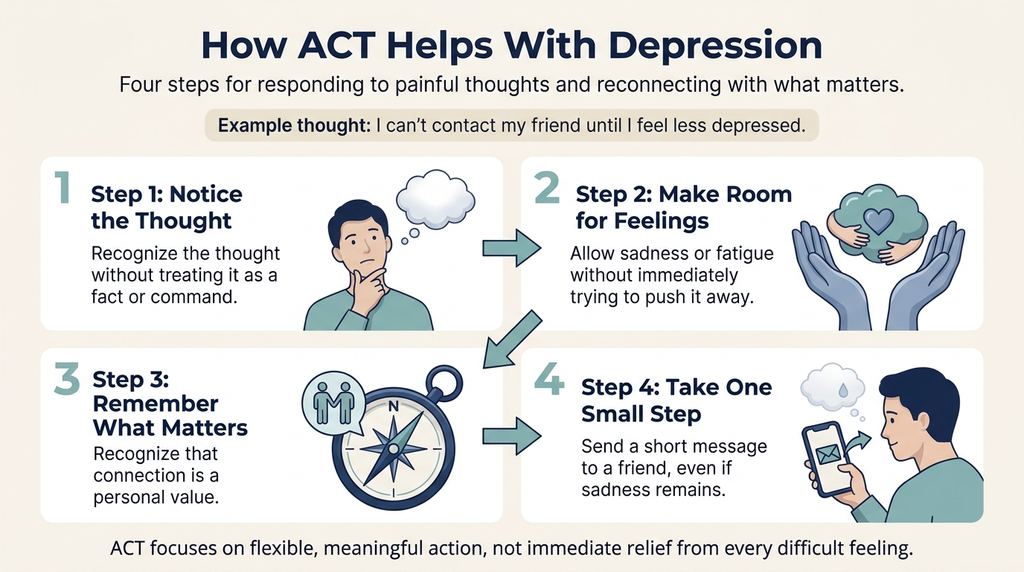
Imagine someone thinking, “I cannot text my friend until I feel less depressed.” In ACT, the person might first notice, “I am having the thought that I cannot reach out.” They make room for the shame or exhaustion they feel, identify connection as a value, and choose a manageable action, such as sending one message. Their mood might improve, remain unchanged, or fluctuate. The immediate goal is taking a meaningful step without making emotional relief a prerequisite.
Does ACT Help Depression? What the Research Shows
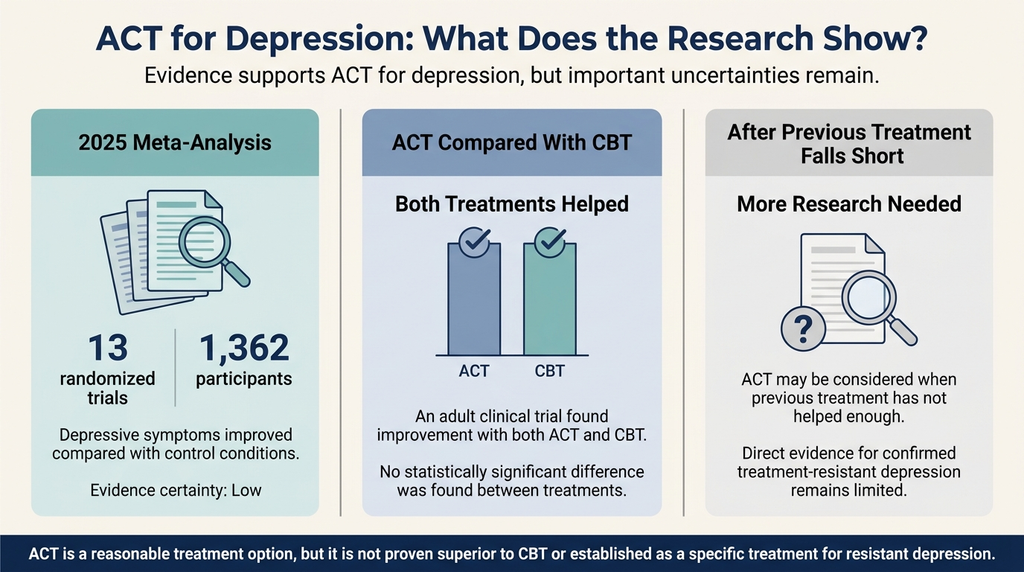
A 2025 systematic review and meta-analysis combined 13 randomized trials involving 1,362 participants, mostly adults. Compared with control conditions, ACT was associated with a moderate average reduction in depressive symptoms (standardized mean difference, SMD, of -0.66). It also improved psychological flexibility and anxiety symptoms on average. The depression evidence was graded as low certainty, however, because the studies varied and had methodological limitations.
An SMD of -0.66 does not mean that 66% of people recovered or that symptoms fell by 66%. It describes a standardized average difference between treatment and comparison groups. The review also found that ACT did not significantly change automatic negative thoughts as a pooled outcome, which fits its focus on changing the relationship to thoughts rather than simply removing them.
A randomized trial with 12-month follow-up compared ACT and cognitive behavioral therapy in adults with major depressive disorder. At the end of treatment, remission was reported in 75% of the ACT group and 80% of the CBT group. Both groups maintained substantial average improvements through one year, without a statistically significant difference between treatments. This single trial does not establish that ACT and CBT are equivalent for every patient, or that ACT reliably works after CBT has failed.
ACT has also been studied as an adjunct to antidepressants. In the LifeStories randomized trial, 93 adults already using antidepressants received medication alone or medication plus a four-week online ACT-based storytelling program. The add-on did not significantly improve depressive symptom severity compared with medication alone, although it improved quality of life and interest in further care. That distinction is essential: the study does not prove ACT can reverse antidepressant nonresponse.
ACT Compared With CBT for Depression
ACT and CBT share behavioral foundations and both can involve activity scheduling, exposure when appropriate, and work between sessions. The differences concern therapeutic emphasis, not an absolute division between two unrelated approaches. For more on conventional cognitive behavioral therapy, the same principles of active treatment and skill practice apply.
| Treatment feature | CBT often emphasizes | ACT often emphasizes |
| Painful thoughts | Examining evidence and developing more balanced appraisals | Noticing thoughts without treating them as commands |
| Difficult emotions | Understanding emotions and learning coping strategies | Making space for emotions while choosing useful action |
| Behavior change | Behavioral activation, problem-solving, planned activities | Committed action linked to chosen values |
| Main treatment target | Changing unhelpful patterns and reducing symptoms | Increasing psychological flexibility and functioning |
Neither approach requires someone to feel motivated before every activity. CBT can emphasize behavior first, and ACT can examine how a thought functions without insisting it is accurate. There is no sound basis for promising that ACT is universally gentler, easier, or superior.
Why People Consider ACT After CBT or Medication Has Not Been Enough
Some people improve only partly with medication, while others find traditional cognitive restructuring frustrating or unhelpful. In those situations, ACT may offer a different and personally acceptable psychotherapy framework. A person who is continually withdrawing from relationships or waiting to feel better before acting may particularly appreciate its focus on avoidance, willingness, and values.
Still, inadequate improvement should prompt a careful review of what was actually tried. The American Academy of Family Physicians review recommends checking diagnosis, medication dose, duration, adherence, co-occurring conditions, and side effects before concluding that depression is treatment resistant. That term commonly refers to the absence of remission after at least two adequate antidepressant trials. Disappointment with one course of therapy does not by itself establish treatment-resistant depression.
Switching psychotherapy, adding therapy to a tolerated antidepressant, and adjusting medication are different decisions. There is good evidence for ACT in depression generally, but limited direct evidence that ACT is specifically effective after confirmed CBT nonresponse or as an augmentation treatment in confirmed treatment-resistant depression. Treatment may also involve psychiatric medication management and, when symptoms are severe or persistent, additional specialist interventions. Do not stop or change medication without consulting the prescriber.
What ACT Therapy for Depression Sessions Look Like
In individual care, ACT sessions commonly take around 45 to 60 minutes, often weekly, although course length and intensity depend on the treatment setting and clinical needs. Early appointments usually explore depression symptoms, withdrawal patterns, previous treatment, personal goals, and safety. Later appointments often include defusion exercises, present-moment awareness, values clarification, and planned behavior between visits.
A therapist might ask what the urge to stay in bed is protecting the person from, or how self-critical thoughts affect the decision to contact a friend. Between-session practice could involve a five-minute walk, a manageable household task, or one conversation. The aim is not to push through genuine danger, overwhelm, or a medical crisis. A good plan adapts to energy, disability, life circumstances, and symptom severity.
ACT can also be provided in groups, via telehealth, or in structured care programs. Format alone does not guarantee quality: access to a trained clinician, a clear treatment plan, appropriate support, and monitoring matter. People whose depression overlaps with anxiety may also find our discussion of ACT for anxiety helpful. More intensive treatment can be considered when weekly therapy does not provide enough support.
How Progress Is Measured During ACT
A useful treatment plan measures both depression symptoms and functioning. The PHQ-9 is a brief questionnaire often used over repeated appointments to track symptom severity. A clinician may also use the QIDS-SR, review sleep and appetite, and ask about work, relationships, daily activities, quality of life, and safety. The VA/DoD depression guideline emphasizes using ongoing assessment to guide treatment choices rather than simply continuing an ineffective plan indefinitely.
ACT also asks whether a person is becoming more willing to experience difficult feelings while taking values-consistent steps. Some therapists use the AAQ-II to explore psychological inflexibility, but its scores overlap with general distress and should not be treated as definitive proof that ACT caused improvement. If depression scores stay high, functioning deteriorates, or safety concerns emerge, a treatment change or higher level of care may be necessary even when values-based goals are being pursued.
Who May Benefit From ACT, and When More Support Is Needed
ACT therapy for depression may be worth discussing when painful thoughts are leading to withdrawal, when previous thought-challenging exercises have not translated into meaningful behavior change, or when a person wants treatment focused on values and everyday functioning. It may be offered as a psychotherapy alternative or included alongside medication, depending on assessment and preference.
ACT should not substitute for urgent evaluation when someone has active suicidal intent, cannot stay safe, develops psychosis or mania, or is experiencing severe deterioration. Depression with these features requires prompt clinical and psychiatric attention. In the United States, someone facing an immediate safety crisis can call 911 or contact the 988 Suicide & Crisis Lifeline.
For people needing more structured support than a standard weekly visit, a clinician can assess whether a different level of care, including an intensive outpatient program, is appropriate. The best fit depends on symptoms, prior treatment, support, risk, and what the person is realistically able to attend.
Taking the Next Step With ACT for Depression
ACT is a credible treatment option for depression, but the research does not show that it is superior to CBT or a proven stand-alone answer for confirmed treatment-resistant depression. Its distinctive contribution is helping people notice painful internal experiences while rebuilding meaningful action. If previous treatment has helped only partly, the next step is a shared plan that reviews what has been tried, identifies why symptoms persist, and measures outcomes.
Summit Mental Health offers depression treatment services that can be tailored to symptoms, goals, and support needs. To discuss whether ACT, another psychotherapy, medication coordination, or a more structured program is appropriate, contact our team.
