
A thought such as “I’m going to embarrass myself” can feel so convincing that you avoid a meeting, cancel plans, or stay silent. Cognitive defusion is a skill from acceptance and commitment therapy (ACT) that helps you notice the thought without automatically letting it decide what you do. The goal is not to erase difficult thinking. It is to make room for a more flexible response.
What Is Cognitive Defusion in ACT?
Cognitive defusion means changing how you relate to a thought rather than necessarily changing its content. Instead of treating “I am a failure” as an established fact, you might notice, “I’m having the thought that I am a failure.” The words may still feel uncomfortable, but you have begun to separate the thought from your identity and choices.
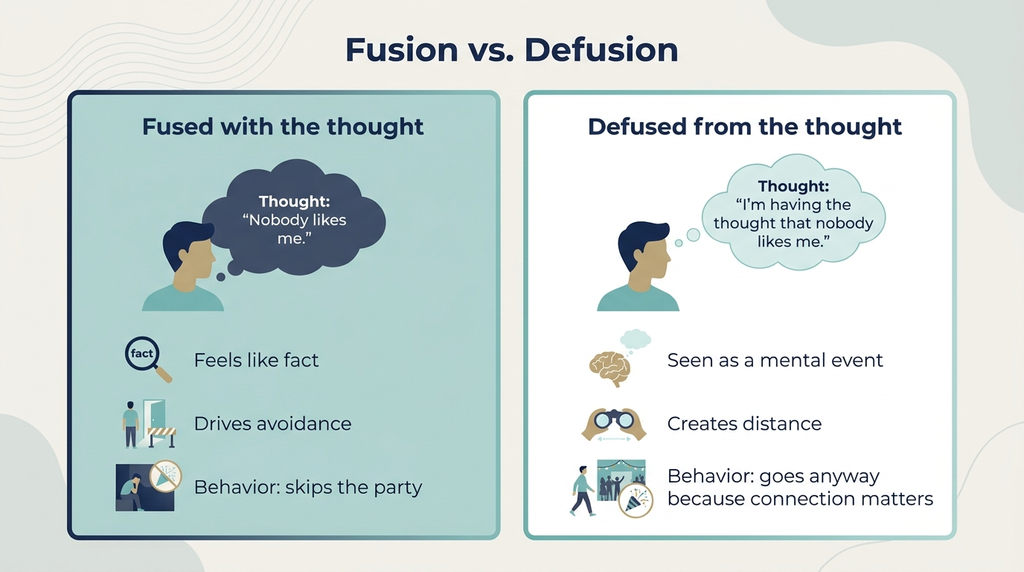
ACT calls the opposite pattern cognitive fusion: becoming so caught up in a thought that it feels like the whole truth, a command, or a prediction you must obey. Defusion helps you see thoughts as mental events—words, images, memories, and stories your mind produces. As the Association for Contextual Behavioral Science explains, the aim is to notice thoughts for what they are, rather than only for what they say.
Cognitive Fusion vs. Defusion: A Simple Example
Imagine the thought “Nobody wants me there” appears before a gathering. When fused with it, you might cancel immediately. With defusion, you could say, “I notice my mind is telling me the nobody-wants-me-there story.” You may still feel nervous, but you can choose to attend because friendship matters to you. You have not proved the thought false; you have stopped treating it as the sole decision-maker.
How Cognitive Defusion Differs From Challenging Thoughts in CBT
Cognitive behavioral therapy (CBT) often uses cognitive restructuring to evaluate a thought and develop a more balanced interpretation. ACT typically asks how the thought is functioning: Does treating it as an absolute truth lead you away from the life you want? Neither approach requires forced positivity, and they can share skills such as stepping back from automatic reactions.
Suppose the thought is “I’m going to ruin the presentation.” A therapist using CBT techniques might ask what evidence supports that prediction, what evidence challenges it, and what would be a fairer conclusion. An ACT therapist might invite you to notice the “I’ll ruin it” story, allow the anxiety to be there, and give the presentation anyway because your contribution matters.
Both methods can be useful. Research on their mechanisms suggests they overlap more than the common “CBT changes thoughts; ACT accepts thoughts” slogan implies. The practical difference is the immediate emphasis: evaluating a thought’s accuracy versus loosening its control over behavior.
Six Cognitive Defusion Techniques With Examples
These cognitive defusion techniques are examples of ACT practice, not a checklist everyone must complete. Choose one that feels approachable. You do not have to make an uncomfortable thought disappear for the exercise to be worthwhile.
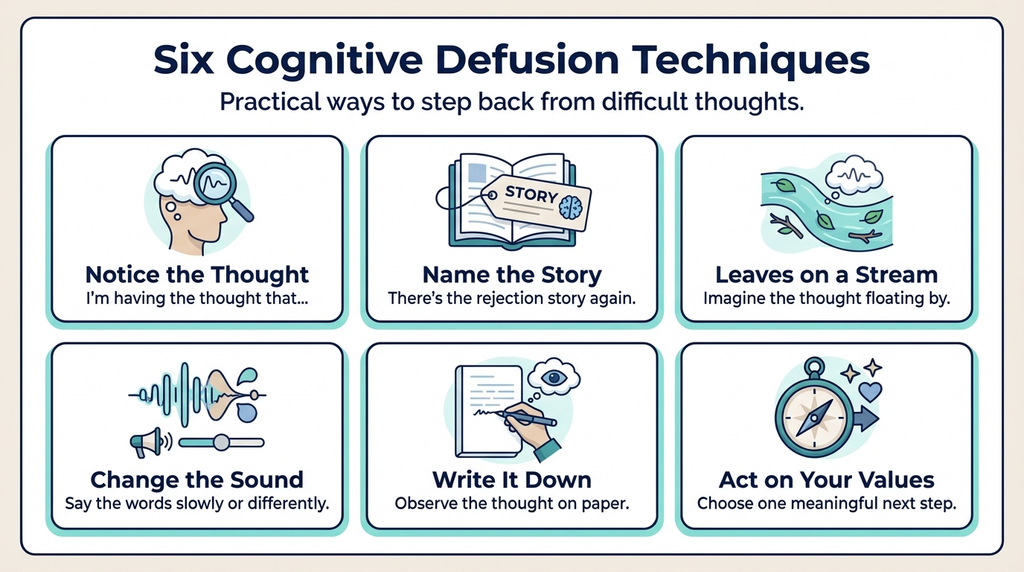
1. Add “I’m Having the Thought That…”
Take a thought such as “I’m not good enough.” Say, “I’m having the thought that I’m not good enough.” You can add, “I notice I’m having the thought that…” The extra words help you observe the thought instead of speaking as if it defines you. A therapist might ask what changes, if anything, when you hear it this way.
2. Name the Story Your Mind Is Telling
Give a recurring thought pattern a short label: “the failure story,” “the rejection prediction,” or “the everything-will-go-wrong story.” When it returns, notice, “There’s that story again.” Naming is not a way to mock your feelings; it helps you recognize a familiar mental pattern without having to argue with it every time.
3. Picture Thoughts as Leaves on a Stream
Imagine sitting beside a slow-moving stream. When a thought appears, picture placing its words on a leaf and watching it float by. If the same thought returns, place it on another leaf. You do not need to push the leaf away or force the stream to move faster. This imagery-based exercise is a familiar part of ACT practice.
4. Change How the Words Sound
For a brief, manageable thought, try saying a word slowly, repeating it, or using an unusual voice. The purpose is to notice the sound of language rather than experience every word as a verdict. The American Psychological Association describes these as examples of defusion methods. If this feels upsetting, artificial, or unhelpful, skip it; there is no need to push through an exercise that does not suit you.
5. Write the Thought Down and Observe It
Write “I can’t handle this” on a piece of paper. Look at the sentence as ink on a page, then notice your reaction to it. You might ask, “Am I looking at a statement my mind produced or a command I must follow?” You can put the paper aside and return to the situation in front of you without needing a final answer about the thought.
6. Connect the Thought to a Values-Based Action
Defusion becomes more practical when followed by a choice. If the thought is “I’ll be awkward,” ask, “What would I do next if connection mattered more than avoiding awkwardness?” The answer might be sending a message or attending for a short time. The aim is not reckless persistence; it is choosing an action that is both safe and consistent with what matters to you.
What a Cognitive Defusion Exercise Might Look Like in Session
A therapist may begin by asking you to describe a situation in which a thought took over. Suppose you skipped a job application after thinking, “They’ll reject me.” Together, you identify what the thought says, what feelings show up, and what you tend to do next.
- Notice the original thought: “They’ll reject me.”
- Try a defusion phrase: “I’m noticing the prediction that they’ll reject me.”
- Check what happens: Does the thought feel any less like an instruction? It is fine if the discomfort remains.
- Choose a small step: Open the application and complete one section because professional growth matters to you.
A clinician can adapt the approach if the exercise becomes another ritual or if practical problem-solving is needed. In everyday life, a shorter version is: notice the thought, name it, and choose one safe next action.
Cognitive Defusion Exercises in Everyday Situations
For work stress, “I’ll never finish” can become “My mind is predicting I won’t finish.” You can then review the deadline realistically and take the next manageable step. Defusion does not replace planning or asking for help when the workload is genuinely too high.
For social anxiety, “Everyone will judge me” can become “I’m noticing a judgment prediction.” You may decide to attend a social event while allowing some discomfort. For grief, you might notice the thought “I should be over this by now” without debating whether your sadness is justified. The next step could simply be resting or contacting someone you trust.
For intrusive thoughts, defusion can support noticing a thought without treating its presence as proof of intent. But if you have obsessive-compulsive disorder (OCD), an exercise may become unhelpful when repeated to obtain reassurance or certainty. That is an important distinction to discuss with a qualified clinician.
Does Research Support Cognitive Defusion?
There is encouraging evidence for ACT as a full treatment, alongside more limited and mixed evidence for individual defusion exercises. These are different claims, and the distinction matters.
In a 2025 meta-analysis of 13 randomized trials involving 1,362 people with depression, ACT improved depressive symptoms, anxiety, and psychological flexibility compared with control conditions. The pooled effect on automatic negative thoughts was not statistically significant. That fits ACT’s emphasis on changing your relationship to thoughts, although the review does not prove that defusion alone caused the improvements.
A 2011 study comparing defusion and cognitive restructuring found improvement with both approaches in a brief intervention involving negative body-image-related thoughts, with differences in how change developed. Short exercises can inform clinical practice, but they do not establish that one full therapy is consistently superior.
A later chatbot-delivered pilot study compared brief defusion and restructuring programs with a control group. Contrary to its predictions, it found no statistically significant between-group differences in thought believability, discomfort, or negativity; participant attrition was substantial. It should not be cited as proof that a defusion chatbot outperformed restructuring.
For perspective, a large 2023 CBT meta-analysis covered 409 depression trials and found meaningful benefits compared with control conditions. A separate randomized trial of ACT versus CBT among 128 adults with anxiety disorders found broadly similar improvement after treatment. The evidence supports choosing an approach that fits your needs, rather than assuming ACT or CBT wins for everyone.
When Defusion Is Not Enough
Defusion is not the same as suppressing thoughts, zoning out, or telling yourself that every concern is imaginary. If a thought points to a real-world problem—an unsafe situation, a missed deadline, or a relationship that needs attention—responding to the facts is appropriate. The skill helps you notice a mental story; it does not replace judgment, planning, or protection.
It can also backfire if used as a reassurance ritual: “I must repeat this phrase until I feel completely certain or calm.” In OCD, exposure and response prevention (ERP) is a first-line psychological treatment. Defusion may complement that work, but it should not replace a structured treatment plan or become another compulsion.
Consider professional support if troubling thoughts repeatedly interfere with daily life, you find yourself avoiding important activities, or exercises increase your distress. A therapist can help determine whether defusion, cognitive restructuring, exposure, or another strategy is appropriate.
Learning Cognitive Defusion With a Therapist
In treatment, cognitive defusion is usually combined with other ACT processes: acceptance, present-moment awareness, self-as-context, personal values, and committed action. A therapist can help you practice these skills in situations that matter to you—not just on worksheets. You can also read about ACT techniques for anxiety and how they support values-based action.
Summit Mental Health offers ACT-informed treatment services as part of its broader mental health approach. If painful or intrusive thoughts are disrupting your work, relationships, or routines, reach out to discuss whether its mental health treatment programs may be an appropriate fit.

