
Talking about a painful memory does not always help you feel it differently, and that gap between insight and change is where experiential therapy comes in. Experiential therapy uses activities like art, movement, and role play to reach feelings that talk alone may miss, and one major review found visual art therapy lowered depression scores in adults. This guide walks through what experiential therapy is, the main types, how it works, and what the evidence actually supports.
What Is Experiential Therapy?
So what is experiential therapy, exactly? It is an approach that uses action, sensory experience, movement, or creative expression as the main tool for change, rather than treating conversation as the only path forward. Instead of just describing a conflict with your partner, you might act it out. Instead of explaining that you feel stuck, you might paint it.
This does not mean thinking and talking get pushed aside. A drawing, a scene, or a bit of movement often becomes something you and your therapist discuss afterward. The activity opens a door. The conversation that follows is where meaning gets built and where change actually takes shape.
One classic example is psychodrama, where a therapist guides a client through a structured scene from their own life, often using a technique called role reversal so the person can see a conflict from another point of view. This method has been described as guided dramatic action that helps a client set up a real situation, act it out, try new responses, and talk through what came up. Drama therapy works a bit differently. It leans on fiction, story, and metaphor instead of a client’s own history, which can feel safer for someone who is not ready to name a painful memory directly.
How Does Experiential Therapy Work?
How does experiential therapy work if it skips straight past conversation? The short answer is that it does not skip conversation at all. It just adds another route in, especially for feelings, memories, or relationship patterns that words alone struggle to capture.
A typical session tends to follow a pattern:
- You settle in, and the therapist checks that you feel safe enough to begin
- A structured activity brings up an emotion, a memory, or a pattern in how you relate to others
- The therapist helps you notice what is happening in your body and mind without letting it become too much
- You talk through what the experience meant and how it connects to your daily life
- You leave with something small to practice or watch for before your next session
The activity itself is not the treatment. The treatment is what happens around it, meaning the pacing, the support, and the reflection that turns a strong moment into something you can actually use. A little emotional intensity can be useful because it makes buried material easier to work with. Too much intensity without support can leave someone shaken instead of helped, which is why a trained clinician stays closely involved throughout.
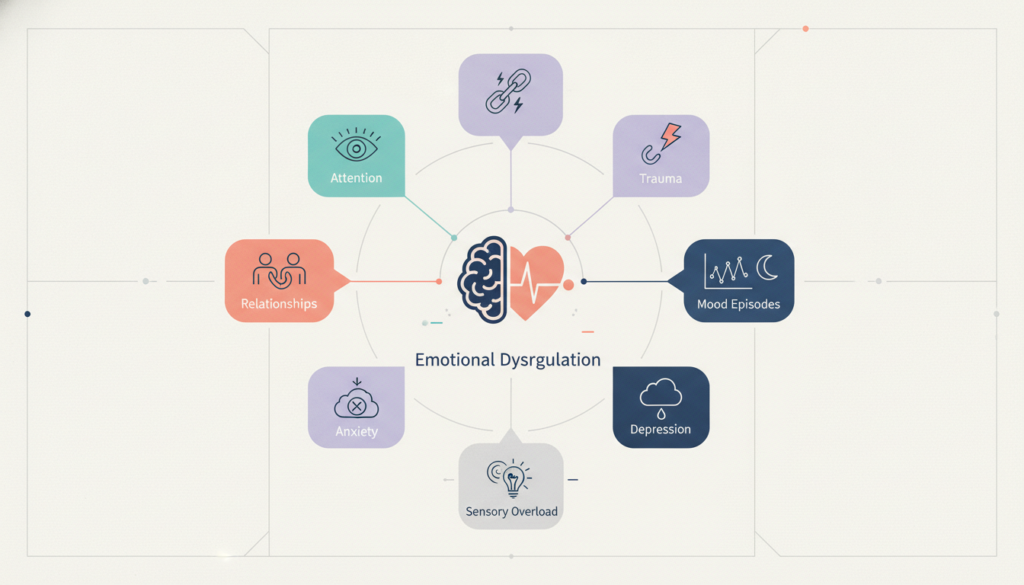
Types of Experiential Therapy
There are several types of experiential therapy in common use, and they differ a great deal in method, format, and how much research backs them up. None of them should be treated as interchangeable.
Psychodrama and Drama Therapy
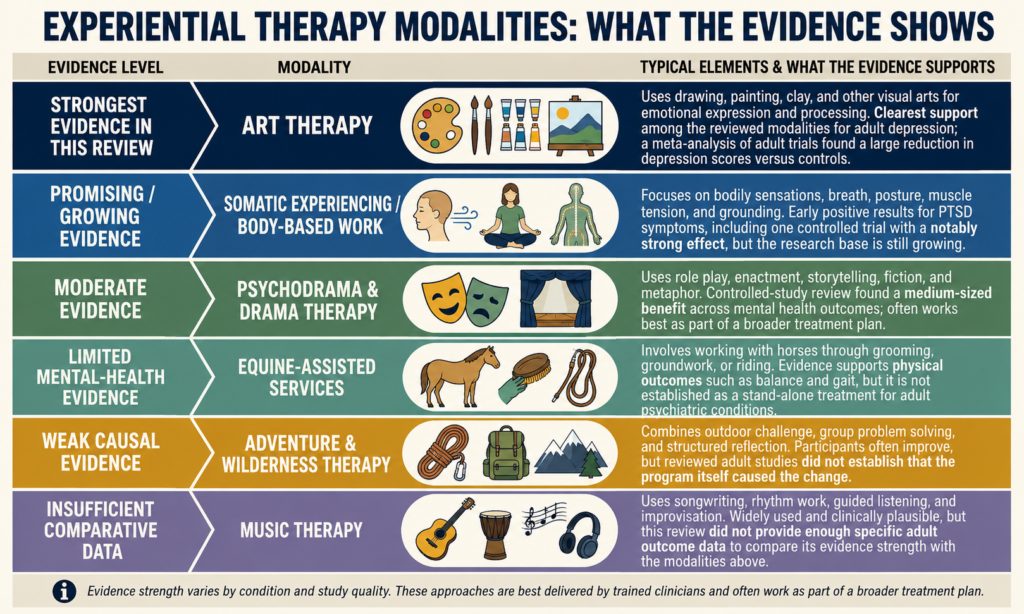
These approaches use role play, storytelling, and enactment to work through relationships, grief, or emotional patterns, often in a group setting. A controlled study review found a medium size benefit for mental health outcomes across drama based methods. The evidence is broad rather than specific to a single diagnosis, so this approach tends to work best as one part of a fuller treatment plan rather than a stand alone fix.
Visual Art Therapy
Here, drawing, painting, or clay work becomes a way to externalize a feeling that is hard to put into words. Among all the types covered here, art therapy has the clearest support for treating adult depression. A recent meta analysis of adult trials found a large drop in depression scores among people who received art therapy compared with controls, though the size of the benefit varied quite a bit from study to study.
Music Therapy
A trained music therapist may use songwriting, rhythm work, or guided listening to support emotional expression and calm the nervous system. Music therapy is widely used and clinically plausible, since rhythm and melody can help people label feelings and regulate arousal. There is not enough specific outcome data available in this review to rank how strong its evidence is for adult mental health care compared with the other types described here.
Somatic and Body Based Work
This category focuses on the body: breath, posture, muscle tension, and the sensations tied to stress or trauma. A scoping review of Somatic Experiencing found early positive results for PTSD symptoms, including one controlled trial with a notably strong effect. Because this work increases attention to bodily sensation, it needs careful pacing so it eases distress instead of increasing panic or a sense of disconnection.
Adventure and Wilderness Therapy
Outdoor challenge, group problem solving, and structured reflection are combined in these programs. Participants often show improvement after treatment, but an independent systematic review found that no adult study included met the standard needed to prove the program itself caused that change. That gap matters if you are weighing this option against something better tested.
Equine Assisted Services
Working with horses, through grooming, groundwork, or riding, can build confidence, boundaries, and present moment attention. An equine intervention review found solid support for physical outcomes such as balance and gait, but current research does not show that these programs treat adult psychiatric conditions on their own.
Common Techniques and Activities
Experiential therapy techniques and experiential therapy activities vary by type, but a few show up again and again across different programs. These are some of the most common experiential therapy examples you might encounter:
- Role reversal, where you take on another person’s part in a scene to build empathy for their point of view
- Guided image making, such as drawing a feeling, a memory, or a hoped for future
- Structured songwriting or lyric discussion tied to a specific emotion or life event
- Grounding exercises that bring attention to breath, posture, or physical sensation in the moment
- Group problem solving tasks completed during an outdoor challenge
- Groundwork with a horse, focused on trust, boundaries, and calm communication
Each of these becomes therapy only when a trained clinician links it to a real goal, watches how you respond, and helps you make sense of it once the activity ends. Without that piece, it is still a meaningful activity, but it is not quite therapy.
Who This Approach Helps Most
Experiential therapy for adults tends to fit best for people who feel stuck in ordinary conversation, struggle to name what they feel, or carry stress in the body more than in words. It is often considered for depression marked by withdrawal and low motivation, anxiety with strong physical symptoms, grief, ongoing relationship conflict, and PTSD related tension, though trauma work always needs extra care and slower pacing.
This approach is not automatically right for everyone. Someone in an acute crisis, dealing with active psychosis, or in a state of severe dissociation usually needs to stabilize first. A good clinician will always assess your readiness before starting anything emotionally intense, and will adjust the plan if you are not ready yet.
What the Research Says About Results
The benefits of experiential therapy are not the same across every type, and that is worth knowing before you commit to one. Visual art therapy has the strongest adult depression evidence, with an art therapy analysis reporting a large drop in depression scores compared with control groups. Psychodrama and drama therapy show a medium sized benefit across broad mental health outcomes in a drama therapy review of controlled studies. Somatic work looks promising for PTSD symptoms, though the research base is still growing. Wilderness programs show frequent improvement but weak proof that the program itself caused it. Equine work has real support, mainly for physical outcomes rather than mental health treatment on its own.
If you have a trauma history, it also helps to know that trauma therapy research still shows gaps in study quality for many approaches, and clinical guidance encourages you and your provider to decide together which method actually fits your needs and comfort level.
Safety First: What to Expect From a Program
Because experiential work can bring up strong feelings quickly, a responsible program should always include a few basics. Before anything intense begins, the clinician should ask about your history, your current safety, and your comfort with the specific activity, and you should be told exactly what you will be asked to do ahead of time. During the activity, someone should be watching for signs of panic, shutdown, or feeling overwhelmed, and you should always have the option to pause or say no without penalty.
After the activity, there should be dedicated time to talk through what came up and connect it back to your daily life and your larger treatment goals. If a provider cannot explain who is leading a session, what training they have, or how a specific activity ties back to your treatment plan, that is worth asking more about before you continue.
Why It Matters
Experiential therapy will not replace every conversation you have with a therapist, and it should never be sold that way. What it offers instead is another route into feelings and patterns that words alone sometimes cannot reach. When it is guided by a trained clinician, paired with clear goals, and followed by real reflection, it can move you past a place where talking alone has stalled. Choosing the right type for your situation, and asking good questions about how it is delivered, makes the difference between an activity that simply feels interesting and one that genuinely helps you heal.
If you are ready to explore whether an experiential approach fits your recovery, reach out to our team at The Summit Wellness Group to learn more about our outpatient treatment programs and how they combine art therapy, somatic work, and other proven methods into one supportive plan.

