
Feeling cut off from joy, love, or even sadness can be frightening, especially when you still know something should matter but you cannot feel it. Emotional numbness is a reduced ability to access, feel, or express emotion, and research in trauma survivors links it to threat overload, dissociation, and depression rather than to not caring. This article explains what the numbness means, why it happens, and what actually helps.
What Emotional Numbness Really Is
Emotional numbness is not one single thing. People use the phrase to describe very different experiences, and each points to a different cause and a different path forward.
You might mean you feel no pleasure in things you once loved. You might feel detached from your own body or from the world around you. You might feel flat after months of relentless stress. Or you might feel intellectually aware of what you “should” feel while nothing lands emotionally.
Because the word compresses so many experiences, a good assessment starts by unpacking it. Someone who says “nothing gives me pleasure and I cannot get myself to do anything” may be describing depression. Someone who says “I feel outside my body and the room looks unreal, but I know it is real” may be describing dissociation. These are not interchangeable.
One key point: numbness is not the absence of emotion. A person can look flat while carrying intense internal activation. In fact, research on Vietnam combat veterans found that hyperarousal symptoms were the strongest predictors of numbing, suggesting that sustained alarm can deplete emotional resources rather than simply switch them off.
Feeling Emotionally Numb After Stress or Trauma
When numbness follows a traumatic event, it often sits inside a broader trauma response. In posttraumatic stress disorder, the inability to feel positive emotions is a recognized symptom, described in the DSM-5 model as difficulty experiencing positive affect. It usually appears alongside avoidance, intrusive memories, and heightened alertness.
The mechanism is not that emotions have vanished. Instead, the nervous system prioritizes threat detection and defense over flexible engagement with warmth, closeness, or play. A recent review describes how perceived threat is processed rapidly through the amygdala, with slower contextual interpretation by the prefrontal cortex arriving afterward. That timing helps explain why a neutral cue can trigger a bodily alarm before your thinking brain corrects it.
Numbness can start in different ways. It may appear during or right after trauma as part of dissociation. It may build gradually as avoidance takes hold. Or it may emerge in a delayed pattern after a period of apparent functioning. A prospective study of military personnel even examined whether pre-trauma anhedonia may raise the risk of later PTSD symptoms, which suggests some reward-related vulnerability can precede trauma.
Numbness may protect you in the short term. During inescapable danger, narrowing your awareness of pain and emotion can help you survive. The trouble comes when that response keeps running long after the threat has passed.
Trauma and Emotional Numbness: The Dissociation Link
Some numbness is better described as dissociation. This includes depersonalization, which is detachment from your own body, thoughts, or feelings, and derealization, in which the world feels dreamlike, foggy, or unreal.
A central feature is that reality testing stays intact. You may feel unreal while still knowing you are not literally unreal. That difference separates dissociation from psychosis, though the picture can get complicated by panic, sleep loss, substances, or medical conditions.
Dissociation matters because it can hide suffering. A person may report low distress not because they are well, but because they are disconnected. Neurobiological work distinguishes hyperarousal responses, which show increased amygdala reactivity, from depersonalization and derealization, which have been linked to excessive top-down inhibition of emotional systems.
Persistent dissociation deserves attention. In one longitudinal study, persistent derealization predicted later PTSD and depressive symptoms even after accounting for concurrent symptom severity. That is why “just feel it” is poor advice. For someone who dissociates easily, pushing emotional intensity too fast can produce more shutdown, not more processing.
Stress and Emotional Shutdown Versus Depression
Not every case of feeling emotionally numb comes from trauma. Two other patterns are worth naming clearly, because they change what helps.
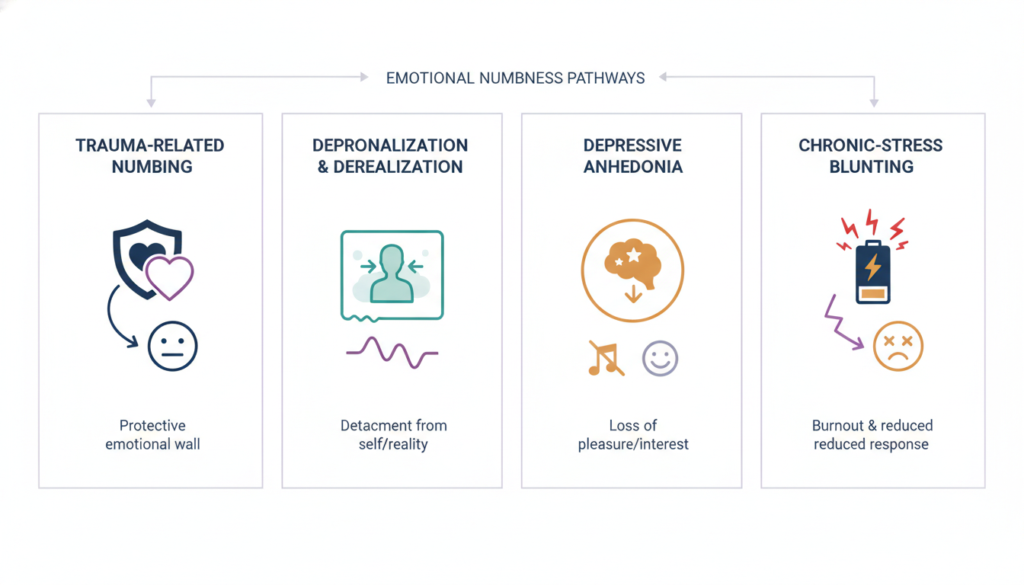
Depressive anhedonia is a marked drop in interest, pleasure, or motivation. It is broader than “not having fun.” It can reduce your desire to start activities, your ability to anticipate enjoyment, and your response to reward. Research suggests a useful split: anhedonia may relate more to the anticipation of reward, while trauma-related numbing may relate more to the response after receiving one. In plain terms, “I do not want things” differs from “I get the thing but feel nothing.”
Chronic-stress emotional blunting describes flatness that follows sustained overload. Months of overwork, caregiving, financial pressure, or lost sleep can leave you saying, “I am functioning, but I feel dead inside.” This is real, but it should never become a catch-all explanation. It may be masking depression, PTSD, substance use, or a medical issue.
Here is a quick way to see how these four patterns differ.
| Pattern | Core experience | Telling question |
| Trauma-related numbing | Cut off from love, joy, closeness after trauma | Is it linked to reminders, avoidance, or hypervigilance? |
| Depersonalization/derealization | Feeling unreal or outside yourself | Do you feel unreal even though you know it is real? |
| Depressive anhedonia | Loss of interest, pleasure, motivation | Has wanting and enjoying stopped? |
| Chronic-stress blunting | Broad flatness during overload | Did it start after prolonged stress and improve with rest? |
Why the Distinction Changes Your Care
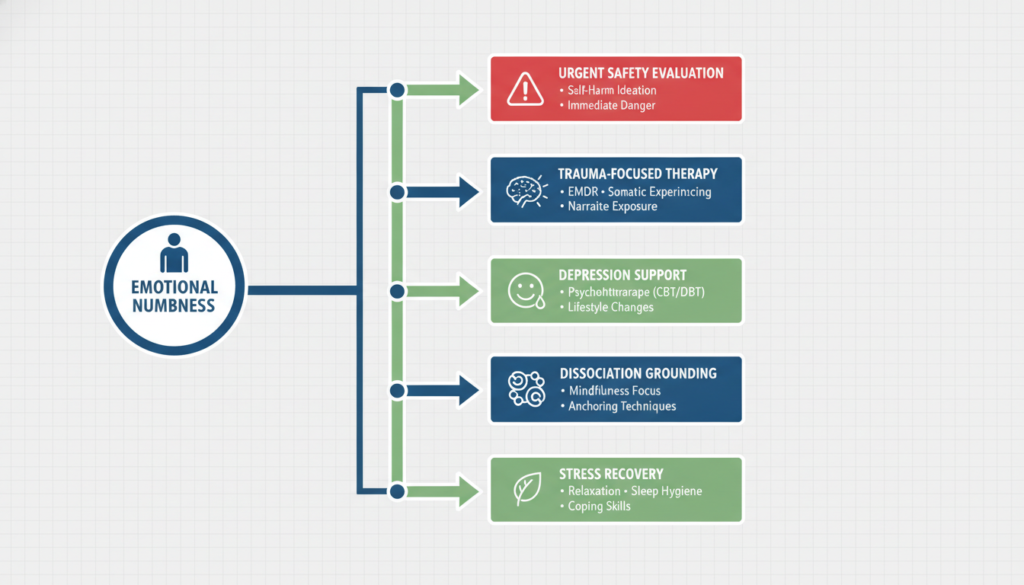
Emotional numbness is a signal, not a diagnosis and not a severity rating. The right level of care depends on safety, medical stability, and how much your life is affected, not on how flat you feel.
A person can feel profoundly numb yet remain safe, oriented, and well suited to outpatient care. Another may appear calm while carrying active suicide risk. Flat affect should never be read as low risk. Anhedonia in particular can hide hopelessness, since someone who feels “nothing” may not look distressed while believing life will never improve.
Emergency evaluation is warranted when numbness comes with:
- Active suicidal intent, a plan, or an inability to stay safe
- Recent serious self-harm or overdose
- Psychosis, severe agitation, delirium, or confusion
- Intoxication, withdrawal, or suspected medical toxicity
- Severe self-neglect or inability to care for basic needs
Guidance on self-harm stresses immediate safety, assessment of intent, and collaborative safety planning, and it warns that risk scores should not replace a compassionate psychosocial assessment.
Therapy for Emotional Numbness That Actually Helps
Here is the encouraging part. Restoring emotional range is most reliably achieved through effective PTSD treatment as a whole, not through a separate “numbing cure.” The 2023 VA/DoD guideline recommends trauma-focused psychotherapy over medication, and the strongest-supported options are Cognitive Processing Therapy, Prolonged Exposure, and EMDR.
Each works through a slightly different route:
- Cognitive Processing Therapy targets rigid trauma-related beliefs, such as “I am permanently damaged” or “if I care, I will be hurt.” Loosening those beliefs can make emotional connection feel possible again.
- Prolonged Exposure reduces avoidance by helping you approach memories and reminders in a safe, paced way. Behavior often changes before feeling does, and emotional life can return as your world stops shrinking.
- EMDR processes traumatic memories using dual attention. It is a first-line choice, though claims that it uniquely “unlocks” stored emotion go beyond the evidence.
Somatic and ACT-based approaches can help as adjuncts, especially for body disconnection or for people stuck “waiting to feel better before living.” Still, current guidelines do not place them on equal footing with the three first-line therapies.
Expect uneven progress. You might sleep better and have fewer nightmares while still feeling detached from your partner. That lag is common and interpretable, because reduced fear does not automatically create joy. As one network analysis showed, avoidance is a central maintaining symptom, and undoing it takes repeated practice.
So how do you judge whether therapy is working? Look at the whole pattern. Are you avoiding less, functioning more, staying present rather than dissociating, and taking small values-based actions? If yes, persistent numbness is likely a later-stage target, not a failure. Periodic measurement, which the APA endorses for tracking progress, keeps this honest.
Why It Matters
Feeling emotionally numb can convince you that you have lost the capacity to love, connect, or care. The evidence tells a different story. Numbness is often a protective adaptation, a sign of overload, or a symptom of a treatable condition, not proof that you are broken.
The practical takeaway is simple. When you notice numbness, do not stop at “am I depressed?” Ask what has gone numb, when it started, whether the world feels unreal, whether trauma symptoms are present, and whether you are safe today. Those answers point toward the right kind of help.
Recovery rarely means constant happiness. It means a wider range of feeling you can tolerate, more presence in your relationships, and a life that grows larger rather than smaller. That is reachable, and you do not have to sort it out alone.
If numbness is keeping you from the people and activities you value, reach out for trauma-informed care and take the first step toward feeling connected again.

