
How long does grief last after losing someone you love deeply? Most adults find the sharpest pain softens within six months to a year, though only about 5 to 7 percent go on to develop prolonged grief disorder, a condition where grief stays severe and disabling long after that point. This guide walks through what grief usually looks like over time and when it may help to seek extra support.
How Long Does Grief Last After a Death?
There is no single number that answers how long does grief last after a death, because grief does not run on a fixed schedule. For most people, the rawest, most consuming pain begins to loosen its grip somewhere in the first year, even though sadness, longing, or tearful moments can still show up years later without meaning anything is wrong.
Doctors and researchers do use certain time markers, but only as one part of a larger picture, not as a countdown. Under the current diagnostic guidance used by mental health professionals in the United States, prolonged grief disorder cannot even be considered in adults until at least 12 months have passed since the death. The International Classification of Diseases, used in many other countries, sets a six month mark instead, though it still requires that grief be unusually severe and disruptive, not just present.
These markers exist to protect people from being mislabeled, not to set a deadline on mourning. Someone can miss a spouse, parent, or child intensely for years and still be grieving in a completely ordinary way.
It also helps to know that grief and depression are not the same thing, even though they can look similar from the outside. Ordinary grief usually comes in waves, with painful stretches followed by moments of relief, laughter, or connection. That mix of hard and lighter moments, even early on, is one of the clearest signs that grief is unfolding in a typical way rather than sliding into something that needs closer attention.
What Grief Looks Like in the First Year
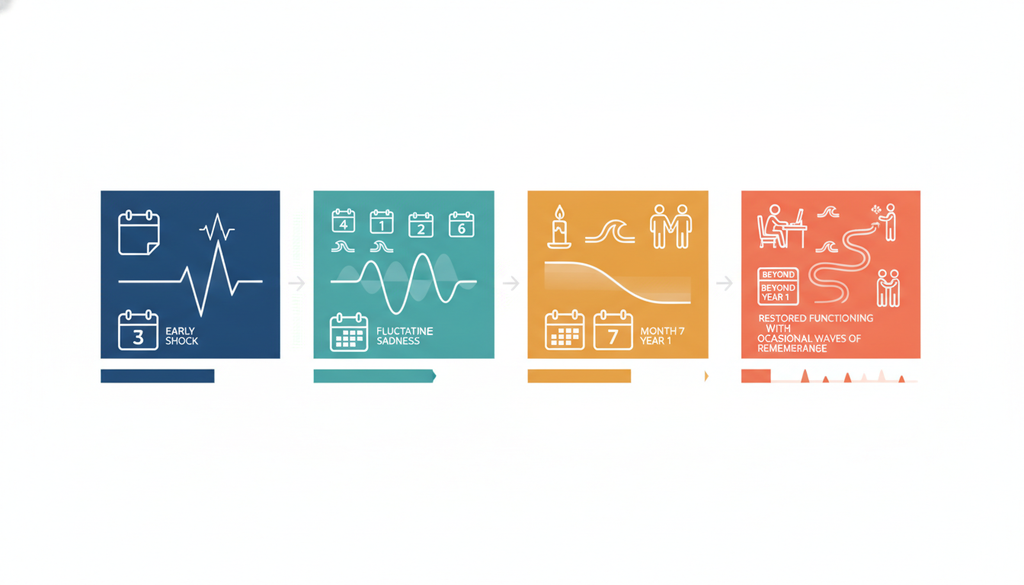
People often ask how long is the grieving process, hoping for a clear map. Grief rarely moves in a straight line, but it does tend to follow some general patterns as time passes. The table below offers a rough guide, not a strict rule, since everyone grieves at their own pace and in their own way.
| Time Since the Loss | What Is Common | When to Consider Reaching Out |
| First few weeks | Shock, disbelief, crying, trouble sleeping or eating | If you cannot function at all or feel unsafe |
| 1 to 6 months | Waves of sadness, guilt, anger, trouble concentrating, mixed with some easier days | If daily life stays completely disrupted with no let up |
| 6 to 12 months | Grief often softens for many people, though anniversaries and holidays can bring it back strongly | If there is no improvement at all during this stretch |
| Beyond 12 months | Continued love, sadness, and memory are normal; most people regain footing at work and in relationships | If longing and preoccupation happen nearly every day and life still feels frozen |
When Does Grief End, and Does It Ever Fully End?
Many people ask when does grief end, expecting a finish line somewhere ahead. In practice, grief rarely ends the way a cold or a broken bone does. It tends to change shape instead of disappearing outright.
A large recent review describes grief as sitting on a spectrum rather than being a switch that flips from broken to fine. Mild to moderate disruption tends to ease gradually for most bereaved people, while a smaller group experiences grief that stays severe and does not soften much with time. Neither pattern is a personal failure. It reflects differences in the relationship, the circumstances of the death, and the support available afterward.
What tends to happen for most people is integration rather than closure. You keep loving the person, you still remember them, and certain days remain hard, but you slowly regain the ability to work, connect with others, and feel occasional joy again. Grief becomes something you carry alongside your life rather than something that blocks it entirely.
Continuing bonds, like talking to the person in your head, keeping a few of their belongings, or marking their birthday each year, are a normal part of this shift rather than something to grow out of. Many cultures build these practices into mourning on purpose, which is one more reason a single universal timeline never quite fits everyone’s experience.
How Long Does Grief Last for Different Types of Loss?
How long does grief last also depends heavily on who died and how they died. Losing a child, facing a sudden or violent death, or grieving someone you depended on closely for daily life all tend to bring longer and heavier grief than losses that were more expected.
Bereavement risk research points to a handful of circumstances that make a harder, longer grief more likely: limited support from family or friends, a history of depression, financial strain layered on top of the loss, and deaths that were sudden, violent, or medically difficult to witness. None of these factors guarantee that someone will develop a diagnosable condition, but they do explain why two people who lost a parent around the same time might be in very different places a year later.
The nature of the relationship matters just as much as the circumstances of the death. Losing a partner you built a life with, a parent who raised you, or a child you expected to outlive you all carry a different weight than losing a more distant relative, and it is fair for the grief to reflect that difference in depth and duration.
Signs Your Grief May Need Extra Support
Grief may be worth a professional evaluation when certain feelings show up nearly every day and stay that way for a long stretch, rather than coming and going in waves. Common signals include intense longing or thoughts about the person that fill most of the day, feeling like part of yourself died along with them, avoiding anything that reminds you they are gone, feeling emotionally numb, or believing life has no point without them.
Grief researchers describe this pattern as centered on the lost relationship itself, which sets it apart from depression, where low mood and loss of interest tend to spread across every part of life rather than staying focused on one person.
Impairment in this context usually looks concrete rather than abstract. It might mean missing weeks of work with no plan to return, avoiding an entire part of your own house, or being unable to picture any kind of future for yourself. That is different from simply feeling sad at work sometimes or preferring to skip a family gathering because it still feels raw.
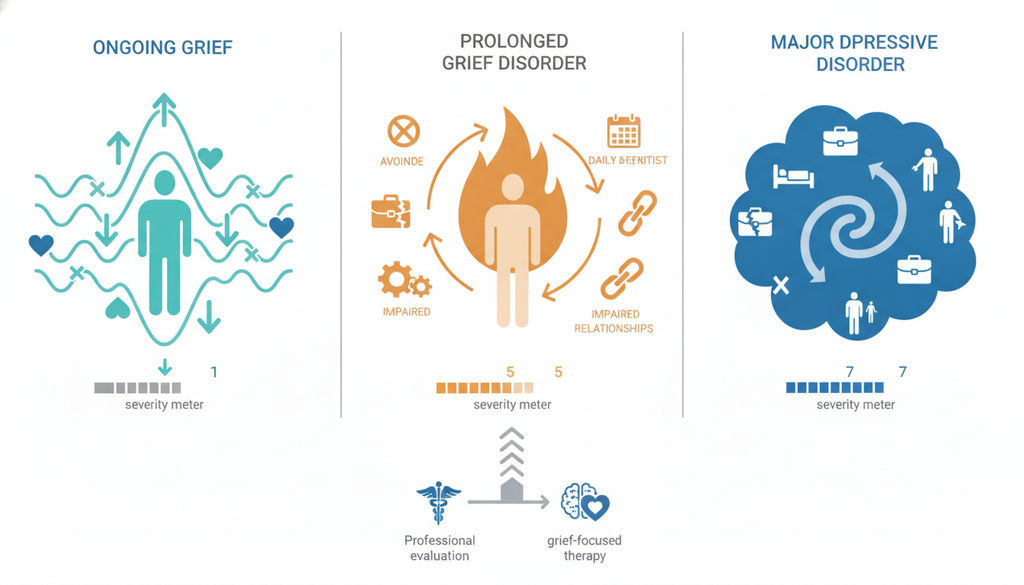
The two conditions often overlap, though. One large study found that nearly 29 percent of bereaved adults met criteria for two or more of prolonged grief, depression, or posttraumatic stress at the same time. Because of that overlap, a short checklist rarely gives a full answer. A conversation with a doctor or therapist who can ask follow up questions is usually a better way to sort out what is actually going on.
What Can Help When Grief Lasts a Long Time
When grief has become this disabling, grief focused therapy built specifically around the loss tends to help more than general talk therapy or medication alone. These approaches usually work on a few things at once: easing avoidance of reminders, gently questioning beliefs like “enjoying anything means betraying them,” and helping you rebuild a sense of identity and daily routine around the loss instead of just managing sadness day to day.
Support groups, whether in person or online, can also make a real difference by connecting you with people who understand this particular kind of loss without needing much explanation. They work best alongside professional support rather than as a replacement for it, especially when grief has been going on for a long time or has stopped improving.
It also helps to pay attention to sleep, work, and connection with others, since these areas often decline together when grief has become too heavy to carry alone. Warning sign research lists major changes in sleep, pulling away from everyone, and a growing sense of hopelessness as signals that deserve prompt attention, particularly if someone starts talking about wanting to die or wanting to be with the person who died. Further safety guidance also points to giving away possessions or saying goodbye as behaviors that should never be brushed off as normal grief, even soon after a loss.
None of this means every hard day requires a hotline call. It does mean that persistent decline across several areas of life is a fair reason to ask for help sooner rather than later.
Why Understanding Your Grief Timeline Matters
Knowing what to expect does not make grief hurt less, but it can stop you from panicking over normal waves of sadness or, just as importantly, from dismissing a pattern that has quietly become disabling. Grief that eases gradually, even slowly, over months and years is not something to fix. Grief that stays locked in place, blocks basic functioning, and shows no signs of softening after a long stretch is a different situation, and it responds well to the right kind of help.
The goal is not to grieve faster or on a schedule. It is to notice whether you are gradually finding your footing again, even in small ways, or whether you feel just as frozen now as you did in the first weeks. If you are unsure which category fits, that uncertainty itself is a reasonable enough reason to talk to a professional, since an outside perspective often sees patterns that are hard to notice from inside your own days.
If your grief has stopped easing and is affecting your sleep, work, or sense of who you are, you do not have to sort through it alone. Reach out to a caring team at The Summit Wellness Group and ask about our depression treatment program to talk through what you are experiencing and build a plan to move forward.

