
Many people with an anxious parent wonder whether their own worry was inevitable or something they picked up along the way. The honest answer is that anxiety is partly genetic, partly hereditary in the family sense, and partly learned, with genes explaining roughly 30% to 50% of population differences in most studies. This article breaks down what that mix really means for you and your family.
Is Anxiety Genetic? What the Science Says
So, is anxiety genetic? Yes, in part. Twin and family studies point to a moderate genetic contribution, commonly around 20% to 60% across disorders and study designs, with many summaries landing near 30% to 50%. A cited twin synthesis attributed about 32% of liability to generalized anxiety disorder to additive genetic factors.
Here is the part people miss. Heritability is a population statistic. It estimates how much of the difference between people in a group is linked to genetic variation. It does not tell you what share of your own anxiety came from your genes.
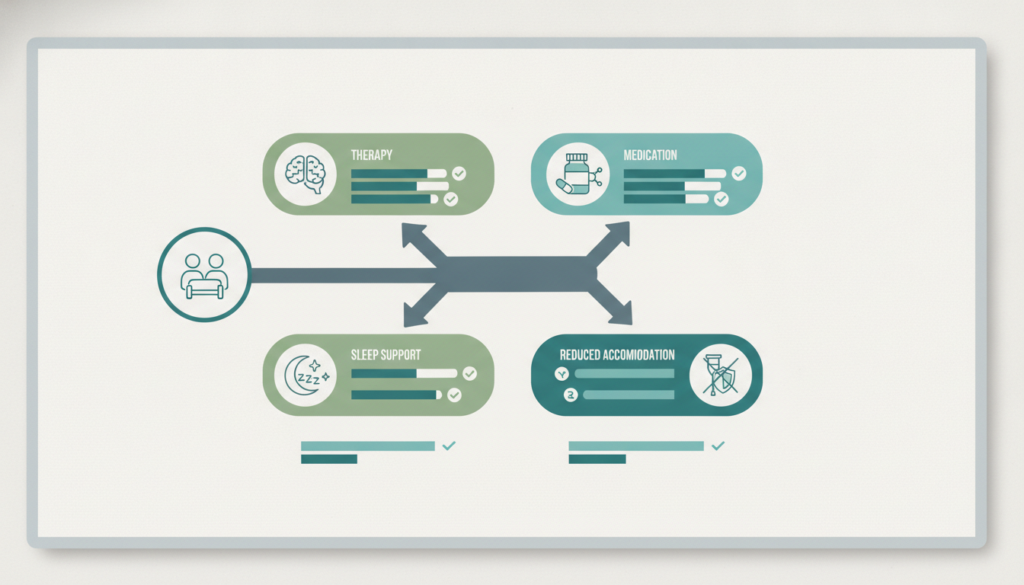
If GAD liability is 32% heritable, that does not mean 32% of your anxiety is genetic and the rest is not. It does not mean you inherited a third of it from a parent. And it definitely does not mean treatment cannot help. A moderately heritable trait can still respond well to therapy, medication, sleep changes, and reduced stress.
Modern genome studies confirm the genetic signal is real but scattered. A 2025 meta-analysis of major anxiety disorders in over 122,000 cases identified 58 replicated risk variants and pointed to brain pathways including GABAergic signaling. Yet each variant has a tiny effect on its own.
That scattered, polygenic pattern is why a single “anxiety gene” does not exist. Instead, many small genetic differences add up to a modest push toward vulnerability.
Is Anxiety Hereditary or Genetic? The Family Question
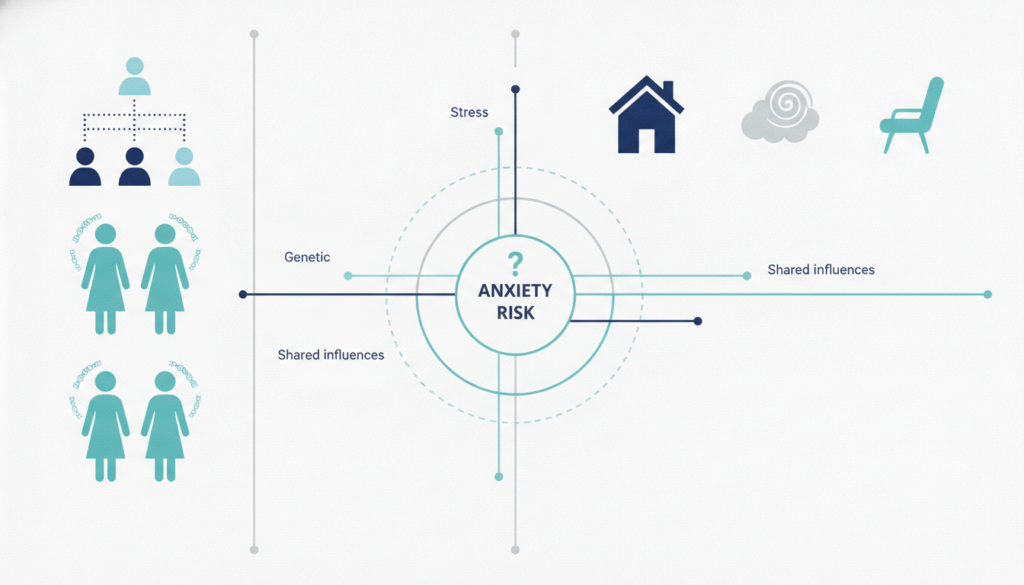
People often use hereditary and genetic as if they mean the same thing. They overlap, but they are not identical. So is anxiety hereditary or genetic in the everyday sense? Family patterns come from more than DNA alone.
When anxiety runs in a family, several things travel together:
- Inherited liability through genes
- A parent’s visible fear and avoidance
- Shared stress, adversity, or financial strain
- Family beliefs about danger and coping
- Learned habits like reassurance seeking and avoidance
One clinical review reports that first-degree relatives of people with anxiety disorders have an estimated four to six times higher recurrence risk than relatives of unaffected people. That is a meaningful jump, but it reflects genes and environment mixed together, not genes alone.
A meta-analysis of 25 studies covering 7,285 children found that offspring of parents with an anxiety disorder had a 76% higher relative risk of an anxiety disorder. Importantly, higher relative risk does not mean 76% of these children become anxious. It means the risk is elevated compared with peers, and the actual number depends on baseline rates and other factors.
So are anxiety disorders genetic in a hereditary sense? They are familial and moderately heritable, but family history is a blended signal. It tells you something about vulnerability, not about destiny.
Is Anxiety a Learned Behavior? The Environmental Side
Now the other half of the question. Is anxiety a learned behavior? A large share of it can be, and this is where the evidence gets encouraging for families.
Children-of-twins research is the key tool here. It compares how strongly a rearing parent’s anxiety predicts a child’s anxiety versus how strongly a same genes aunt or uncle predicts it. In a Swedish children-of-twins study, the parent-child anxiety link stayed strong even after accounting for shared genes. The researchers read this as a direct environmental connection, not just inherited biology.
That does not erase genetics. It shows that genes cannot fully explain why anxiety clusters across generations. Learning matters too.
Several learned pathways stand out:
Modeling. Children watch how caregivers react to uncertainty. A parent who avoids elevators, panics at ambiguous news, or treats mistakes as catastrophes teaches, without words, that the world is dangerous. A measure of parental modeling found the “displaying anxiety and avoidance” pattern was most strongly tied to child anxiety symptoms.
Overcontrol. A longitudinal study found parental psychological control partly explained the link between parent anxiety and child anxiety, and that the cycle ran both ways over time.
Family accommodation. This is when parents change routines to ease a child’s distress, like sleeping in the child’s room or answering endless “what if” questions. It is extremely common. A clinical update reports that 95% to 100% of parents of anxious youth accommodate at least sometimes. Accommodation soothes distress now but often strengthens avoidance later.
Is Anxiety Genetic or Environmental? Both, Working Together
The cleanest answer to “is anxiety genetic or environmental” is that it is both, interacting across development. Genes shape sensitivity. Environment shapes exposure, learning, onset, and recovery.
Here is a simple comparison of how the main influences show up.
| Influence | What it contributes | Can it be changed? |
| Genetic liability | Moderate push toward threat sensitivity | No, but it does not fix outcome |
| Family history | Blended marker of genes and environment | Not the past, but responses can |
| Parental modeling | Learned fear and avoidance patterns | Yes, with coping focused modeling |
| Family accommodation | Reinforced avoidance and low confidence | Yes, gradually and with support |
| Current stress and context | Triggers onset and persistence | Often, with practical support |
Genome studies help explain why the environmental side matters so much. The 2025 anxiety study found SNP-based heritability of about 10%, and a 2026 study of anxiety symptom severity found polygenic scores explained only around 1.2% to 2.9% of variance in symptoms. Those scores are useful for research, but far too weak to predict any one person’s future or treatment response.
Is Anxiety Disorder Genetic Enough to Shape Treatment?
A common worry is that inherited anxiety will not respond to therapy. The evidence says otherwise. A systematic review and meta-analysis of 69 randomized trials found that cognitive behavioral therapy produced moderate symptom reductions across anxiety disorders for up to 12 months.
CBT does not need to rewrite genes. It changes avoidance, threat appraisals, safety behaviors, and the learning that keeps anxiety going. Medication helps too. Pooled pediatric trials suggest roughly 50% to 70% of children respond to SSRIs or SNRIs, with a moderate effect size in one meta-analysis.
Family history does not reliably tell clinicians which treatment to choose. In anxious youth, a positive family history of anxiety did not significantly predict fluoxetine response. Parental anxiety influenced some medication trajectories, but the researchers noted genomic data were missing and that family effects likely work through context and engagement.
So no, being asked “is anxiety disorder genetic” should not lead anyone to skip therapy or assume medication is destiny. Symptoms, functioning, comorbidity, and preferences guide treatment far better than a family tree.
Why This Matters for You and Your Family
The most hopeful finding is that learned pathways can be interrupted. In a randomized trial of 136 high-risk families, only 5.3% of children who received a brief family-based program developed an anxiety disorder over a year, compared with 30.7% in the control group. The number needed to treat was about four.
Parent-focused care works too. In a noninferiority trial, a program teaching parents to reduce accommodation was as effective as child CBT for childhood anxiety, and it cut accommodation even more.
The takeaway is steady and clear. Anxiety is partly inherited, partly familial, and partly learned. Genes load a modest tendency, but they do not seal your fate, and they do not block recovery. Family patterns can be recognized and changed. If anxiety runs in your family, that is a reason for early, compassionate support, not resignation.
If worry is affecting your work, sleep, relationships, or your child’s daily life, help is available and it works. Reach out to exploreanxiety treatment options and take one steady step toward relief.

