
You’ve done the talking, the journaling, and the insight work, but your shoulders still lock up and your heart still races when nothing dangerous is actually happening. Somatic therapy for trauma addresses this gap, and one 2017 trial linked it to large drops in PTSD symptoms after just 15 sessions. This piece breaks down how the body stores trauma, what the evidence says about somatic therapy for PTSD, and how to tell if it fits you.
What Is Somatic Therapy for Trauma?
Somatic therapy for trauma is not one single method. It is an umbrella term that covers Somatic Experiencing, Sensorimotor Psychotherapy, trauma sensitive yoga, body oriented talk therapy, breathwork, and other movement based approaches. Each one has its own training path, its own theory, and its own level of research support. That matters because a claim about one method should not be treated as proof for all of them.
Most versions of somatic trauma therapy share a common goal. They want to help you notice bodily sensations, movement urges, posture, and breath, then use that awareness to build a felt sense of safety and choice. A trauma therapy guide distinguishes structured trauma focused psychotherapies like EMDR from looser body based practices, since lumping them together can create confusion about what has actually been tested.
How the Body Stores Trauma
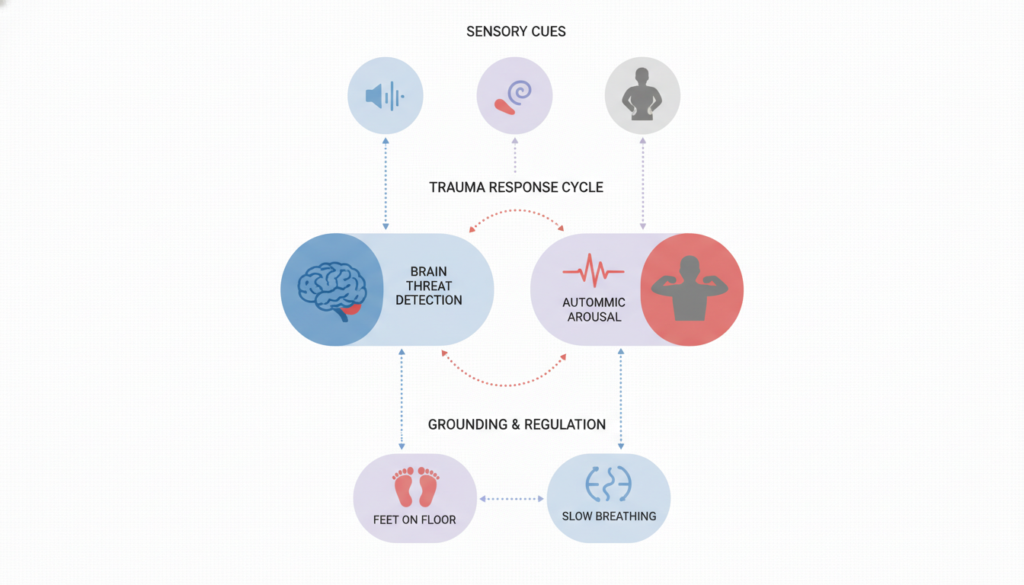
People often say trauma lives in the body, and there is real science behind that idea, just not the version involving muscles or fascia storing memories like a filing cabinet. PTSD involves altered coordination between threat detection, memory, emotion regulation, and the autonomic nervous system. Key structures include the amygdala, hippocampus, insula, and prefrontal regions, all mapped in detail in PTSD brain research on the neurobiology of trauma.
In practice, this means a sound, a smell, or a body position can trigger a racing heart, muscle bracing, or a wave of panic before you consciously know why. That reaction is real and physical. It is best understood as a learned survival response carried by your nervous system, not a literal recording stuck in tissue. Some people stay in constant high alert. Others go numb or shut down. A third group swings between the two. There is no single body pattern that fits everyone with PTSD, which is one reason no single somatic exercise works the same way for every person.
Somatic Experiencing for Trauma: The Evidence
Among the named body based psychotherapies, Somatic Experiencing has the clearest direct research. A 2017 randomized trial gave 63 adults with PTSD either 15 weekly sessions of Somatic Experiencing or a spot on a waitlist. The treatment group showed large improvements in PTSD symptoms and depression, with effect sizes roughly between 0.94 and 1.26 for trauma symptoms. Nearly 44 percent of participants no longer met PTSD criteria after treatment.
That is genuinely encouraging, and it should not be dismissed. But the study compared Somatic Experiencing to doing nothing, not to an already proven treatment such as EMDR or Cognitive Processing Therapy. A 2021 scoping review confirmed this large early effect while also describing the wider evidence base as promising but still preliminary, with a small number of trials and real questions about replication. So somatic experiencing for trauma looks like a reasonable option for some people, not a treatment with proof of being equal or superior to established trauma focused psychotherapy.
Sensorimotor and Body Based Trauma Therapy
Sensorimotor Psychotherapy takes a broader approach than Somatic Experiencing, weaving in posture, movement, attachment history, and cognitive work alongside body awareness. Clinicians who work with complex trauma and dissociation often find it useful in practice. The honest limitation is that no randomized trial or meta analysis currently establishes its effectiveness for PTSD compared with active treatment. That gap in the data does not mean it fails, only that certainty is lower than clinicians sometimes suggest.
The wider category of body based trauma therapy, including yoga, movement, and mindfulness based movement, has somewhat stronger group level evidence. A 2019 systematic review pooled 15 studies and found symptom improvement across varied movement based approaches, though the studies differed enough in design that firm conclusions are hard to draw. A 2021 meta analysis of mind body exercise trials, including yoga and tai chi, found a moderate average reduction in PTSD symptoms. These practices look genuinely useful as support, not as a stand in for trauma focused psychotherapy.
Does Somatic Therapy Work for PTSD?
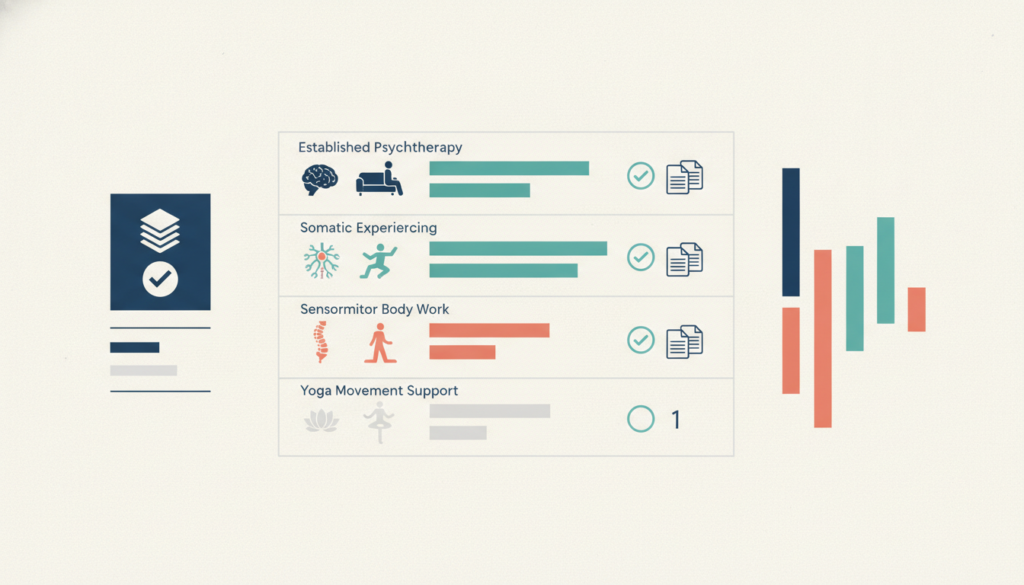
The direct answer is yes, in a limited and specific sense. Some somatic approaches, particularly Somatic Experiencing and general mind body movement, show real symptom reduction in controlled studies. What the research does not show is that somatic therapy for PTSD outperforms or replaces first line trauma focused treatments. APA treatment guidelines continue to give the strongest recommendation to Cognitive Processing Therapy, Prolonged Exposure, trauma focused CBT, and EMDR, based on a much larger body of comparative research.
| Approach | What current evidence shows |
| PE, CPT, EMDR, trauma focused CBT | Strongest and most tested, guideline recommended first choice |
| Somatic Experiencing | One strong small trial versus waitlist, promising but not yet compared to active treatment |
| Sensorimotor Psychotherapy | Clinically used, no qualifying trial identified yet |
| Yoga and movement therapy | Moderate group level support as an add on, not a replacement |
That table is a snapshot, not a ranking of worth. A method with less research can still be the right fit for a specific person and a specific set of symptoms.
Somatic Exercises for Trauma You Can Try
Simple somatic exercises for trauma can help with everyday regulation, especially between therapy sessions or during a rough moment. These are coping skills, not trauma processing, and they work best when kept brief and optional rather than forced.
- Sensory grounding, such as naming five things you can see, four you can touch, and three you can hear
- Feeling both feet pressed into the floor while naming the room, the date, and one safe detail nearby
- Gentle breath pacing, making the exhale slightly longer than the inhale without forcing deep breaths
- Brief muscle release, such as pressing your hands together for a few seconds, then letting go
- Slow, voluntary movement like walking or stretching when stillness feels agitating
If any of these increase panic, dizziness, or a sense of unreality, stop and shift to something purely external, like describing an object in the room. Distress during an exercise is not proof that it is working, and pushing through it is not required for progress.

Is Somatic Therapy for Trauma Right for You?
Somatic therapy for trauma tends to fit best when talk therapy has helped you understand your history but your body still reacts as if danger is present. That includes chronic tension, exaggerated startle, panic that shows up in the body before a thought forms, numbness, or difficulty trusting internal sensations.
Body awareness itself is not automatically calming for everyone. A scoping review on interoception and PTSD found that people with dissociation often show reduced connection to internal signals, and simply telling someone to pay closer attention to their body can backfire. A related analysis found that noticing sensations correlated modestly with more distress, while trusting the body correlated with less. That is a useful distinction. The goal of somatic work should be building tolerance and trust, not just cranking up body awareness.
If you have severe active symptoms, frequent dissociation, or have not yet tried a structured trauma focused treatment, that treatment usually deserves priority. Somatic work fits best as an addition, guided by someone trained to pace it safely.
Why Somatic Trauma Therapy Matters
None of this means the body’s role in trauma is exaggerated marketing. Stress genuinely affects sleep, muscle tension, pain sensitivity, and startle response, and connective tissue can genuinely contribute to pain and restricted movement, as described in a recent fascia research review. What is not supported is the idea that tissue stores specific memories waiting to be released through pressure or shaking.
Somatic trauma therapy matters because it offers a way to work directly with the physical side of PTSD, the part that talking alone sometimes cannot reach. Used thoughtfully, alongside evidence based trauma treatment rather than instead of it, body based care can help close the gap between understanding your trauma and actually feeling safe in your own body again.
If tension, panic, or numbness keep showing up no matter how much you have already talked through, you do not have to sort out the next step by yourself. Our team at The Summit Wellness Group blends evidence based and body focused care within individualized outpatient support, and we would be glad to talk with you about our treatment programs to see what fits your recovery.

