
Feeling anxious, stuck, or overwhelmed and unsure whether therapy would actually help is a common worry before booking a session. Counseling is a structured, confidential relationship with a trained professional who helps you manage emotional or relational struggles, and counselors plus social workers make up nearly 70 percent of the country’s behavioral health workforce today. This guide covers the counseling definition, the main types of counseling, what a counselor does, and how to choose the right one for you.
What Is Counseling? A Simple Definition
Counseling is talk based support from a trained professional who helps you work through emotional, relational, or behavioral difficulties in a private, structured setting. At its core, the counseling definition is simple: it is a relationship built on trust, where a licensed clinician listens, asks the right questions, and helps you build skills to handle whatever brought you in, whether that is anxiety, grief, a rocky marriage, or a habit you are trying to break.
The tricky part is that counselor titles are not standard across the country. You might see LPC, LMHC, LPCC, LCPC, or LCMHC on a therapist’s profile, and these titles usually describe a similar level of training, generally a master’s degree plus supervised practice, but the actual scope of practice is set state by state. A counselor licensed in one state is not automatically allowed to treat someone who is physically sitting in another state during a video call, even if the training looks nearly identical on paper.
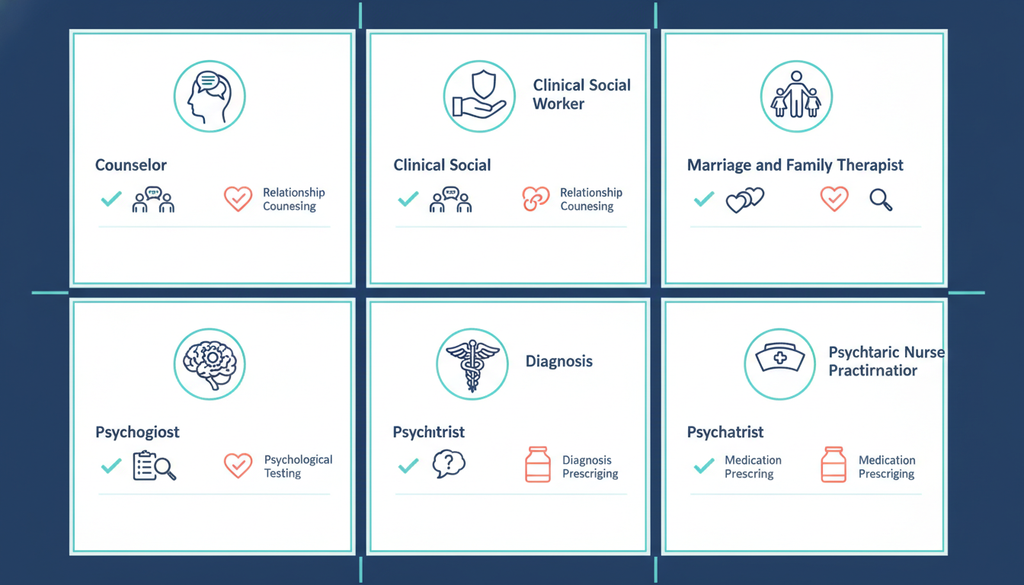
Most counselors diagnose within limits set by their state, meaning they can often name a condition like generalized anxiety or major depression, build a treatment plan, and track your progress session by session. What counselors generally cannot do is prescribe medication. That job usually belongs to a psychiatrist or a psychiatric nurse practitioner, a distinction that matters once you start comparing the different types of counseling and the provider titles attached to each one.
What Does A Counselor Actually Do
A counselor’s day to day work is more concrete than the job title suggests. In a typical week, a counselor might run individual therapy sessions, lead a grief support group, coach a couple through a rough patch, and help someone build coping skills for panic attacks. Many counselors also handle treatment planning, basic crisis support within their training, and coordination with other providers, such as a primary care doctor or a psychiatric prescriber.
There is also a difference between an independently licensed counselor and someone still working under supervision, often labeled an associate, intern, or resident. Both can provide real, helpful care, but a supervised counselor usually has more limits on independent practice, insurance billing, and cross state telehealth. It is a fair question to ask directly: are you independently licensed, or are you practicing under supervision right now?
What a counselor does not usually do is order or interpret formal psychological testing, the kind of in depth evaluation used for autism, ADHD, or complex learning concerns. That work is more commonly handled by a psychologist. Counselors also generally cannot prescribe medication, so if you want a medication review alongside therapy, you will likely need a second provider working alongside your counselor.
One detail people often miss: telehealth counseling is usually governed by where you are sitting during the session, not where the counselor’s office happens to be. A therapist licensed only in Texas generally cannot legally treat you over video while you are visiting family in another state, unless a specific exception or compact privilege applies. This is worth asking about directly before you book, especially if you travel often or split time between two homes.
Types Of Counseling You Might Encounter
Once you know what a counselor generally can and cannot do, the next question is which type of counseling fits your situation. The different types of counseling are usually organized around who is in the room and what problem you are trying to solve, rather than around a single therapy technique.
Individual counseling is the most common starting point, used for anxiety, depression, stress, and general life struggles. Couples counseling focuses on communication, conflict, and rebuilding trust between partners. Family counseling brings in parents, children, or other relatives to work on conflict or communication patterns. Grief counseling supports people after a loss, while trauma counseling addresses the aftermath of a frightening or harmful event. Group counseling gathers several people with a shared concern, such as addiction recovery or social anxiety, into one guided session. Substance use counseling focuses specifically on reducing or stopping harmful use of alcohol or drugs.
The table below gives a quick snapshot of who commonly provides each type.
| Type of Counseling | Main Focus | Typically Provided By |
| Individual counseling | Personal struggles like anxiety or depression | Counselor, social worker, psychologist |
| Couples counseling | Relationship conflict and communication | Marriage and family therapist |
| Family counseling | Parenting or family communication issues | Family therapist, counselor, social worker |
| Grief counseling | Loss and bereavement | Counselor, social worker, psychologist |
| Trauma counseling | Trauma reactions and PTSD symptoms | Psychologist, counselor, social worker with trauma training |
| Group counseling | Shared support among peers | Counselor, social worker, psychologist |
| Substance use counseling | Addiction and recovery | Counselor with addiction training, social worker |
None of these categories are locked boxes. A single counselor might offer individual sessions on Monday, run a grief group on Wednesday, and see a couple on Friday. The label mostly tells you what the session is built around, not the exact license of the person leading it.
How A Counseling Session Usually Works
Your first session usually looks less like therapy and more like an interview. The counselor asks about your history, current stressors, sleep, relationships, and what you are hoping to change. From there, most counseling follows a regular rhythm, often weekly or every other week, with sessions built around whatever goals you set together.
Many counselors use short questionnaires to track how you are doing over time. Tools like the PHQ-9 for depression symptoms and the GAD-7 for anxiety symptoms are common, and a diagnostic accuracy study found they can flag concerns well in general practice, though neither should stand alone as a diagnosis. A high score on a worry questionnaire is a signal to look closer, not a verdict. For trauma specific concerns, a short trauma screen may come up too, and it works the same way: a starting point for conversation, not a label.
Duration matters for formal diagnosis, but it should not be the reason you wait to book a session. A major depressive episode is generally defined as symptoms lasting at least two weeks, generalized anxiety disorder usually requires excessive worry most days for six months, and PTSD symptoms are formally assessed once they pass the one month mark after a trauma. None of that means you need to suffer quietly until the clock runs out. If symptoms are disrupting your sleep, work, or relationships right now, that is reason enough to schedule an evaluation today.
If you notice thoughts of self harm, a plan to hurt yourself, or a sense that you cannot keep yourself safe, that is not a wait and see situation. Reach out to a crisis line or emergency service right away instead of waiting for a scheduled counseling appointment.
How To Choose The Right Counselor For You
Start with the problem, not the title. If you want ongoing talk therapy for anxiety, depression, or a tough life transition, a licensed counselor, social worker, or psychologist are all reasonable starting points. If you are dealing with relationship or family conflict, look specifically for someone trained in couples or family work. If medication feels like part of the answer, you will need a psychiatrist or a psychiatric nurse practitioner in the mix, since counselors generally do not prescribe.
Insurance coverage adds another layer. Being licensed does not automatically mean a counselor is covered by your specific plan. Behavioral health benefits are sometimes handled by a separate network from your regular medical coverage, so a plan’s general provider list may not reflect who actually treats mental health concerns under your benefits. Calling your insurer directly, and giving them the counselor’s exact name and license number, is a reliable way to confirm coverage before your first visit.

Once you have a shortlist, verify the license directly rather than trusting a directory alone. State licensing boards keep public records that show whether a license is active, when it expires, and whether there is any public discipline attached to it. Texas, for example, tells the public that its online license search counts as primary source verification, and other states offer similar tools. A quick search before your first appointment can save you from booking with someone whose license lapsed months ago.
Finally, ask about the practical basics before you commit. Are you accepting new patients right now? Are you covered under my exact insurance plan? Can you legally see me if I am physically located in this state during our session? These questions feel a little clinical, but they protect you from surprise bills and wasted appointments.
Why The Right Fit Matters
Matching your concern to the right kind of counselor is not a technicality. It shapes whether therapy actually helps. Someone stuck with a mismatched provider, a couples specialist for a medication question, or a general counselor for a formal testing need, often loses months before getting real traction. Getting the type of counseling and the provider’s scope right from the start means less wasted time, fewer dead end appointments, and a faster path toward feeling better.
If you are ready to talk to someone, our team offers individual, group, and family therapy across a range of outpatient programs, and you can explore our programs to find the right starting point for you at The Summit Wellness Group.

