
Not sure if you need counseling or therapy for what you’re going through right now? In the debate over counseling vs therapy, counseling usually means short, goal focused sessions, while therapy often means a longer, structured plan, such as the eleven to twenty session cognitive behavioral therapy course many people use for depression. This guide breaks down what actually separates the two so you can choose the right kind of support and know what to expect.
Counseling vs Therapy: The Core Difference
People often use counseling and therapy like they mean the same thing, and in daily conversation they mostly do. On paper, state law and insurance rules draw a sharper line. A counselor and a therapist can hold different licenses, follow different training paths, and legally be allowed to do different things, even when both are sitting across from you having what looks like the exact same conversation.
Mental Health America explains that licensed professional counselors and mental health counselors are trained to diagnose and provide individual or group counseling, while clinical social workers, marriage and family therapists, and psychologists each carry their own scope of practice. Titles such as LPC, LMHC, LPCC, and LCPC often point to similar training, but the rules that govern what each title can actually do shift from state to state, based on a state licensing overview that tracks these differences directly.
Picture two people, both dealing with anxiety after a job loss. One sees a licensed professional counselor for eight sessions of practical coping work. The other sees a psychologist who runs a longer, structured protocol because the anxiety turns out to be tangled up with a trauma history. Same feeling, same word people might use to describe it, very different plans. So when you ask about counseling vs therapy, the honest answer is that it depends on the license, the state, and the treatment plan in front of you, not just the word on the door. The real difference between counseling and therapy usually shows up once you look past the title and into how the sessions are actually structured.
Counselor vs Therapist: Do Titles Matter
In plain terms, therapist is a broad umbrella. It can describe a licensed professional counselor, a clinical social worker, a marriage and family therapist, or a psychologist. Counselor is usually a specific license, most often a master’s level clinician trained in individual and group work. The University of Washington describes marriage and family therapists as clinicians trained to treat mental health concerns in relational and family settings, while other master’s level clinicians tend to focus more on individual symptoms rather than family systems.
So a counselor vs therapist debate isn’t really about who is more qualified. It comes down to training focus. A marriage and family therapist reads a depression case through the lens of relationships and communication patterns. A licensed professional counselor might approach that same case through coping skills and behavior change. A clinical social worker often adds a third layer, paying close attention to housing, finances, caregiving strain, and other outside pressures that keep symptoms in place. All three are legitimate, independently licensed paths, and all three commonly provide psychotherapy once fully licensed.
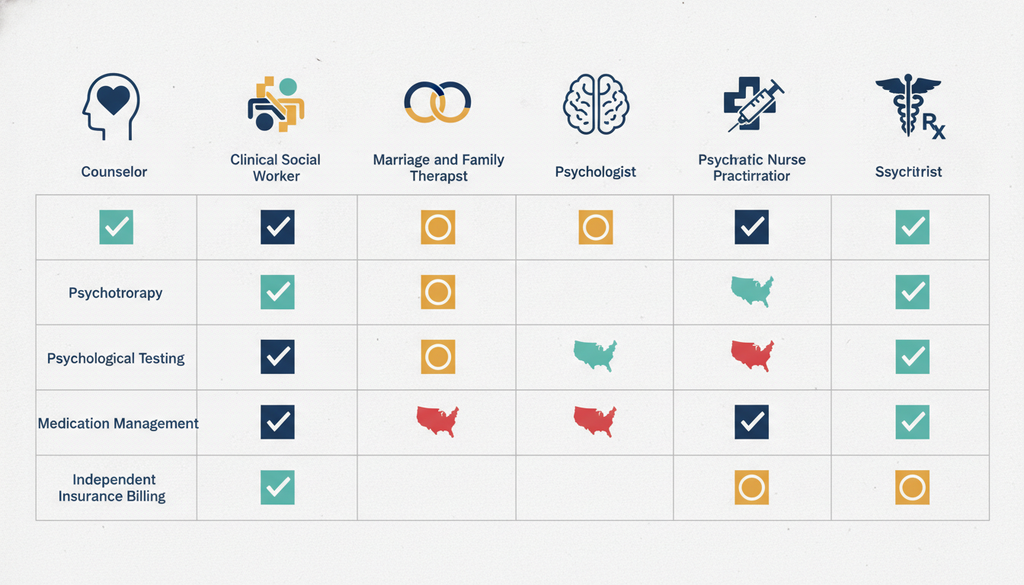
What actually varies by license and by state is whether a clinician can diagnose on their own, bill your insurance directly, or refer out for testing and medication. Title alone won’t tell you that. You need to ask directly, and a clinician worth working with should answer plainly.
Psychotherapy vs Counseling: Training and Scope
Psychotherapy vs counseling sometimes gets framed as a fight between deep work and surface work, but that framing oversimplifies things. In practice, psychotherapy usually refers to a longer, more structured course of treatment aimed at a diagnosed condition, while counseling often describes shorter, goal focused work on a specific problem. The line softens once you look at what a clinician is actually trained and licensed to do.
Licensed psychologists hold the clearest claim to formal psychological testing, including memory, personality, and intelligence batteries used to sort out complicated diagnostic questions. A guide from William James College notes that licensed psychologists, or trainees under their direct supervision, are the professionals trained to administer psychological evaluations that combine standardized testing with clinical interviews and behavioral observation. Counselors, social workers, and marriage and family therapists commonly run clinical assessments and screening tools as part of ordinary treatment, but they are generally not the profession performing full neuropsychological batteries.
That distinction matters if you need documentation for a disability accommodation, a learning disorder question, or a memory concern after an illness or injury. It matters far less if your goal is simply talking through anxiety, grief, or a rough patch at work. A screening questionnaire in a counseling session is useful and valid, but it is not the same thing as a formal evaluation, and payers tend to treat the two very differently for coverage purposes.
Mental Health Counselor vs Therapist: Who Prescribes What
Neither a mental health counselor vs therapist debate nor a general counselor vs therapist debate answers the medication question, because none of these master’s level or doctoral level talk therapy licenses include prescribing power in most states. Licensed professional counselors, clinical social workers, marriage and family therapists, and the large majority of psychologists cannot prescribe medication.
Medication management usually falls to psychiatrists and psychiatric mental health nurse practitioners. The American Association of Nurse Practitioners tracks how much independence these nurse practitioners have in each state, since some states allow full independent prescribing while others require an ongoing agreement with a physician, laid out in its state practice framework. A small number of states, along with a handful of federal health systems, also allow specially trained psychologists to prescribe after they complete extra coursework and pass a national exam, a path described in detail by the prescribing psychologists overview from the Association of State and Provincial Psychology Boards. That remains the exception rather than the rule almost everywhere else.
If your main need is starting or adjusting medication, book with a psychiatrist or a psychiatric nurse practitioner directly. If your main need is working through thoughts, behavior, or relationship patterns, a counselor or therapist without prescribing power is often the right first call, sometimes alongside a prescriber for medication support when symptoms are more severe.
How Session Length Signals Depth of Care
One practical way to sort counseling from therapy is to look at planned length and structure rather than the title printed on the intake form. Short, goal focused counseling tends to run a handful of sessions built around one clear stressor, like a breakup, a move, or a rough transition at work. Structured psychotherapy protocols run longer because they are built to change patterns, not just get you through a hard week.
Depression research reviewed by Cuijpers and colleagues found that individually delivered cognitive behavioral therapy commonly runs eleven to twenty sessions and produces medium to large improvements, especially with an experienced clinician. That range is not a rule carved in stone. Some people improve faster. Others need more time, especially with repeated depressive episodes, trauma, or symptoms tangled up with another condition such as heavy substance use.
The honest takeaway is that neither approach is automatically better than the other. A short course of counseling can fully resolve a situational problem and leave you with tools you keep for years. A longer psychotherapy protocol earns its length when the issue is persistent, keeps coming back, or is tied to trauma that needs steady, structured processing rather than a quick fix.
Which One Fits Your Situation Right Now
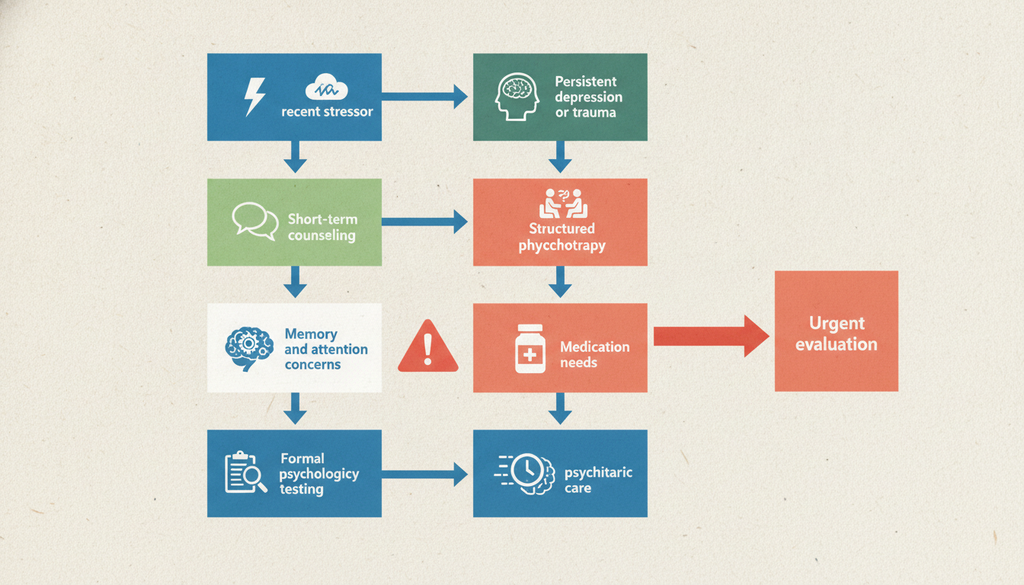
A useful way to think about fit is to match the intensity of care to the size of the problem, then let your own progress guide whether you stay, step up, or wrap up. Consider these markers before you book anything:
- A recent, clear stressor with mild symptoms and steady daily functioning often fits short term counseling well.
- Symptoms that persist for months, keep returning, or shrink your work, sleep, or relationships usually point toward structured psychotherapy.
- Nightmares, flashbacks, or avoidance tied to a specific traumatic event call for trauma focused therapy rather than general counseling.
- Confusion about memory, attention, or learning that won’t clear up with talk alone may call for formal psychological testing.
- Thoughts of self harm, an inability to stay safe, or an active crisis call for urgent evaluation, not a routine counseling appointment.
The National Institute for Health and Care Excellence recommends matching treatment to a person’s needs and preferences, then reviewing progress within weeks rather than assuming the first plan is set in stone. That advice travels well outside its home guideline. Whatever you start with, plan an early check in with your clinician and be ready to adjust course if things aren’t moving.
Counseling vs Therapy: Making Your Choice
There is no single right answer to counseling vs therapy that applies to every person or every problem. What matters is matching the depth of care to what you’re actually carrying, then paying attention to whether it’s working. A short run of counseling can be exactly enough for a situational rough patch. A longer, structured psychotherapy course earns its place when symptoms are persistent, complex, or trauma related. Ask any clinician directly about their license, their approach, and how they’ll know if the plan needs to change. That one conversation tells you more than any title ever could.
If you’re weighing counseling against a fuller therapy program and want guidance on the right level of care, the team at Summit Wellness Group can help you sort it out. Reach out to explore their outpatient programs and find a plan that actually fits where you are.

