
If you are comparing ACT vs CBT for anxiety, depression, or persistent negative thoughts, you do not have to find a universal winner. Both approaches can help. Cognitive behavioral therapy (CBT) often focuses on testing unhelpful beliefs and changing behavior, while acceptance and commitment therapy (ACT) emphasizes making room for difficult experiences and acting on what matters. Direct studies often find similar average outcomes, but the skills used in treatment can feel different.
ACT vs CBT: What Is the Main Difference?
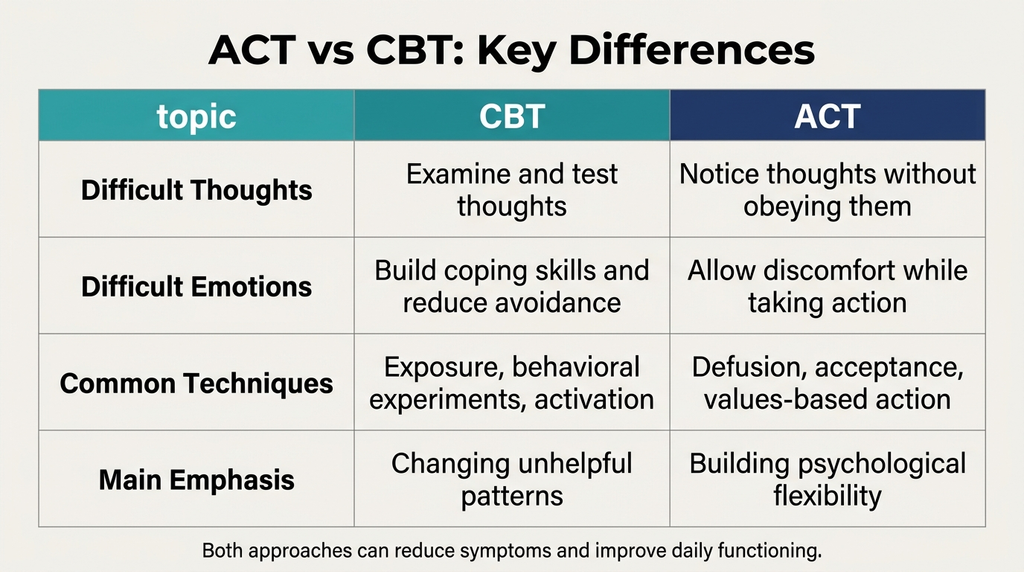
The clearest difference between ACT and CBT is how each approach typically responds to a difficult thought. In CBT, you might ask, “What evidence supports this prediction, and what is a more balanced way to understand it?” In ACT, you might ask, “Can I notice this thought without letting it dictate what I do next?”
Neither therapy is just talking or thinking positively. Both can involve practicing skills, facing avoided situations, and making changes between appointments. The differences are in emphasis rather than an absolute divide. For a closer introduction, see Summit Mental Health’s overview of ACT therapy.
How CBT Works for Anxiety and Depression
CBT explores how thoughts, feelings, physical sensations, and behaviors influence one another. A therapist may help you identify a prediction such as “If I speak up, everyone will judge me,” examine the evidence, and test it through a manageable real-world action. That test is called a behavioral experiment; it is more than simply telling yourself to be positive.
For anxiety, CBT frequently incorporates exposure: gradually approaching feared situations or sensations while reducing avoidance and safety behaviors. For depression, CBT may include behavioral activation, which helps someone resume useful or rewarding activities even when motivation is low. These techniques can be adapted to the diagnosis rather than delivered as a generic worksheet program. Learn more about Summit Mental Health’s cognitive behavioral therapy approach.
How ACT Works for Anxiety and Depression
ACT aims to build psychological flexibility: the ability to notice thoughts and feelings, make room for discomfort when helpful, and take action aligned with personal values. Its six interconnected processes are acceptance, cognitive defusion, present-moment awareness, self-as-context, values, and committed action.
For example, someone may still think “I am going to embarrass myself” before meeting friends. Instead of waiting until the thought disappears, they can notice it as a mental event, choose to tolerate some anxiety, and attend because friendship matters to them. ACT is not resignation; it combines willingness with meaningful action. Summit Mental Health also describes these elements in its ACT therapy services.
The Difference Between ACT and CBT in a Therapy Session
Imagine telling a therapist, “Everyone will see that I am incompetent” before a presentation. A CBT therapist might help you review what actually happened at past presentations and run a behavioral experiment. An ACT therapist might help you label the “incompetent” story, notice your anxiety, and give the presentation in service of your career goals. Both could encourage you to present rather than avoid it.
| Focus | Typical CBT emphasis | Typical ACT emphasis |
| Difficult thoughts | Evaluate predictions and develop more balanced appraisals. | Notice thoughts as mental events; reduce their control over behavior. |
| Uncomfortable feelings | Build coping skills and change patterns that maintain distress. | Practice willingness to feel discomfort while taking meaningful action. |
| Behavioral work | Exposure, behavioral experiments, activity scheduling. | Values-guided action, exposure, acceptance and defusion practice. |
| Progress | Reduced symptoms and improved everyday functioning. | Greater flexibility and values-consistent functioning, often with symptom relief. |
These are tendencies, not rigid rules. Modern CBT can include mindfulness and acceptance, and ACT can use exposure and activity scheduling. As the U.S. Department of Veterans Affairs explains, both therapies teach skills for changing how thoughts and actions influence daily life.
Is ACT Better Than CBT? What Research Actually Shows
For adults with anxiety or depression, the best-supported answer is that neither therapy has consistently proved better overall. Research can show differences in specific outcomes or groups, but studies finding no statistically significant gap do not establish that the treatments are identical.
ACT vs CBT for Anxiety
In a 2012 randomized trial involving 128 adults, participants received 12 sessions of ACT or CBT, and both approaches included exposure. Improvement was similar from the start to the end of treatment. ACT showed some favorable clinical-severity findings during follow-up, while CBT showed a quality-of-life advantage at 12 months. Importantly, the ACT group used more psychotherapy outside the study during follow-up, complicating the interpretation of later differences.
A 2014 social-anxiety trial also found that both active therapies improved outcomes compared with waiting, without a consistent ACT-versus-CBT advantage across the main clinical and public-speaking measures.
ACT vs CBT for Depression
In a randomized study of 82 adults with major depression, both therapies produced substantial improvements, and the study did not detect a significant difference between them. The same research team’s 12-month follow-up found sustained reductions in depressive symptoms and improved quality of life in both groups, again without a significant overall treatment difference.
A 2025 meta-analysis of 13 trials involving 1,362 participants found that ACT improved depression, anxiety and psychological flexibility compared with control conditions. It did not find a reliable improvement in automatic negative thoughts, although certainty for that outcome was very low. Crucially, ACT-versus-control findings cannot be interpreted as proof that ACT outperforms CBT.
What About Claims That ACT Has an Overall Edge?
A 2012 comparative meta-analysis of 16 studies across different problems found an aggregate advantage for ACT on primary outcomes. But the anxiety-specific difference was not significant, and apparent advantages for depression and quality of life did not reach statistical significance. The review was also based on an older, heterogeneous group of studies. Its results do not establish ACT as the superior choice for a particular diagnosis today.
Which Therapy May Fit Different Mental Health Needs?
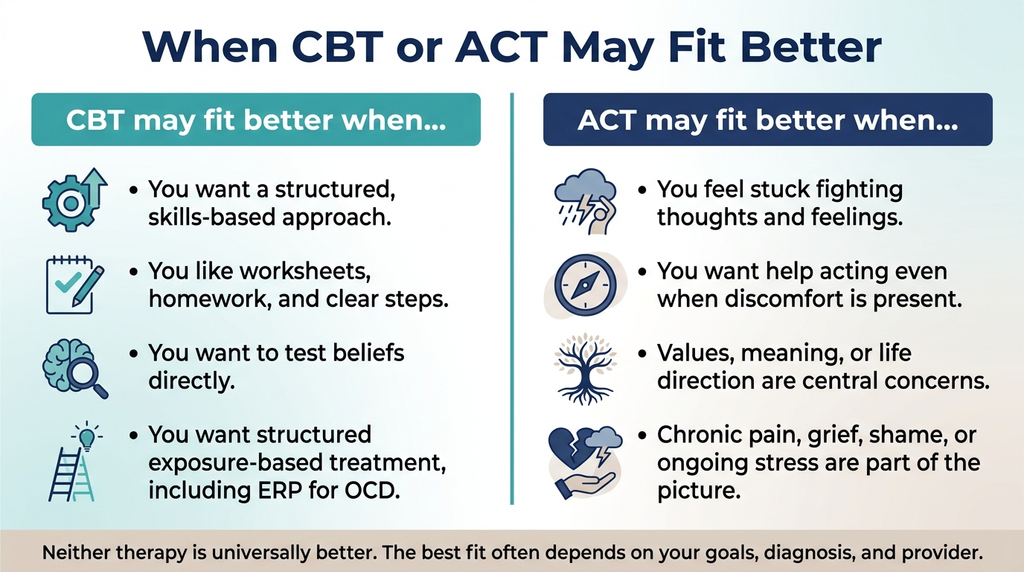
The condition being treated and the clinician’s skill with specific methods may matter more than the therapy label. The following guidance describes reasonable starting points, not guaranteed individual outcomes.
- For generalized anxiety or a mixture of anxiety and depression, ACT and CBT can both be reasonable options. Consider your preferences, earlier treatment experiences and whether the plan addresses avoidance and worry.
- For social anxiety, structured exposure-based CBT has a particularly extensive disorder-specific evidence base. ACT may also help when it includes real-world approach practice.
- For panic disorder and specific phobias, ask about exposure to feared bodily sensations or situations; generic talk therapy alone may miss a central treatment ingredient.
- For obsessive-compulsive disorder (OCD), exposure and response prevention (ERP) is central to guideline-supported care. ACT-based techniques may be integrated, but they should not replace ERP. See NICE’s OCD guidance and Summit Mental Health’s OCD treatment information.
- For post-traumatic stress disorder (PTSD), prioritize clinicians trained in evidence-based trauma-focused interventions. NICE recommends trauma-focused CBT and also recognizes EMDR for appropriate adults; ACT should not be presented as a proven superior substitute.
- For persistent pain, illness-related distress or grief, ACT’s acceptance and values framework may feel especially relevant. That is a rationale for considering ACT, not proof it works better than CBT for everyone with those experiences.
Common Misconceptions About ACT vs CBT
“CBT is just positive thinking.” No. Effective CBT includes evidence testing, behavior change and, when appropriate, exposure. The goal is not to force cheerful thoughts.
“ACT teaches people to accept harmful situations.” No. ACT focuses on responding differently to internal experiences; it does not ask people to tolerate abuse, ignore real danger or abandon practical problem-solving.
“ACT is better because it is newer.” No. The age of a therapy is not a measure of effectiveness. CBT has a longer disorder-specific research history, while ACT has a growing evidence base.
“If negative thoughts remain, treatment failed.” Not necessarily. You can function better even if some unpleasant thoughts continue. Treatment progress should also include behavior, relationships, safety and quality of life—not just the number of difficult thoughts.
How to Choose Between ACT and CBT
If you prefer clear agendas, thought records, behavioral experiments and direct work with feared predictions, CBT may be an appealing starting point. If you have spent a long time arguing with thoughts or avoiding feelings, ACT’s emphasis on defusion, acceptance and values may feel more workable. Neither preference alone predicts clinical response.
When comparing therapists, ask these questions:
- What training and experience do you have with my specific condition, and what would treatment look like during a typical week?
- Will we use exposure, behavioral activation, values-based action or another active technique relevant to my needs?
- How will we measure progress in both symptoms and daily functioning?
- If I am not making meaningful progress after an agreed review period, how will you adapt the plan or coordinate additional care?
A review after roughly six to eight sessions may be helpful for some treatment plans, but it is not a universal deadline for improvement. Review timing should reflect the condition, severity, safety needs and treatment protocol. For treatment options tailored to specific symptoms, see Summit Mental Health’s anxiety treatment and depression treatment pages.
The Bottom Line: Choose a Plan, Not Just a Therapy Label
The practical choice is rarely “acceptance or change.” ACT and CBT both aim to help you build a more workable life; they often reach that goal through overlapping behavioral tools and different ways of relating to thoughts. Choose a clinician who can explain the treatment plan, use evidence-based methods for your concerns and check whether the work is improving your daily life.
If anxiety, depression or another mental health concern is affecting your routine, Summit Mental Health can discuss available treatment approaches and help you understand which level of care may be appropriate. Explore our intensive outpatient program or contact the team to discuss options.

